
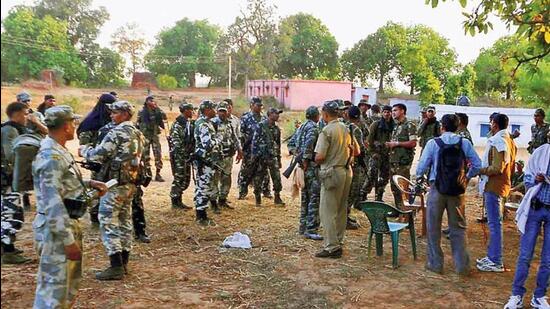
Largest Maoist weapons dump found as 108 insurgents surrender in Chhattisgarh| India News
Bastar Sees Significant Maoist Surrender in Chhattisgarh
A notable development has emerged from Chhattisgarh’s Bastar region, as the Union Home Ministry confirmed the surrender of 108 Maoist insurgents. Among those who laid down their arms were eight crucial divisional committee members, a clear indication of a shifting tide in the long-standing conflict within the state. This event, closely watched by security analysts and local communities alike, signals a potential pathway towards greater peace and stability in an area historically gripped by insurgency.
For decades, Bastar, with its dense forests, rich mineral resources, and predominantly tribal population, has been the epicenter of left-wing extremism in India. The Maoists, also known as Naxalites, are a rebel group that advocates for communist ideology, often through armed struggle, aiming to overthrow the government they perceive as oppressive and exploitative of the poor and tribal communities. Their presence has often hindered development, intimidated local populations, and led to frequent clashes with security forces, causing immense suffering for ordinary citizens caught in the crossfire.
Understanding the Maoist Movement
To truly grasp the importance of this surrender, it is helpful to understand the context. Imagine a group of people in remote, forested areas who believe that the existing government system is unfair. They feel that local communities, especially tribal people, are not getting their fair share of resources or opportunities, and that they are being exploited. These individuals decide to take up arms to fight against what they see as injustice, creating their own parallel government structures in isolated villages. This is a simplified view of the Maoist movement. They often recruit disillusioned youth, promising them a better future and a fight against perceived injustices. However, their methods often involve violence, extortion, and disrupting government projects meant for development, which ultimately harms the very people they claim to protect.
The government, on the other hand, views them as an internal security threat and has been working on a two-pronged strategy: robust security operations to counter their violence, and development initiatives combined with a clear surrender and rehabilitation policy to bring misguided individuals back into the mainstream.
The Significance of the Latest Surrender
The recent surrender of 108 individuals is not merely a number; it represents a significant blow to the Maoist hierarchy and a victory for the government’s sustained efforts. The fact that eight divisional committee members chose to surrender is particularly noteworthy. Divisional committee members are not ordinary foot soldiers. They are experienced leaders, strategists, and influential figures within the Maoist organization, responsible for planning operations, propaganda, and recruitment across specific zones. Their decision to abandon the armed struggle can have a ripple effect, potentially encouraging other cadres to follow suit.
Such high-ranking surrenders often stem from a combination of factors. Continuous pressure from intensified security operations, dwindling public support due to their disruptive tactics, and a growing realization among the cadres that their cause is losing momentum are key drivers. Furthermore, the effectiveness of the government’s surrender and rehabilitation policy plays a crucial role.
Chhattisgarh’s Path to Reintegration
Chhattisgarh’s state government has a comprehensive surrender and rehabilitation policy designed to offer a fresh start to those who choose to renounce violence. Under this policy, former Maoists receive financial assistance, help with housing, and opportunities for skill development and employment. The aim is not just to disarm them but to reintegrate them as productive members of society, ensuring they do not return to their old ways out of desperation.
Local initiatives, such as the “Niyad Nellanar” (Your Village, Our Camp) campaign, have also been instrumental. This strategy involves establishing security camps deeper into Maoist-affected areas, not just as military outposts but as centers for community engagement, offering health services, educational opportunities, and development projects. This helps build trust with local villagers, reducing the Maoists’ influence and creating a more favorable environment for surrenders. These ground-level efforts demonstrate a commitment to addressing the root causes of discontent, rather than solely focusing on security.
A Glimmer of Hope for Bastar
This mass surrender, especially involving key leaders, offers a substantial glimmer of hope for Bastar. It signifies that the Maoist movement is facing internal challenges and losing its grip in certain areas. For the surrendered individuals, it’s a chance to embrace a life free from fear and violence, to reconnect with their families, and to contribute to their communities through peaceful means. For the region, it opens doors for stalled development projects to resume, for schools and hospitals to function without threat, and for the local economy, particularly tribal livelihoods, to flourish.
Omni 360 News understands that while this is a significant step forward, the road to complete peace in Bastar is still long. The underlying issues of poverty, lack of infrastructure, and social inequality that Maoists often exploit still need continuous attention. However, each surrender, especially of influential members, weakens the insurgency and strengthens the resolve of the government and local communities to build a more secure and prosperous future. This event highlights the importance of sustained efforts—a blend of robust security, focused development, and compassionate rehabilitation—in tackling complex challenges like left-wing extremism. The ultimate goal remains a Bastar where peace prevails, and every citizen can live with dignity and opportunity.
Key Takeaways
* 108 Maoists, including 8 high-ranking divisional committee members, surrendered in Chhattisgarh’s Bastar.
* This marks a significant setback for the Maoist movement and a success for government strategies.
* Chhattisgarh’s surrender and rehabilitation policy offers financial aid and skill training for reintegration.
* Local campaigns like “Niyad Nellanar” build trust and promote development in conflict zones.
* The event signals a potential for increased peace, development, and reduced violence in the region.
* Addressing root causes like poverty and inequality remains crucial for long-term stability.





