
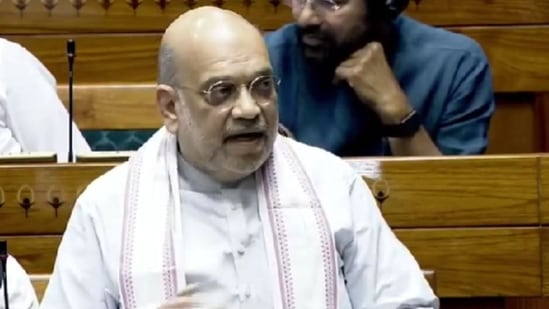
'Questioned democracy's foundation': Amit Shah blasts Opposition in Lok Sabha during no-confidence debate| India News
The hallowed halls of India’s Parliament, the Lok Sabha, recently witnessed a spirited debate that underscored the bedrock principles of legislative conduct. During discussions surrounding a motion seeking the removal of Speaker Om Birla, Union Home Minister Amit Shah articulated a fundamental truth: the Speaker’s role is intrinsically that of a neutral mediator. This assertion, made amidst political crosscurrents, shines a spotlight on an office designed to uphold fairness and decorum in the nation’s highest legislative body.
The Speaker’s Unwavering Impartiality
For those new to the workings of India’s parliamentary system, understanding the Lok Sabha Speaker’s position is crucial. Imagine a referee in a spirited football match. Just as the referee ensures fair play, interprets the rules, and maintains order regardless of which team is playing, the Lok Sabha Speaker presides over debates, enforces parliamentary rules, and ensures every voice, from both ruling and opposition benches, gets an opportunity to be heard. This is not merely a ceremonial post; it is a constitutional bulwark designed to protect the integrity of legislative discourse.
The Constitution of India vests significant powers and responsibilities in the Speaker. They are the chief presiding officer, responsible for admitting motions, regulating debate, putting questions to vote, and maintaining discipline. Crucially, the Speaker is expected to be above party politics once elected. Their decisions, whether on allowing discussions, certifying bills as Money Bills, or even suspending unruly members, must be seen as fair and unbiased. The strength of Indian democracy hinges significantly on the perceived neutrality of this pivotal office.
Understanding the Context: A Motion for Removal
The recent debate centered on a motion to remove the Speaker. Such motions are rare and often indicative of deep disagreements between the ruling dispensation and the opposition. While the specifics of the motion itself are part of the political narrative, Shah’s intervention during this particular discussion was significant. By reiterating the Speaker’s expected role as a neutral mediator, he was, in essence, affirming the institutional expectations that transcend immediate political skirmishes. It was a reminder to all stakeholders of the fundamental principles that govern parliamentary conduct, even when tensions run high.
Challenges and Perceptions of Neutrality
However, upholding neutrality is a constant challenge for any Speaker. Traditionally, the Speaker is chosen from among the elected members of the Lok Sabha, often from the ruling party. This electoral reality can sometimes lead to perceptions, fair or otherwise, that the Speaker might lean towards the party that elevated them to the position. Yet, the convention and expectation are that once in the Speaker’s chair, partisan loyalties are set aside. Their oath is to the Constitution and to the smooth functioning of Parliament, not to any political group.
The Speaker must navigate intricate situations, from managing boisterous debates to making rulings on sensitive procedural matters. Every decision is scrutinized, and a slight misstep can draw accusations of bias. The very act of a Home Minister, a prominent leader of the ruling party, emphasizing neutrality during a debate about the Speaker’s removal, underscores the importance of this principle. It serves as a public declaration of the institutional standard that all members, regardless of their political affiliation, should aspire to see upheld.
Building Trust and Maintaining Legislative Integrity
The Speaker’s ability to foster trust among all parties is paramount. When members believe the chair is impartial, debates are more constructive, decisions are accepted with greater legitimacy, and the legislative process itself gains credibility. A Speaker who successfully projects an image of neutrality contributes immensely to the health of parliamentary democracy. They become a guardian of the rules, a protector of minority voices, and an enabler of robust, meaningful debate. This steadfast commitment to fairness ensures that the Lok Sabha remains a true forum for national deliberation, reflecting the diverse will of the people.
From the perspective of Omni 360 News, the discussion around the Lok Sabha Speaker’s neutrality is far from a mere procedural point. It’s a vital sign of the health of India’s legislative framework. It reminds every citizen that while politics is often about winning and losing, the institutions governing our nation must stand on principles of impartiality and fairness. The Speaker’s chair is not just furniture; it’s a symbol of democratic equilibrium, demanding a commitment to neutrality above all else.
Key Takeaways
- The Lok Sabha Speaker holds a crucial constitutional role as the chief presiding officer of Parliament.
- Neutrality is the cornerstone of the Speaker’s office, ensuring fair play and adherence to parliamentary rules.
- Union Home Minister Amit Shah’s statement during the removal debate highlighted the enduring expectation of impartiality from the Speaker.
- Maintaining neutrality is challenging but essential for the Speaker to build trust among all political parties.
- A neutral Speaker is vital for ensuring the integrity and smooth functioning of India’s legislative process.





