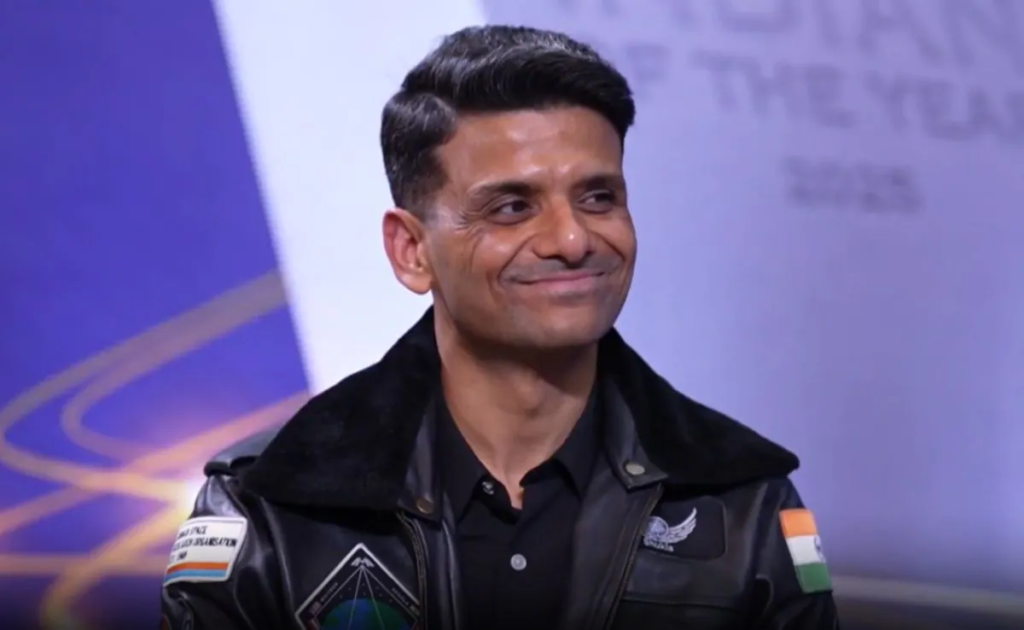
After 41 Years, a New Chapter in India’s Space History: Astronaut Shubhanshu Shukla Awarded the Ashoka Chakra
India’s space journey has reached another historic milestone after a gap of 41 years. Group Captain Shubhanshu Shukla, the first Indian astronaut to visit the International Space Station, has been awarded the Ashoka Chakra, India’s highest peacetime gallantry award. This rare honour was conferred by President Droupadi Murmu on the eve of Republic Day, recognising his courage, dedication, and extraordinary service to the nation.
This is the first time an Indian astronaut has received the Ashoka Chakra for a space mission. The award highlights not only individual bravery but also India’s growing strength and ambition in space exploration. The entire nation has hailed this moment as a proud chapter in Indian history.
Group Captain Shubhanshu Shukla became a household name after his historic journey to space as part of the Axiom 4 mission. In June last year, he travelled to the International Space Station and spent 18 days in space. During this mission, he participated in scientific experiments, technology demonstrations, and international cooperation efforts that added valuable experience to India’s future human spaceflight plans.
Shukla’s spaceflight came exactly 41 years after India’s first human space mission. In 1984, Wing Commander Rakesh Sharma travelled to space aboard the Soviet Soyuz spacecraft, becoming the first Indian to do so. For more than four decades, India dreamed of sending another astronaut into space. That dream finally became reality with Shubhanshu Shukla’s mission, making him the second Indian to travel to space and the first to visit the International Space Station.
Before becoming an astronaut, Shubhanshu Shukla had a distinguished career in the Indian Air Force. He is a highly skilled fighter pilot with more than 2000 hours of flying experience. Over the years, he has flown several advanced fighter aircraft, including the Su 30 MKI, MiG 21, and MiG 29. His experience in handling complex aircraft under extreme conditions played a major role in preparing him for the challenges of space travel.
The Ashoka Chakra is awarded for acts of valour, courage, and self sacrifice away from the battlefield. By honouring Shukla with this award, the government has recognised the risks involved in human space missions and the bravery required to undertake them. Space travel is not only about technology and science but also about human courage, mental strength, and discipline. Shukla’s journey symbolises all these qualities.
The historic mission also brought recognition to another officer. Group Captain Prashant Balakrishnan Nair, who served as the backup astronaut for the mission, has been awarded the Kirti Chakra. As a backup astronaut, Nair underwent the same intense training and was ready to step in at any moment if required. His contribution highlights the teamwork and preparation behind every successful space mission.
At present, Group Captain Shubhanshu Shukla is also closely associated with India’s ambitious Gaganyaan mission led by ISRO. Gaganyaan aims to send Indian astronauts to space using completely indigenous technology. If the mission succeeds, India will become the fourth country in the world to independently send humans into space, after the United States, Russia, and China.
The Gaganyaan mission is seen as a major step towards making India a global space power. Lessons learned from Shukla’s mission to the International Space Station will play a crucial role in improving astronaut training, life support systems, mission planning, and safety measures for future Indian spaceflights.
Experts believe that awarding the Ashoka Chakra to a space mission astronaut sends a strong message. It shows that India values courage and excellence not only on land, sea, and air, but also beyond Earth. It also inspires young Indians to dream big and consider careers in science, defence, aviation, and space research.
For students, especially those studying science and mathematics, Shubhanshu Shukla’s journey is a powerful example of how dedication, discipline, and hard work can take a person to the highest levels of achievement. From flying fighter jets to floating in space, his story reflects years of training, sacrifice, and commitment to the nation.
As India looks ahead to future space missions, including lunar exploration, space stations, and deep space research, moments like this remind the country of how far it has come. From Rakesh Sharma’s iconic words in 1984 to Shubhanshu Shukla’s modern spaceflight, India’s human space journey is once again alive and moving forward.
The Ashoka Chakra awarded to Shubhanshu Shukla is not just a personal honour. It is a salute to India’s scientists, engineers, defence forces, and visionaries who continue to push the boundaries of what the nation can achieve. It marks a proud day for India and a hopeful sign for the future of Indian space exploration.