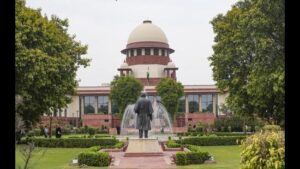
Air Force Group Insurance Society performs public function, it is 'State' under Constitution: SC| India News
***
**Air Force Insurance Society Accountability Deepens as Supreme Court Affirms ‘State’ Status**
A landmark decision from the nation’s highest court has cast a brighter spotlight on the Air Force Group Insurance Society (AFGIS), declaring it a ‘State’ under the Constitution. This pivotal ruling, widely discussed in legal circles and among armed forces communities, signifies a substantial win for transparency and accountability within welfare organizations serving India’s brave personnel. For the countless men and women in uniform, and their families, this isn’t just a legal pronouncement; it’s a reinforced promise of justice, directly impacting their access to fundamental rights.
At Omni 360 News, we understand the profound implications of such rulings for everyday citizens. This judgment, rather than being a mere legal technicality, reshapes the landscape for how welfare bodies associated with the armed forces are held to account, ensuring they operate within the constitutional framework designed to protect every individual.
Understanding ‘State’ in Our Constitution
To truly grasp the weight of this Supreme Court decision, it’s essential to understand what it means for an entity to be designated a ‘State’ under Article 12 of the Indian Constitution. Imagine a school playground. The government runs some schools directly, like a municipal school. These are clearly ‘State’. But what about a private school that gets significant funding from the government, has its curriculum approved by the government, and serves a public purpose? For all practical intents and purposes, it might operate almost like a government school in many aspects, particularly in how it treats its students.
Similarly, under Article 12, the definition of ‘State’ isn’t limited to just the central and state governments, Parliament, and state legislatures. It extends to “all local or other authorities within the territory of India or under the control of the Government of India.” Over time, courts have interpreted this broadly to include entities that are not directly government departments but perform public functions, are financially controlled by the government, or are deeply intertwined with government operations. When an entity is declared ‘State’, it becomes subject to the fundamental rights enshrined in the Constitution – rights like equality, freedom from discrimination, and due process. This means citizens can petition High Courts directly if such an entity violates their fundamental rights.
AFGIS: A Pillar for Air Force Families
The Air Force Group Insurance Society (AFGIS) was established to provide a safety net for Air Force personnel and their families. It offers various insurance schemes, covering life, disability, and other welfare benefits. For decades, AFGIS has been a crucial support system, offering financial security to those who dedicate their lives to national service. It functions under the administrative control of the Ministry of Defence, specifically the Indian Air Force. Its board typically comprises senior Air Force officers, and its operations are deeply integrated with the structure and welfare policies of the Air Force.
Prior to this ruling, the precise legal character of AFGIS regarding its ‘State’ status was a point of contention in various legal proceedings. While its public welfare function was undeniable, whether it could be challenged under writ jurisdiction—a powerful tool for citizens to enforce fundamental rights against government bodies—remained a subject of debate.
The Supreme Court’s Resounding Affirmation
The Supreme Court, after careful deliberation, concluded that AFGIS indeed performs public functions and operates under deep and pervasive control of the Indian Air Force and, by extension, the government. The court observed that AFGIS is not a purely private insurance provider. Its very existence is intrinsically linked to the welfare of Air Force personnel, a critical public service. The schemes it offers are mandatory for Air Force members, and its management is overseen by senior officials, indicating a lack of true autonomy from the State’s machinery. Its financial operations, while drawing contributions from members, are also influenced by government policies and support mechanisms.
This comprehensive analysis led the court to unequivocally declare AFGIS a ‘State’ under Article 12.
What This Means for Service Members and Their Families
This ruling brings profound implications, particularly for those who depend on AFGIS for crucial welfare support:
* Enhanced Accountability: AFGIS is now unequivocally subject to constitutional scrutiny. This means its decisions and actions can be challenged in High Courts if they are arbitrary, discriminatory, or violate any fundamental rights of its members or their dependents.
* Access to Justice: Members or their families, if they believe AFGIS has denied a claim unfairly or acted against their constitutional rights, now have a clearer path to seek justice through writ petitions in High Courts. This is a quicker and often more accessible legal remedy compared to protracted civil lawsuits.
* Fairer Dealings: Knowing they are subject to constitutional oversight, AFGIS will need to ensure its policies and their implementation are transparent, fair, and adhere to principles of natural justice.
* Precedent for Other Welfare Bodies: This judgment could set a significant precedent for other similar welfare organizations operating under the aegis of government departments or armed forces. It may prompt a review of their functioning and accountability mechanisms, potentially bringing more such entities under the umbrella of ‘State’ and thus, constitutional scrutiny.
For example, an ex-serviceman from a district in Karnataka recently shared how a technicality nearly derailed his disability claim, leaving his family vulnerable. Such individuals, facing what they perceive as arbitrary denial, now have a more direct legal avenue. Similarly, in military cantonments across Punjab, families struggling with delayed insurance payouts could find stronger grounds for legal recourse, prompting greater efficiency from the welfare body. This ruling humanises the legal process, giving power back to the individuals.
Key Takeaways from the Ruling
* The Supreme Court has expanded the scope of ‘State’ under Article 12 to include the Air Force Group Insurance Society.
* AFGIS is now directly accountable to fundamental rights and subject to writ jurisdiction in High Courts.
* This decision enhances transparency, fairness, and access to justice for Air Force personnel and their families regarding insurance and welfare claims.
* The ruling reinforces the principle that bodies performing public functions under government control, even if not direct government departments, must adhere to constitutional principles.
In essence, this Supreme Court judgment is not just a legal technicality; it’s a vital reinforcement of the constitutional promise that every individual, including those who serve our nation, is entitled to justice and fair treatment from any entity that performs public functions. It ensures that the welfare of our armed forces is not just a policy objective, but a constitutionally protected right, making institutions like AFGIS more responsible and responsive. This is a crucial step towards deepening democratic accountability and strengthening the rights of those who protect our nation.
***