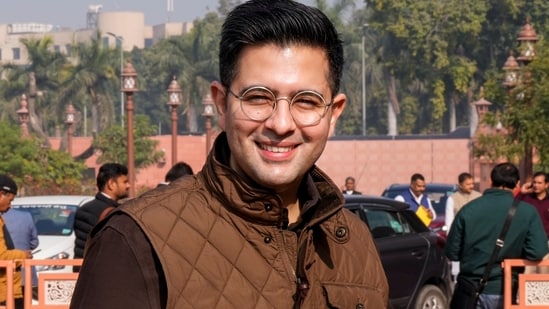
‘Airport samosas’, prepaid recharge: 7 ‘soft’ issues Raghav Chadha raised in Parliament| India News
**Navigating the Public Square Raghav Chadha’s Advocacy Meets AAP’s Scrutiny**
In the bustling arena of Indian politics, a recent exchange has brought to the forefront the delicate balance between public interest advocacy and strategic political communication. Member of Parliament Raghav Chadha of the Aam Aadmi Party (AAP) recently expressed that he felt “silenced” in Parliament, despite consistently bringing up matters directly affecting the daily lives of citizens. Conversely, his own party, the AAP, has reportedly suggested his focus leaned towards “soft PR.” This dichotomy sparks a vital discussion about the role of a parliamentarian and the perception of their work, a topic Omni 360 News explores with careful detail.
Chadha’s assertion of being sidelined highlights a perceived challenge in having seemingly smaller, yet deeply impactful, issues heard on the national stage. He has, on record, raised a diverse array of concerns that touch the common person’s pocket and peace of mind. For instance, the discussion around the high cost of food items, like samosas, at airports might seem trivial at first glance. However, it quickly morphs into a significant point when viewed through the lens of inflation, consumer rights, and the accessibility of basic amenities in public spaces that are increasingly used by a wide cross-section of society. It’s a point that resonates with anyone who has felt the pinch of inflated prices in captive markets.
Beyond airport snacks, Chadha’s parliamentary interventions have delved into other crucial areas. He questioned the often-overlooked issue of extra charges levied on prepaid mobile recharges. In an era where digital transactions are the backbone of daily life for millions, even a small, seemingly insignificant charge can accumulate to a substantial burden, particularly for those with limited incomes. This concern underscores the need for greater transparency and consumer protection in the digital economy.
Furthermore, Chadha has reportedly championed the cause of paramilitary forces regarding pension issues, a subject that impacts the morale and financial security of those dedicated to national service. He also brought attention to the critical matter of Minimum Support Price (MSP) for farmers, a long-standing demand from the agricultural community that directly affects their livelihood and the country’s food security. His advocacy has extended to the imperative for a national water policy, acknowledging the growing challenges of water scarcity across India. The welfare of Indian students facing difficulties abroad and the implications of new taxation policies on online gaming were also among the diverse issues he placed before the legislative body. These points, taken together, paint a picture of an MP attempting to address a broad spectrum of public grievances.
However, the narrative is not without its counterpoints. The Aam Aadmi Party, the very party Chadha represents, has reportedly critiqued his approach, suggesting that some of his parliamentary efforts lean towards “soft PR.” This phrase, in political discourse, often implies a focus on issues that generate easy public sympathy or media attention without necessarily addressing deeper, systemic policy changes or legislative heavy lifting. It raises the question: in the complex world of governance, what constitutes effective representation? Is it about highlighting relatable, everyday problems, or about pushing for more complex, perhaps less visible, policy reforms?
This internal party observation, as reported by various news outlets, suggests a potential strategic divergence within AAP regarding parliamentary priorities. While highlighting issues like airport food prices can certainly make an MP relatable to the masses and generate headlines, some within the political sphere might argue for a greater emphasis on economic policies, social welfare schemes, or legislative reforms that have a broader, long-term impact on the nation. The perception of “soft PR” could stem from a belief that an MP’s time and parliamentary platform should be predominantly dedicated to issues with direct legislative or policy implications, rather than those that are more observational in nature.
The debate between Chadha’s claims of being silenced and AAP’s “soft PR” assessment underscores a perpetual challenge for elected representatives: how to effectively serve constituents. Is it by meticulously bringing up every small injustice, or by strategically focusing on major policy shifts? Both approaches have merit, and the public often expects a blend of both. A parliamentarian’s role ideally encompasses not just raising concerns but also contributing to solutions, engaging in committee work, and shaping legislation.
For Omni 360 News readers, understanding this dynamic is key. It’s a reminder that political actions are often viewed through multiple lenses: the politician’s intent, the party’s strategy, and the public’s perception. Chadha’s efforts highlight the importance of everyday issues, while the party’s comments reflect the strategic calculations inherent in parliamentary politics. Ultimately, the effectiveness of an MP is judged by their ability to bring about positive change, whether through highlighting overlooked details or driving significant policy shifts.
Key Takeaways:
* Raghav Chadha claims he faces silencing for raising diverse public issues, from airport food prices to farmer MSP.
* The issues he raised directly affect people’s daily lives and financial well-being.
* His party, AAP, reportedly believes his focus might be on “soft PR,” suggesting a strategic rather than purely policy-driven approach.
* This situation prompts a discussion about the most effective way for an MP to represent constituents and engage in parliamentary duties.
* The public’s understanding of political advocacy is shaped by both visible, relatable issues and broader policy debates.