Assam constituency watch: Dispur turns 3-cornered after BJP candidate change sparks revolt| India News
Dispur Uproar BJP Candidate Switch Ignites Three-Cornered Assam Poll Battle
The tranquil political waters of Dispur, the legislative capital of Assam, have been stirred dramatically by the ruling Bharatiya Janata Party’s recent decision regarding its assembly election candidate. This unexpected move, dropping a sitting two-term Member of Legislative Assembly, has not only sparked a widespread rebellion within party ranks but has effectively transformed the upcoming electoral contest for this crucial seat into a high-stakes three-cornered fight. For keen observers of Assam politics and citizens alike, this development presents a compelling narrative of loyalty, ambition, and the unpredictable nature of democratic contests.
Dispur, a significant urban constituency that encompasses parts of Guwahati, has long been considered a stronghold for the Bharatiya Janata Party. The seat holds symbolic importance, being the heart of Assam’s administrative machinery. For the past two terms, since 2016, Atul Bora (not to be confused with the AGP president of the same name) has represented Dispur in the Assam Legislative Assembly under the BJP banner, securing victories in both 2016 and 2021. His consistent wins suggested a firm grip on the local electorate, building a strong personal connect with the voters over a decade.
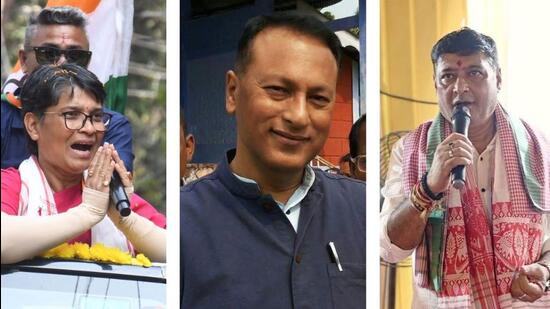
However, in a move that blindsided many, the BJP high command opted to replace the seasoned legislator. The party announced Manas Deka, the energetic state president of the BJP Yuva Morcha, as its chosen candidate for the forthcoming assembly polls. While Deka brings youth and a fresh perspective, this decision immediately triggered a wave of discontent among loyal party workers and supporters of Atul Bora. Local reports from the ground, gathered by Omni 360 News, indicated spontaneous protests erupting in various parts of the constituency. Party cadres, who had worked tirelessly for Bora’s previous campaigns, expressed dismay and a sense of betrayal at what they perceived as a disregard for a dedicated and winning leader.
The rebellion culminated in Atul Bora’s resolute decision to contest the elections as an independent candidate. This act fundamentally alters the electoral landscape of Dispur. When a party’s sitting MLA, especially one with a proven track record, decides to go against the party line, it signals deep fissures. Bora’s move is not merely a personal challenge but a direct test of the BJP’s organizational strength and the electorate’s allegiance – whether it lies with the party symbol or the individual leader they have known and voted for.
This internal turmoil within the BJP has presented a golden opportunity for the opposition, particularly the Congress party. Manash Borah, the Congress candidate for Dispur, now finds himself in a considerably more advantageous position than before. Historically, in constituencies where the ruling party faces internal dissent, opposition parties often gain significant traction. The votes that would have traditionally consolidated under the BJP banner are now likely to be split between the official BJP candidate, Manas Deka, and the independent Atul Bora. This fragmentation could very well pave an unexpected path to victory for the Congress, turning what was once a comfortable BJP seat into a battleground for all three key players.
Explaining this political dynamic for a 12th-standard student, imagine a football match where a strong team, expected to win easily, suddenly has two of its best players decide to play for separate teams instead of together. Now, instead of one strong team playing against another, it’s like having three teams, two of which used to be part of the same strong team, all competing. This makes the game much harder to predict, and the third original opponent (like the Congress here) suddenly has a much better chance because the votes, or “goals,” that would have gone to the stronger team are now divided.
The reasons behind the BJP’s decision to drop a winning candidate are multi-faceted and often shrouded in strategic calculations by the party leadership. These could include a desire to infuse new blood, address perceived anti-incumbency, manage factional politics, or make way for younger leaders. However, such moves always come with the inherent risk of alienation and rebellion, as witnessed in Dispur. The local sentiment clearly indicates a strong bond between Bora and his constituents, cultivated through years of representation. Voters often prioritize a candidate’s personal accessibility and work over strict party allegiance, especially at the local level.
This three-cornered contest in Dispur is more than just a local election; it serves as a litmus test for the BJP’s candidate selection process and its ability to manage internal dissent across Assam. If the rebel candidate gains substantial support, it could signal a broader pattern of local leaders challenging central party decisions, potentially impacting other constituencies where similar dynamics might be at play. For the Congress, it is a chance to re-establish a foothold in urban Assam, demonstrating that internal strife within the ruling party can be capitalized upon.
Key Takeaways:
- The BJP’s decision to replace two-term sitting MLA Atul Bora with Manas Deka in Dispur has triggered significant internal dissent.
- Atul Bora’s subsequent decision to contest as an independent candidate has created a high-stakes three-cornered electoral battle.
- This situation offers a substantial opening for Congress candidate Manash Borah, as BJP votes are likely to be split.
- The contest reflects a deeper struggle between party loyalty and individual candidate popularity among the electorate.
- The outcome in Dispur will provide insights into the effectiveness of BJP’s candidate strategy and internal discipline across Assam.
As election day approaches, all eyes will be on Dispur. The constituency’s voters face a complex choice: align with the established party, support a fresh face, or back a familiar leader who chose to defy his former party. The outcome will not only determine the next representative for Dispur but will also send a powerful message about the evolving political landscape of Assam. The ripples from this Dispur rebellion are set to resonate far beyond the constituency’s boundaries, influencing narratives and strategies across the entire state.