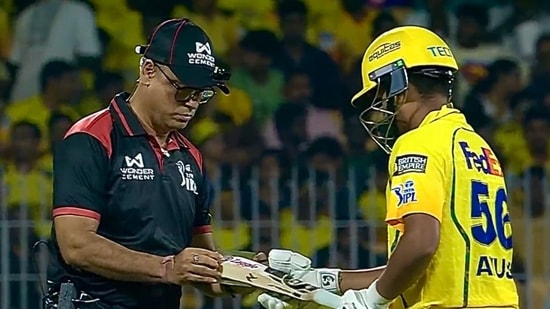
Ayush Mhatre pulled up for bat test, umpire’s error sparks bizarre chain of events; Clarke stunned: ‘Oh my god’
Umpire’s Oversight Triggers Chennai Cricket Chaos
A local cricket match in Chennai took an unexpected and highly unusual turn on Friday, casting a spotlight on the meticulous details of the game and the human element of officiating. An umpire’s initial failure to accurately measure Ayush Mhatre’s bat led to a series of events that left players, coaches, and spectators in a state of bewilderment, creating a memorable, if not chaotic, moment in the city’s sporting calendar. This peculiar incident has become a significant talking point, underscoring the vital role of precision in every aspect of cricket.
The unfolding drama began during a crucial league fixture at a popular Chennai ground. Ayush Mhatre, a promising young batsman known for his aggressive strokeplay, was in good form, having already settled at the crease and contributed valuable runs to his team’s total. It was during a routine mid-innings check, a measure often taken to ensure fair play, that the anomaly surfaced. While Mhatre’s bat had been presented for inspection prior to the match, a subsequent, more rigorous check requested by the opposing captain raised red flags.
Cricket’s laws are precise about equipment. A bat, for instance, must adhere to strict dimensional regulations. Its maximum width is set at 108 millimeters (approximately 4.25 inches), and its depth cannot exceed 67 millimeters. These rules are in place to maintain the balance between bat and ball, ensuring no unfair advantage is gained by a batsman using an oversized implement. Umpires are equipped with specialized bat gauges to verify these dimensions. The initial oversight, it became clear, was a simple but profound human error in applying this gauge, leading to Mhatre’s bat being cleared despite subtly exceeding the permissible width.
The subsequent discovery sent ripples of confusion across the field. When the second measurement, performed by a different official with heightened scrutiny, confirmed the bat was indeed marginally wider than regulation, the game came to an immediate halt. This wasn’t a case of deliberate cheating by the player, but rather a procedural lapse by the officiating team compounded by the sheer unpredictability of human error under pressure. Mhatre, visibly surprised and concerned, explained he had used the same bat for months, always believing it to be compliant, a belief reinforced by the initial inspection.
What followed was a protracted discussion involving the on-field umpires, the match referee, and both team captains. The options were varied and complex: Should Mhatre be declared out? Should all runs scored with the non-compliant bat be nullified? What about the integrity of the game already played? Explaining this to a 12th-grade student, it was like finding out a board game player was using a slightly larger piece, not on purpose, but because the game’s initial setup was incorrect. How do you fairly correct it mid-game without upsetting everyone? The rules, though clear in spirit, often leave room for interpretation in unprecedented scenarios.
After nearly thirty minutes of deliberation, a pragmatic decision was reached to avoid derailing the entire contest. Mhatre was instructed to replace his bat immediately with a compliant one from his team’s reserves. All runs scored up to that point with the oversized bat would stand, but a five-run penalty would be applied to his team’s total – a compromise aimed at acknowledging the breach without overly punishing a player who was likely unaware. This decision, while an attempt at fairness, still sparked debate among those present, highlighting the subjective nature of justice in unforeseen circumstances.
The incident underscores the profound importance of vigilant officiating at all levels of the game, from school tournaments to international fixtures. Even a seemingly minor deviation in equipment can trigger significant disruptions and cast a shadow over a match. It serves as a potent reminder that the foundation of fair play rests not only on the integrity of the players but equally on the unwavering accuracy and attention to detail of the officials. For Omni 360 News, this local Chennai incident offers a micro-snapshot of how crucial every single detail is in the grand tapestry of sport.
The bizarre sequence of events prompted a review of pre-match equipment inspection protocols for future local matches. Officials are now expected to conduct more thorough, double-checked measurements to prevent similar occurrences. The incident, while initially unsettling, has become a valuable learning experience for the local cricketing community, reinforcing the principle that even the smallest error can ripple through a game and impact its outcome and atmosphere. Ayush Mhatre, despite the controversy, continued his innings with a new bat, though the momentum of the game had undeniably shifted, proving that the human element, both in play and in officiating, is an irreplaceable and often unpredictable aspect of sport.
Key Takeaways:
* Human Error’s Impact: A simple oversight by an umpire in measuring a bat’s dimensions triggered significant game disruption.
* Rules and Fair Play: Cricket’s strict equipment rules are vital for maintaining competitive balance and integrity.
* Procedural Review: The incident led to calls for more rigorous pre-match equipment checks in local leagues.
* Decision-Making Under Pressure: Officials faced a complex challenge in deciding how to fairly address the breach mid-game.
* Lessons Learned: This unusual event serves as a crucial reminder for all levels of cricket about the importance of precision in officiating.