BJP candidate’s ‘Hindu MLA’ call in Guruvayur sparks backlash| India News
Guruvayur MLA Remark Sparks Political Firestorm Kerala Students Union Lodges Complaint
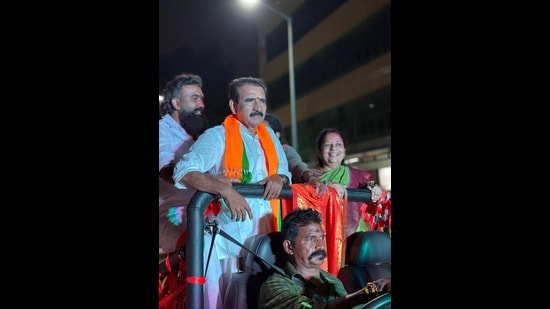
The tranquil cultural landscape of Guruvayur, a prominent pilgrimage destination in Kerala, found itself at the epicenter of a brewing political controversy. Recent remarks by Bharatiya Janata Party (BJP) leader B Gopalakrishnan, a candidate for the Guruvayur assembly constituency, advocating for a “Hindu MLA” to “reclaim” the revered Guruvayur Sree Krishna Temple, have drawn sharp condemnation and prompted a formal complaint from the Kerala Students Union (KSU). The incident, widely reported across local news outlets, has ignited a fervent debate on communal politics and the secular fabric of the state, placing a crucial focus on electoral conduct. Omni 360 News brings you a detailed report on the unfolding events.
The controversy originated from statements made by B Gopalakrishnan during his campaign ahead of the state assembly elections. Speaking to local gatherings and media, Gopalakrishnan reportedly asserted that the Guruvayur Sree Krishna Temple, a cornerstone of Hindu faith and culture in Kerala, was under the control of “non-Hindus” through its administrative board. He then issued a clear call for the Guruvayur constituency to elect a “Hindu MLA” to facilitate the “reclamation” and proper administration of the temple. These statements, delivered in the charged atmosphere of an election campaign, quickly resonated beyond local circles, echoing across the state’s political spectrum.
Guruvayur, famed for its ancient temple, holds significant cultural and religious importance. The temple’s administration falls under the Guruvayur Devaswom Board, a statutory body constituted by the state government, responsible for managing the temple and its properties. While the board’s members are typically Hindu, the sentiment of the constituency itself reflects Kerala’s diverse population. The suggestion of a specific religious identity for a legislative representative, particularly when linked to the control of a religious institution, touched a raw nerve among many who champion Kerala’s long-standing secular traditions.
The immediate and most significant response to Gopalakrishnan’s remarks came from the Kerala Students Union, the student wing of the Indian National Congress. Perceiving the statements as a direct attempt to communalize the electoral process and incite religious division, KSU leaders moved swiftly. They filed a formal complaint with the Election Commission and also submitted a petition to the Thrissur District Collector, who doubles as the District Election Officer. The complaint specifically accused Gopalakrishnan of violating the Model Code of Conduct, a set of guidelines issued by the Election Commission to regulate the conduct of political parties and candidates during elections. KSU contended that such remarks were designed to create animosity between different religious communities, an act prohibited under electoral laws, and potentially contravened sections of the Representation of the People Act which aims to prevent the misuse of religion for electoral gains.
Political analysts and observers following local news reports highlighted the timing and implications of Gopalakrishnan’s statements. In a state like Kerala, known for its progressive politics and communal harmony, any attempt to inject religion explicitly into electoral discourse often draws strong reactions. The BJP, while aiming to expand its footprint in Kerala, has frequently been accused by rival parties of employing communal strategies. This incident further fueled those accusations, with leaders from the ruling Left Democratic Front (LDF) and the opposition United Democratic Front (UDF) quickly condemning the BJP candidate’s remarks. They collectively expressed concerns that such calls could undermine the pluralistic ethos of Kerala and sow discord among its communities.
For a 12th standard student, understanding this issue requires grasping a few core concepts. India is a secular country, meaning the government and its elected representatives are expected to treat all religions equally and not favor one over another. The Model Code of Conduct is like a rulebook for elections, ensuring a fair play. When a candidate uses religion to ask for votes, or says only people of a certain religion can represent an area, it’s seen as breaking these rules. It can cause groups of people to mistrust each other, which goes against the idea of unity and equality that our constitution promotes. The Guruvayur controversy underscores the importance of upholding these principles, especially in the context of democratic elections.
The repercussions of the complaint by the Kerala Students Union are now in the hands of the Election Commission. The outcome could range from a warning to stricter actions, depending on the commission’s interpretation of electoral laws and the Model Code of Conduct. Regardless of the official ruling, the incident has undoubtedly injected a new, volatile dimension into the Guruvayur constituency’s electoral battle, compelling voters and political parties alike to reflect on the boundaries of religious discourse in public life.
Key Takeaways:
- BJP’s B Gopalakrishnan sparked controversy with his “Hindu MLA” remark concerning the Guruvayur Sree Krishna Temple.
- The Kerala Students Union (KSU) filed a complaint with the Election Commission and District Collector, citing Model Code of Conduct violations and attempts to communalize elections.
- The incident highlights concerns over the use of religious identity in electoral campaigns in a secular state like Kerala.
- Guruvayur’s significance as a pilgrimage site and its diverse local population are central to the debate.
- The controversy has drawn widespread condemnation from rival political fronts, emphasizing the importance of upholding secular democratic principles.