Congress kept Northeast far from ‘Dilli’ and ‘Dil’, alienated Barak Valley: PM Modi| India News
Silchar Unveils Massive Projects Amidst Political Firestorm Over Northeast Neglect
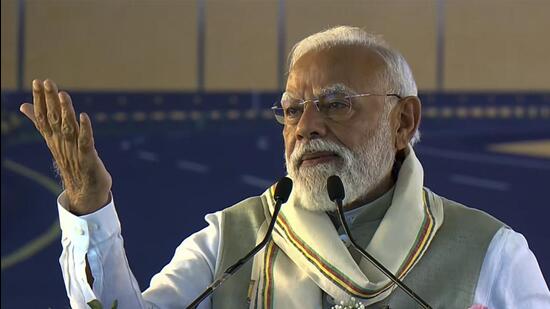
Silchar, Assam – Prime Minister Narendra Modi recently addressed a vibrant gathering in Silchar, Assam, not only to inaugurate and lay the foundation stones for development projects worth a staggering ₹23,550 crore but also to launch a direct and pointed critique against the Congress party. The Prime Minister accused the grand old party of decades of neglect towards India’s northeastern region and specifically of alienating the crucial Barak Valley. This substantial investment and the accompanying political broadside underscore the government’s intensified focus on the region, as meticulously reported by Omni 360 News.
The event, held in the heart of the Barak Valley, served as a powerful platform to showcase the government’s commitment to accelerating progress in a region long perceived as lagging in national development indices. For a 12th standard student, understanding the significance of such an event involves grasping two main facets: the tangible benefits of large-scale infrastructure and the underlying political narrative shaping regional development.
A Flood of Development: Understanding the ₹23,550 Crore Package
Let us first delve into the essence of the ₹23,550 crore investment. This sum is not merely a number; it represents a wide array of projects designed to significantly uplift the quality of life and economic prospects for millions. Think of it like a comprehensive upgrade for an entire community, touching various essential aspects.
The lion’s share of these projects is concentrated on bolstering infrastructure, a fundamental pillar for any region’s growth. Key initiatives include substantial upgrades to national highways. Imagine smoother, wider roads that drastically cut down travel time between towns and cities, making it easier for goods to be transported, businesses to thrive, and people to connect. This means fresh produce from local farms can reach markets faster, tourists can access scenic spots with greater ease, and daily commuters spend less time stuck in traffic.
Beyond roads, significant investments are earmarked for railway electrification. This might sound technical, but its impact is quite straightforward. Electrifying railway lines means trains can run more efficiently, faster, and are more environmentally friendly. It also often leads to increased train frequency and improved connectivity, making travel more reliable for students, workers, and families.
The energy sector also received a substantial boost, particularly in the oil and gas domain. Projects from entities like ONGC (Oil and Natural Gas Corporation) are aimed at enhancing energy security and creating local employment opportunities. This involves exploring and extracting natural resources responsibly, which can power industries and homes, reducing reliance on external sources.
Furthermore, the package includes initiatives in housing, ensuring more families have access to safe and dignified homes, and power transmission lines, which are critical for ensuring a stable and uninterrupted electricity supply to every household and business. These projects collectively represent a concerted effort to weave the Northeast more tightly into India’s national fabric, both economically and socially. The government frames these as crucial steps towards realizing the vision of a developed and interconnected Northeast, often referred to as the ‘Ashta Lakshmi’ (eight forms of wealth) of India.
The Political Scrutiny: Modi’s Accusations Against Congress
During his address, Prime Minister Modi didn’t mince words, squarely blaming the Congress party for what he described as decades of neglect towards the Northeast. He painted a picture of a region historically treated with indifference, left isolated and underdeveloped, struggling with poor infrastructure and limited opportunities.
This narrative holds particular resonance in the Northeast, where many older residents recall periods of slower development and a sense of being geographically and politically distant from the national mainstream. Modi emphasized that previous governments, predominantly led by Congress, failed to prioritize the unique challenges and vast potential of these states. He suggested that policies were either lacking or inadequately implemented, leading to a visible disparity in growth when compared to other parts of the country.
The Prime Minister specifically highlighted the “alienation of Barak Valley.” This region, comprising districts like Cachar, Karimganj, and Hailakandi, holds a distinct cultural and linguistic identity within Assam, primarily Bengali-speaking. Historically, the Barak Valley has often felt marginalized even within Assam, struggling with connectivity issues, economic disparities, and a perception of being overlooked by both state and central governments. Modi’s direct mention taps into these deep-seated sentiments, implying that Congress’s policies (or lack thereof) further exacerbated this feeling of isolation. He positioned his government as the one actively working to bridge these gaps, foster inclusivity, and integrate the valley fully into the national development agenda.
For a student, this political dynamic can be understood as a historical argument. One side (the current government) says, “You didn’t do enough for this region,” while the other (the opposition) would likely counter with their own past initiatives or contextualize the challenges they faced. Modi’s speech served to reinforce the current government’s narrative of being the true champion of the Northeast, correcting historical injustices and driving unprecedented development.
The ‘Act East’ Vision and Regional Integration
The investments and rhetoric from Silchar are not isolated incidents but fit into the broader framework of the government’s ‘Act East Policy’. This policy is a strategic shift from the previous ‘Look East Policy’, aiming for more proactive engagement with Southeast Asian nations. However, its success hinges on developing India’s northeastern states as gateways to this engagement. This means robust infrastructure – roads, railways, waterways, and digital connectivity – within the Northeast itself is paramount.
By pouring resources into connectivity projects, the government aims to transform the Northeast from a peripheral region into a vibrant hub for trade, tourism, and cultural exchange. Improved connectivity not only links the region better to the rest of India but also facilitates its role as a land bridge to neighbouring countries like Bangladesh and Myanmar, opening up new economic corridors.
Key Takeaways for Omni 360 News Readers:
* The ₹23,550 crore project unveiling in Silchar signifies a major developmental push for Assam and the Northeast, focusing heavily on infrastructure, energy, and connectivity.
* Prime Minister Modi used the occasion to launch a strong political attack on the Congress, accusing them of historical neglect and alienating the Barak Valley.
* These initiatives are central to the government’s ‘Act East Policy’, aiming to integrate the Northeast more deeply into India’s economic fabric and position it as a gateway to Southeast Asia.
* The emphasis on Barak Valley underscores its strategic importance and addresses long-standing sentiments of marginalization within the region.
* The event highlights the government’s narrative of rectifying past developmental imbalances and ushering in an era of rapid progress for the entire northeastern region.
This significant development, meticulously covered by Omni 360 News, represents not just an investment in concrete projects but a powerful political statement about the government’s priorities and its vision for India’s dynamic northeastern frontier. It sets a clear trajectory for the region’s future, aimed at overcoming historical challenges and realizing its immense potential.