
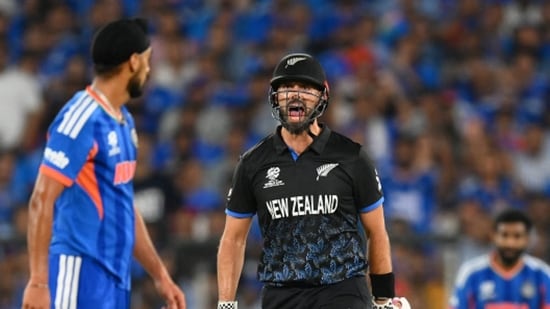
Daryl Mitchell furious at Arshdeep after being hit by throw: Surya steps in, umpire intervenes; all hell breaks loose
Mitchell’s T20 WC 2026 Final Flashpoint Arshdeep’s Throw Ignites Tension Suryakumar Steers Calm
The T20 World Cup 2026 final, a stage meant for cricketing heroics, briefly witnessed a tense human moment. New Zealand’s Daryl Mitchell and India’s Arshdeep Singh clashed in an unexpected flare-up, momentarily overshadowing the on-field drama. It required India captain Suryakumar Yadav’s calm leadership to diffuse, highlighting how even at sport’s peak, pressure can ignite tempers.
The incident unfolded during a crucial phase of the match. Following a delivery, with the ball safely gathered and no immediate threat of a run-out, Indian pacer Arshdeep Singh, perhaps driven by heightened adrenaline or misjudgment, hurled the ball back towards the stumps with considerable force, narrowly missing Daryl Mitchell who was well within his crease. The unnecessary nature of the throw, coupled with its proximity to the batsman, immediately drew a furious reaction from Mitchell. His body language—a quick turn, a pointed glare, and clearly exchanged words—spoke volumes.
Reports from Wellington and Christchurch fan forums conveyed widespread New Zealand supporter frustration. Many viewed Arshdeep’s action as a lapse in sportsmanship, particularly in a high-stakes final. Local sports analysts across New Zealand media suggested Mitchell’s anger was understandable, interpreting it as an act of irritation rather than a genuine attempt at a run-out. The Black Caps’ camp, while officially quiet, was reportedly displeased by the perceived lack of decorum.
From the Indian perspective, as debated on regional sports channels in Punjab and Mumbai, the incident was seen differently. While not condoning any perceived aggression, some pundits attributed Arshdeep’s action to youthful exuberance and the sheer pressure of a World Cup final. The argument was made that such moments, though regrettable, are part of high-stakes cricket where split-second decisions can lead to an over-the-top reaction. It was largely viewed as an unintentional act of frustration, not a malicious one.
Amidst the rising tension, India’s captain, Suryakumar Yadav, stepped in with remarkable composure. Displaying the leadership that defines him, Yadav quickly moved towards the irate Mitchell, placing a reassuring hand on his shoulder and engaging him in a brief, calming conversation. His intervention was swift and decisive, a clear signal to both his player and the opposition that such heated exchanges had no place in the spirit of the game. This timely act not only de-escalated the situation but also reaffirmed his authority and commitment to fair play, earning widespread praise.
The incident, though quickly diffused, served as a stark reminder of the emotional stakes in a World Cup final. While the game continued without further confrontation, the moment lingered, a talking point in post-match analysis. It underscored how easily a game of skill can tip into a test of temperament, and how crucial mature leadership is in managing volatile moments. The crowd, initially buzzing, had momentarily hushed, sensing the gravity before Yadav’s calm presence restored equilibrium.
Cricket, often called a gentleman’s game, occasionally sees these flashes of raw emotion. The T20 World Cup 2026 final presented a compelling case: how players, under immense global scrutiny, navigate the fine line between competitive fire and the spirit of the game. Mitchell’s palpable frustration demonstrated his passion. Arshdeep’s action, while perhaps regrettable, reflected the pressure cooker environment. Ultimately, recovering from such moments, individually and collectively, defines a team’s character.
Captured vividly by Omni 360 News, this incident highlights the human element in professional sports.
Key Takeaways:
* Global final pressure can spark emotional flare-ups.
* Experienced leadership, exemplified by Suryakumar Yadav, is crucial for sportsmanship.
* Small actions can provoke significant reactions; composure is key.
* The incident reflects the ongoing balance between competitive drive and cricket’s spirit.
Beyond runs and wickets, the swift resolution of this tense exchange proved as memorable as the final’s outcome, offering a glimpse into cricket’s psychological battles.