Delhi Air Quality Declines Amid Rising Mercury
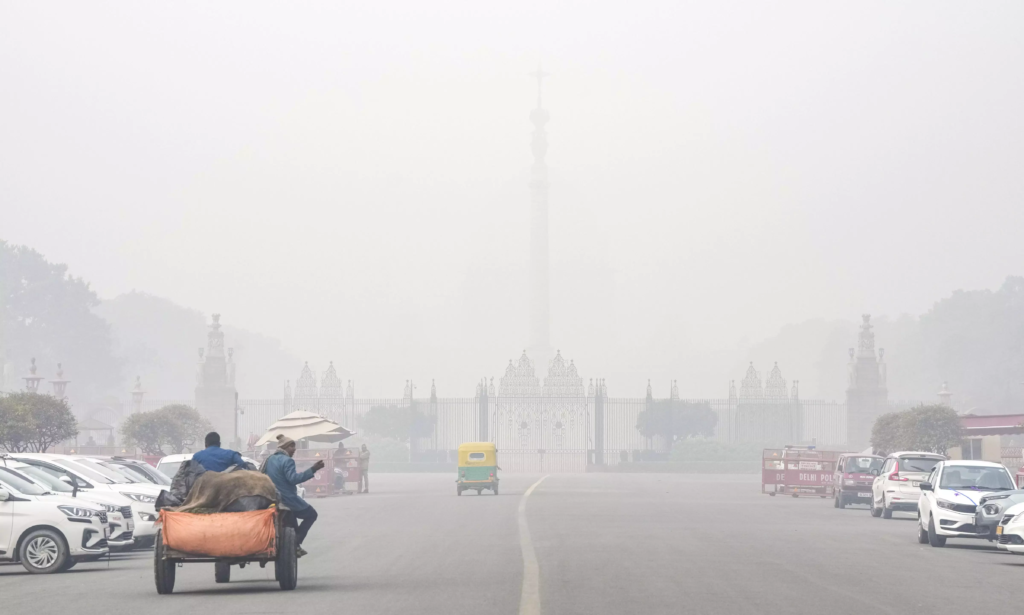
NEW DELHI – The national capital’s battle with atmospheric stagnation intensified on Wednesday, February 11, 2026, as air quality slipped further into the “poor” category. According to the latest data from the Central Pollution Control Board (CPCB), the city’s 24-hour average Air Quality Index (AQI) was recorded at 297 at 9:00 AM, a significant jump from the 272 recorded at 4:00 PM on Tuesday.
Parallel to the rising pollution levels, the city experienced a warmer-than-usual morning. The minimum temperature settled at 13.2°C, three degrees above the seasonal average, providing little respite as the combination of high humidity and low wind speeds trapped pollutants close to the surface.
The Pollution Surge: A Statistical Breakdown
The deterioration in Delhi’s air quality has been a steady trend over the last 72 hours. From a “moderate” reading of 189 on Sunday, the AQI climbed to 249 on Monday and reached 272 on Tuesday evening. The Wednesday morning spike to 297 brings the city to the doorstep of the “very poor” category (301–400).
| Date | Time | AQI Level | Category |
| Feb 8 (Sun) | 4:00 PM | 189 | Moderate |
| Feb 9 (Mon) | 4:00 PM | 249 | Poor |
| Feb 10 (Tue) | 4:00 PM | 272 | Poor |
| Feb 11 (Wed) | 9:00 AM | 297 | Poor |
Weather experts attribute this decline to a significant reduction in wind speed, which hindered the dispersion of particulate matter. While the sun was visible by mid-morning, a layer of mist and shallow fog early in the day exacerbated the accumulation of PM2.5 and PM10 pollutants.
Meteorological Factors and Temperature Trends
The India Meteorological Department (IMD) noted that the city’s thermal profile has been unusually high for mid-February. On Tuesday, the maximum temperature surged five notches above normal to hit 28.6°C. While Wednesday’s maximum is expected to hover around 26–28°C, the elevated minimum temperatures indicate a lack of the “piercing cold” typically associated with the withdrawal of winter.
The IMD has identified a series of three feeble Western Disturbances currently impacting Northwest India.
- System 1: Began affecting the Western Himalayan region on Tuesday.
- System 2: Expected to arrive around February 13 (Friday).
- System 3: Forecast for February 16–17.
While these systems are likely to bring light rain or snow to the mountains, their impact on the Delhi plains will remain minimal, limited largely to “partially cloudy skies.” However, meteorologists remain optimistic that surface winds of 15–20 km/h expected over the weekend may help flush out the current pollutant load.
Health Risks and Advisory
With the AQI nearing 300, health experts have issued warnings for vulnerable populations. Prolonged exposure to “poor” air quality can lead to respiratory discomfort, particularly for those with pre-existing conditions like asthma or COPD.
“The current combination of 13.2°C minimum temperatures and high humidity creates a ‘heavy’ atmosphere. Pollutants don’t rise; they settle. Residents should avoid strenuous outdoor activities in the early morning hours when the concentration of PM2.5 is at its peak,” says a senior environmental scientist at the Air Quality Early Warning System (EWS).
As of now, the Graded Response Action Plan (GRAP) Stage-I and Stage-II remain in effect across the National Capital Region (NCR), mandating dust control at construction sites and increased frequency of mechanized road sweeping. If the AQI crosses the 300-mark, the Commission for Air Quality Management (CAQM) may consider stricter Stage-III restrictions.