Don’t forgive Congress that treated Assam in step-motherly manner: Rajnath| India News
BJP’s Vision for Assam Rajnath Singh Contrasts Development with Congress Past Key Takeaways
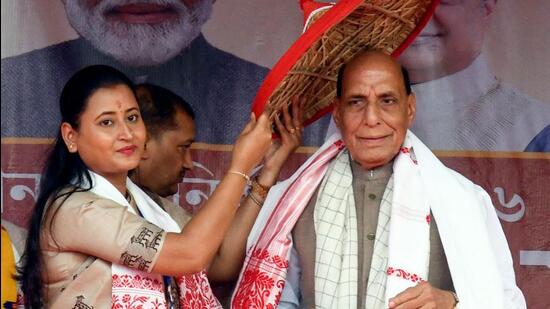
As the political fervor intensified across India ahead of the crucial Lok Sabha elections, Defence Minister Rajnath Singh visited Assam, delivering a sharp critique of the Congress party’s historical stewardship of the state. Speaking at a rally in Lakhimpur, a key constituency in Upper Assam, Singh urged voters to reflect on past governance and cast their ballots decisively, highlighting the Bharatiya Janata Party’s (BJP) relentless focus on development in the region. This report from Omni 360 News delves into the Minister’s allegations and the BJP’s counter-narrative, offering a clear picture of the electoral battleground.
Singh’s address, delivered with customary resolve, accused the Congress of treating Assam with a “step-motherly” attitude during its long years in power. He painted a picture of neglect, where the state’s potential remained untapped and its people struggled with underdevelopment and a lack of critical infrastructure. This isn’t just political rhetoric; it taps into a long-standing sentiment in many parts of the Northeast, where residents often felt marginalized by distant central governments. The Minister emphasized that under previous Congress administrations, Assam’s rich cultural heritage and strategic importance were overlooked, leading to missed opportunities for progress and prosperity. He argued that the historical record speaks for itself, inviting the electorate to recall the pace of development and the state of affairs before the BJP assumed power.
In stark contrast, Singh presented the BJP’s tenure as a period of transformative growth for Assam and the broader North Eastern region. He highlighted Prime Minister Narendra Modi’s personal commitment, often referred to as the “Act East Policy,” which has seen an unprecedented focus on connectivity, infrastructure, and economic integration for the region. Specific projects mentioned by local news outlets covering the rally included improvements in road networks, railway expansion, and efforts to enhance air connectivity, all vital for a state like Assam with diverse geographical challenges. Beyond physical infrastructure, the BJP government has also emphasized peace and stability, pointing to a significant reduction in insurgency and unrest, fostering an environment more conducive to investment and development. This narrative aims to convince voters that the BJP not only cares for Assam but has also delivered tangible results that have positively impacted daily lives.
The Defence Minister’s call to action was unequivocal: voters should “not forgive” the Congress for its past actions. This plea goes beyond simply asking for votes; it seeks to create a clear choice in the minds of the electorate between a past perceived as neglectful and a present and future envisioned as progressive and opportunity-filled under BJP leadership. For a 12th standard student trying to understand this, imagine a situation where one friend promises a lot but never delivers, while another friend, new to the group, actively helps with projects and makes things better. Rajnath Singh is essentially asking the voters of Assam to choose the friend who has shown a clear track record of helping and developing their home. The elections, therefore, become a referendum on governance, focusing heavily on development and regional inclusion.
Local sentiment often plays a crucial role in these electoral dynamics. Many Assamese citizens have historically voiced concerns about being overlooked by national political discourse. The BJP’s emphasis on integrating the Northeast into the national development agenda, along with initiatives specifically tailored for the region’s unique cultural and economic landscape, aims to address these long-standing grievances. Ministers and party leaders frequently tour the region, a practice that local observers note has increased significantly, creating a sense of direct engagement that was sometimes absent in previous eras. The promises of job creation, agricultural support, and preserving indigenous cultures form the bedrock of the BJP’s appeal, aiming to resonate deeply with the local populace. The political stakes in Assam are high, not just for parliamentary representation, but also for reinforcing the BJP’s regional dominance and its narrative of inclusive national development.
Key Takeaways:
* Defence Minister Rajnath Singh accused the Congress of neglecting Assam, describing their past approach as “step-motherly.”
* Singh urged Assamese voters to reject Congress, citing their alleged lack of development during their rule.
* The BJP highlighted its own significant development initiatives in Assam, focusing on infrastructure, connectivity, and peace, under Prime Minister Modi’s “Act East Policy.”
* The electoral campaign positioned the upcoming elections as a choice between past neglect and future progress under BJP governance.
* The statements underscore the BJP’s strategy to cement its political influence in the strategically vital Northeast, appealing to local aspirations for growth and recognition.
As the election results unfolded, the impact of such powerful campaigning by figures like Rajnath Singh became clear, shaping the political landscape and the future trajectory of development in Assam. The discourse centered around development, regional pride, and historical accountability, themes that continue to resonate deeply with the electorate.