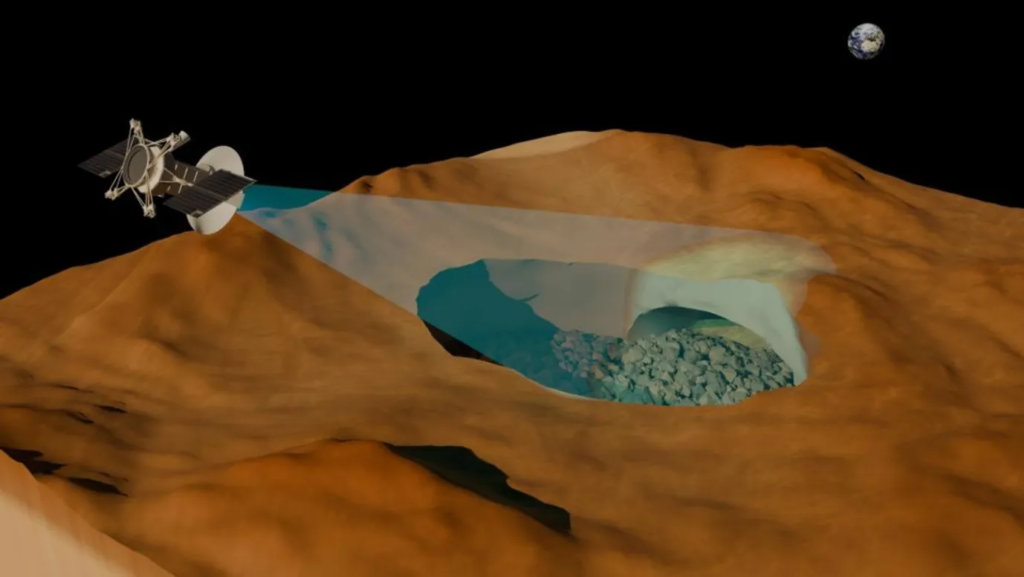
The collapsed roof of the lava tube was detected through a reanalysis of orbital radar data from NASA's Magellan probe in the 1990s. RSLab/University of Trento
Move over Mars Venus just got a lot more interesting. For a time the thick clouds of Venus have hidden a volcanic landscape that scientists are just starting to understand. Researchers have just confirmed the discovery of a lava tube an underground tunnel made by ancient molten rock deep beneath Venus.
This isn’t a small hole; it’s a huge underground cavern that could swallow skyscrapers. Here’s everything you need to know.
A Hidden Clue: How We Found It
This discovery didn’t come from a telescope. Instead scientists at the University of Trento in Italy looked at radar data from NASAs Magellan probe from the early 1990s.
By using imaging techniques on these 30-year-old maps they found a “skylight” a place where the roof of an underground cave had collapsed. This opening is near Nyx Mons, a shield volcano.
How Big is This Underground Tunnel?
The lava tube is really big. According to the report:
- The collapsed “skylight” is 150 meters deep.
- The cave itself is least 375 meters deep.
- The tube could be up to one kilometer wide.
These tubes are much larger than those on Earth or Mars. They are similar to the lava tubes on the Moon.
Why We Can’t Visit (Yet)
On the Moon or Mars lava tubes are considered places for future astronauts because they provide natural protection. On Venus it’s different.
Venus is extremely hot. Has very high pressure. The pressure is 93 times higher than Earths. The temperatures are hot enough to melt lead. Our electronics would break in seconds. While humans won’t be moving in soon the existence of these tubes helps scientists understand volcanoes on planets without plate tectonics.
The Future: VERITAS and EnVision
This discovery is exciting, for two space missions:
- NASA’s VERITAS: Set to launch by June 2031.
- ESA’s EnVision: Expected to launch that same year.
Both spacecraft will have radar that will see through the Venusian clouds. This discovery shows that with old data there are still big secrets waiting to be uncovered.