India Celebrates 77th Republic Day
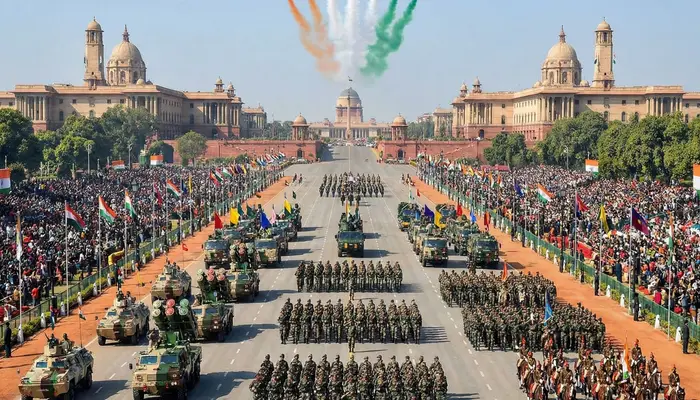
India on Monday marked its 77th Republic Day, commemorating the day when the Constitution of India came into force in 1950 and the country became a sovereign democratic republic. The celebrations began early in the morning at Kartavya Path in New Delhi, the heart of the national capital, where the President of India unfurled the national flag. This was followed by the annual Republic Day parade, one of the most significant ceremonial events in the country.
The Republic Day parade is not just a display of military power but also a celebration of India’s rich cultural heritage and developmental journey. Marching contingents of the armed forces, tableaux from various states and Union Territories, and performances by school children together reflected the unity in diversity that defines India.
This year’s Republic Day celebrations gained added global importance with the presence of two top leaders from the European Union as chief guests. Ursula von der Leyen, President of the European Commission, and Antonio Luís Santos da Costa, President of the European Council, attended the celebrations in New Delhi. Their participation highlights the growing strategic partnership between India and the European Union.
The two European leaders are on a state visit to India from January 25 to January 27, following an invitation from Prime Minister Narendra Modi. Their visit is being seen as a major step in strengthening diplomatic, economic, and security ties between India and the European Union at a time when global geopolitics is undergoing rapid change.
A unique feature of this year’s parade is the participation of a European Union contingent. The EU group includes four flag bearers riding on three gypsies. They carried the flag of the European Union, the EU Military Staff flag, and the flags of EU Naval Force Atalanta and EU Naval Force Aspides. This rare presence of an EU contingent at India’s Republic Day parade underlines the deepening defence and security cooperation between the two sides.
Ursula von der Leyen, who currently serves as President of the European Commission, was born in 1958 and is a trained medical doctor. She has more than 20 years of experience in public service and has held several important ministerial positions in Germany between 2005 and 2019. These include portfolios such as family and youth, labour, and defence. In 2019, she became the President of the European Commission and was re-elected for a second term in July 2024.
In her current role, von der Leyen is focusing on strengthening Europe’s economic competitiveness, democratic institutions, and defence and security capabilities. She has repeatedly spoken about the importance of India as a strategic partner for Europe. Recently, she said that Europe and India have chosen the path of strategic partnership, dialogue, and openness, and are working together to build mutual resilience.
At the World Economic Forum in Davos, von der Leyen stated that the European Union is close to finalising a long-awaited free trade agreement with India. She described the proposed agreement as historic, saying it could create a market of nearly 2 billion people and account for almost one-fourth of the global gross domestic product. According to EU Trade Commissioner Maros Sefcovic, negotiations on the free trade agreement are now nearing their conclusion, after being under discussion for more than two decades.
The second chief guest, Antonio Luís Santos da Costa, is the President of the European Council. Born in Lisbon in 1961, Costa is a senior Portuguese political leader with a diverse background. His family has Portuguese, Indian, and Mozambican roots, reflecting strong historical connections between Europe and other parts of the world. He holds a law degree from the University of Lisbon and joined the Portuguese Socialist Party early in his political career.
Over the years, Costa has served in many important positions, including minister for parliamentary affairs, minister for justice, vice-president of the European Parliament, minister of state, minister for the interior, and mayor of Lisbon. He served as the Prime Minister of Portugal from 2015 for nine years. During his tenure, Portugal experienced stable economic growth, a reduction in unemployment, sound public finances, and increased investment in renewable energy. He assumed office as President of the European Council in December 2024.
During the visit of the European leaders, India and the European Union are expected to unveil a major security and defence strategic partnership. Discussions are also expected to focus on the proposed free trade agreement. The defence partnership is set to be signed by EU High Representative and Vice-President Kaja Kallas and India’s Defence Minister Rajnath Singh. Once signed, it will become only the third such comprehensive defence partnership the European Union has entered into in Asia, after similar agreements with Japan and the Republic of Korea.
An EU official described the current phase of India-EU relations as the culmination of years of steadily strengthening ties. The official noted that both sides now clearly understand that their security and economic prosperity are closely linked in a rapidly changing global environment.
Adding a spiritual and cultural dimension to the celebrations, a large group of monks and nuns from 40 countries attended the Republic Day parade as honoured guests. These monks and nuns had earlier participated in the two-day Global Buddhist Summit held in New Delhi on January 24 and 25. The summit was organised by the International Buddhist Confederation in collaboration with the Ministry of Culture.
The theme of the summit was “Collective Wisdom, United Voice, and Mutual Coexistence.” According to the Ministry of Culture, the gathering reflected India’s message as the land of the Buddha, advocating peaceful resolution of conflicts, addressing global inequalities, and responding to ecological challenges facing the world today.
Speaking at a press conference, International Buddhist Confederation Secretary General Ven Shartse Khensur Rinpoche Jangchup Choeden said that while India would display its military strength at the parade, it would also highlight its identity as the land of Buddha Dhamma. He said India continues to spread messages of peace, love, kindness, and compassion to countries around the world. He stressed the need for peace and friendly coexistence in today’s troubled global environment.
The Global Buddhist Summit brought together more than 800 delegates from 40 countries. This included over 200 international participants, around 100 members of the Sangha, as well as diplomats, scholars, academicians, and lay practitioners from India and abroad. Their presence at the Republic Day celebrations symbolised India’s soft power and its role as a bridge between ancient wisdom and modern global challenges.
Overall, India’s 77th Republic Day celebrations not only reaffirmed the country’s democratic values and national strength but also highlighted its growing role on the global stage. With strong cultural roots and expanding international partnerships, India continues to project itself as a nation committed to peace, cooperation, and shared prosperity.