India Signs Major Free Trade Deal With Europe Amid Trump Tariffs, US Raises Objections
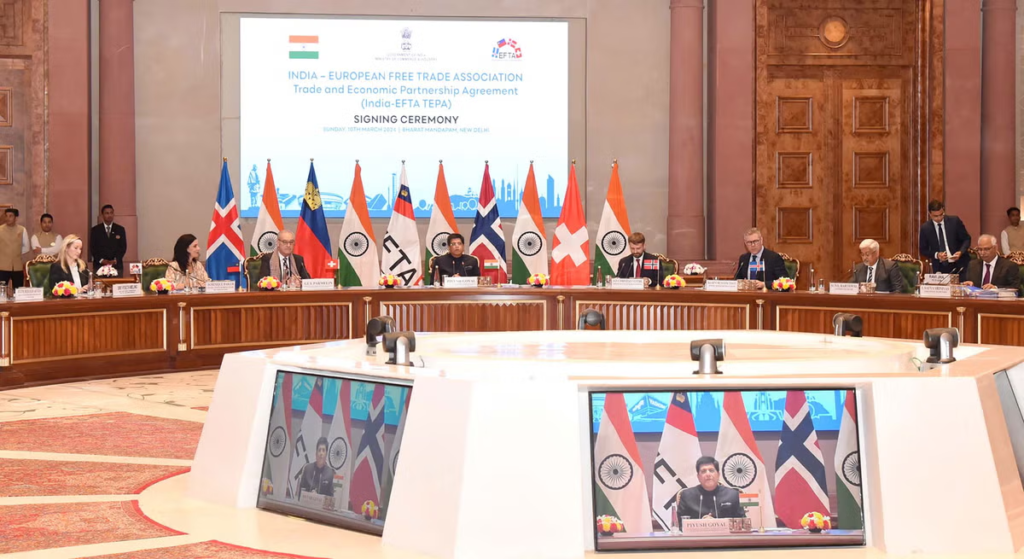
India has taken a bold and strategic economic decision at a crucial moment in global trade politics. While trade tensions with the United States continue to rise, New Delhi has signed a major Free Trade Agreement with the European Union. This agreement comes after nearly 19 years of long and complex negotiations, finally marking one of the most important trade deals in India’s recent history.
The timing of the agreement is significant. The United States, under former President Donald Trump’s tariff policy, has imposed heavy duties of up to 50 percent on several Indian products. Despite multiple rounds of discussions, India has not been able to secure relief from these high tariffs. As a result, India has been looking for alternative global markets to protect its exporters and economic interests. Europe has now emerged as that key partner.
The India European Union Free Trade Agreement is wide in scope and detailed in structure. The deal includes a total of 24 chapters, covering almost every major area of modern trade. These chapters include trade in goods, trade in services, investment rules, and customs duties. One of the most important highlights of the agreement is that tariffs will be reduced or completely removed on more than 90 percent of traded goods between India and the European Union.
This means Indian products will become more competitive in European markets. Sectors such as textiles, pharmaceuticals, engineering goods, chemicals, leather products, and information technology services are expected to benefit the most. With lower duties, Indian exporters will find it easier to enter European markets, increase sales, and create more jobs back home.
For India, this deal is also a strategic response to growing pressure from Washington. The United States has not only imposed high tariffs but has also expressed dissatisfaction with India’s independent foreign policy choices. One major point of disagreement has been India’s purchase of oil from Russia. The US administration has repeatedly criticised New Delhi for continuing energy trade with Moscow despite Western sanctions.
Washington has openly reacted to the India Europe trade deal. The United States has shown strong displeasure over the growing economic closeness between India and the European Union. US Treasury Secretary Scott Bessent made a sharp remark, saying that countries were “funding a war against themselves,” indirectly referring to India’s oil purchases from Russia and its independent trade decisions.
However, India has maintained that its trade and foreign policies are guided by national interest. Officials in New Delhi believe that diversifying trade partners is essential for economic stability, especially at a time when global supply chains are under stress.
The European Union also finds this partnership important. Europe itself is under pressure due to Trump era tariff policies and rising economic uncertainty. At the same time, concerns are growing within Europe about China’s manufacturing dominance and aggressive export strategies. Many European nations are now looking to reduce over dependence on Chinese supply chains. In this situation, India is seen as a reliable and democratic alternative manufacturing and trade partner.
The agreement strengthens India Europe relations not just economically, but also strategically. Both sides see mutual benefit in closer cooperation, especially in a changing global order where trade is increasingly linked with geopolitics.
Experts believe this deal is a major diplomatic and economic victory for India. It reflects New Delhi’s ability to balance global powers while protecting its own interests. After nearly two decades of negotiations, finalising this agreement shows India’s growing confidence on the global economic stage.
In the long term, the India European Union Free Trade Agreement is expected to increase exports, attract foreign investment, and support India’s goal of becoming a global manufacturing hub. It also sends a clear message that India will not depend on any single country for trade and will continue to build partnerships based on mutual respect and shared benefit.