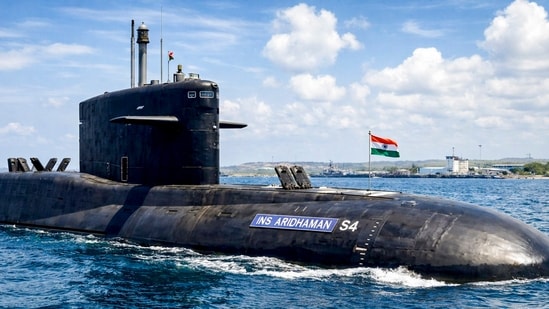
Indian Navy gets its third indigenous nuclear submarine, Rajnath Singh commissions INS Aridaman in service| India News
India Fortifies Naval Strength as INS Aridaman Joins Fleet
The Indian Navy has quietly, yet significantly, bolstered its strategic might with the induction of the INS Aridaman, the third vessel in the nation’s groundbreaking Arihant class of indigenous nuclear-powered ballistic missile submarines. Built under the secretive Project ATV (Advanced Technology Vessel) at the shipbuilding facilities in Vishakhapatnam, this addition represents a monumental leap in India’s self-reliance and its capacity for credible deterrence on the global stage. This development, while handled with the discretion befitting a project of its nature, signals a robust advancement for India’s maritime security.
For decades, nations have sought to achieve a nuclear triad a comprehensive defense capability allowing for the launch of nuclear weapons from land, air, and sea. The Arihant class submarines, of which INS Aridaman is the latest iteration, are the cornerstone of India’s sea-based nuclear deterrence. They are not merely warships; they are strategic assets designed to operate undetected for extended periods, providing a second-strike capability that ensures no adversary could contemplate a first strike without fear of devastating retaliation. This is a critical component of national security for any major power.
The story of the Arihant class began with the INS Arihant, the lead vessel, which was commissioned earlier, followed by INS Arighat. Each submarine in this class represents years of intense research, indigenous design, and meticulous engineering by a consortium of Indian scientists, engineers, and defense personnel. The construction process in Vishakhapatnam has nurtured a specialized ecosystem of shipbuilding and defense technology, fostering invaluable expertise within the country. This isn’t about buying off the shelf; it’s about building from the ground up, a testament to Indian ingenuity.
What makes the INS Aridaman, and its sister ships, so vital for India? Firstly, they are nuclear-powered, meaning they can stay submerged for much longer periods than conventional diesel-electric submarines. This endurance is crucial for maintaining a continuous patrol and remaining undetected. Secondly, they are capable of carrying ballistic missiles, providing the aforementioned second-strike capability. This means that even if India’s land-based or air-based nuclear assets were compromised, the submarines could still deliver a retaliatory strike, making any attack on India far too costly for an aggressor. This strategic depth is paramount for national security in an increasingly complex geopolitical landscape.
The commissioning of INS Aridaman also underscores India’s commitment to indigenous defense manufacturing, often referred to as ‘Make in India.’ It showcases the nation’s capability to design, develop, and construct highly complex defense platforms. This not only saves crucial foreign exchange but also builds a robust domestic industrial base, creating jobs and fostering advanced technological skills within the country. It’s a powerful statement of self-sufficiency.
For the Indian Ocean Region, the presence of such advanced submarines significantly enhances India’s maritime security posture. As a major player in this vital trade route, India has a responsibility to maintain stability and protect its interests. The INS Aridaman contributes directly to this goal, projecting India’s influence and ensuring its ability to safeguard its extensive coastline and maritime interests. It sends a clear message about India’s resolve to protect its sovereignty and its place in the world order.
Key Takeaways:
* The INS Aridaman is India’s third indigenous nuclear-powered ballistic missile submarine (SSBN) under the Arihant class.
* Its commissioning significantly boosts India’s self-reliance in strategic defense capabilities.
* The vessel enhances India’s credible nuclear deterrence, offering a vital second-strike capability.
* Built at Vishakhapatnam under Project ATV, it highlights advanced indigenous shipbuilding and technological prowess.
* This addition strengthens India’s presence and security commitments within the critical Indian Ocean Region.
For more updates on India’s evolving defense landscape and its impact on global affairs, stay tuned to Omni 360 News.