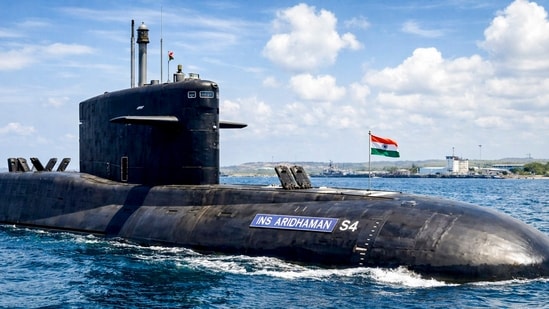
Indian Navy gets its third indigenous nuclear submarine, Rajnath Singh commissions INS Aridaman in service| India News
India’s Undersea Might Grows with INS Aridaman Commissioning A Strategic Leap for Naval Defence
The Indian Navy has quietly, yet significantly, bolstered its underwater capabilities with the recent induction of the INS Aridaman. This third vessel of the indigenous Arihant class nuclear-powered ballistic missile submarines marks a monumental step in India’s quest for strategic self-reliance and robust maritime security. Built meticulously under the classified Project ATV (Advanced Technology Vessel) at the Ship Building Centre in Vishakhapatnam, the Aridaman’s commissioning represents years of dedicated effort by scientists, engineers, and naval personnel.
A New Guardian Beneath the Waves
The INS Aridaman joins its formidable sister ships, INS Arihant and INS Arighat, in forming the backbone of India’s underwater nuclear deterrence. For decades, global powers have recognized the strategic imperative of a credible “second-strike capability”—the ability to retaliate with nuclear weapons even after absorbing a first strike. Nuclear-powered ballistic missile submarines (SSBNs) like the Arihant class are the ultimate guarantors of this capability, as their stealth and endurance make them virtually undetectable once submerged, offering an assured platform for delivering deterrent strikes.
The commissioning ceremony, presided over by Defence Minister Rajnath Singh, underlined the nation’s commitment to strengthening its defence infrastructure through indigenous development. Speaking at the event in Visakhapatnam, local media outlets echoed the sentiment of national pride. The Aridaman’s entry into service is not merely the addition of another vessel; it is a profound enhancement of India’s overall strategic posture, signifying a mature capability in designing, building, and operating highly complex nuclear submarines.
Project ATV A Vision for Self-Reliance
Project ATV, shrouded in secrecy since its inception, has been the crucible for India’s nuclear submarine program. It epitomizes the “Make in India” and “Aatmanirbhar Bharat” initiatives in the most critical and technologically demanding defence sector. Developing nuclear propulsion technology, sophisticated stealth features, and the intricate weapon systems required for such submarines is a challenge that only a handful of nations have mastered. India, through Project ATV and the Arihant class, has firmly placed itself in this elite group.
The construction of these submarines in Visakhapatnam has not only created a highly skilled workforce but also fostered a robust ecosystem of ancillary industries and research institutions across the country. From specialized steel alloys to complex electronic systems and reactor components, the indigenous content in these submarines is remarkably high, reducing dependence on foreign suppliers and ensuring long-term operational autonomy. This local expertise is invaluable for the sustained maintenance and future upgrades of these strategic assets.
Understanding the Arihant Class
For a 12th-grade student, imagining a submarine that can stay underwater for months, traveling thousands of miles without needing to refuel, and carrying missiles that can reach distant targets might seem like science fiction. But that’s precisely what the Arihant class delivers.
Unlike conventional submarines that run on diesel-electric engines and need to surface or snorkel frequently to recharge batteries, nuclear submarines like the Arihant class use a small nuclear reactor to generate power. This reactor heats water, creating steam that drives turbines, which in turn propel the submarine and generate electricity. This enables them to remain submerged for incredibly long periods, limited only by the crew’s endurance and onboard supplies.
These submarines are designed to carry Submarine Launched Ballistic Missiles (SLBMs), specifically India’s indigenous K-series missiles (such as the K-15 Sagarika and the longer-range K-4). These missiles, launched from underwater, are capable of carrying nuclear warheads. The ability to launch such missiles from a hidden platform deep in the ocean makes the Arihant class a potent and nearly invulnerable part of India’s nuclear arsenal. It ensures that no adversary can eliminate India’s nuclear deterrent in a first strike, thereby making such an attack unthinkable.
Strategic Implications for the Region
The induction of INS Aridaman sends a clear signal about India’s growing maritime power and its resolve to protect its national interests. In an increasingly complex geopolitical landscape, especially in the Indo-Pacific, a strong and diversified naval force is paramount. The Arihant class, with its strategic deterrence role, contributes significantly to regional stability by maintaining a balance of power.
This development is not about aggression; it’s about deterrence. It’s about ensuring that India has the ultimate safeguard against any nuclear coercion. For Omni 360 News, monitoring these strategic developments is crucial, as they shape the future of international relations and security doctrines. The Aridaman’s presence reinforces India’s position as a responsible nuclear power committed to maintaining peace through strength.
The lessons learned from Project ATV and the experience gained in building and operating the Arihant class will be instrumental in developing even more advanced submarines in the future. India’s journey in mastering undersea warfare is a testament to its scientific prowess and unwavering commitment to national security.
Key Takeaways
The commissioning of INS Aridaman solidifies India’s nuclear triad with a robust underwater leg. It underscores the nation’s success in indigenous defence technology, bolstering its strategic autonomy. This advanced submarine enhances India’s second-strike capability, acting as a powerful deterrent in the region. Its operational presence reinforces the nation’s resolve to safeguard its interests, marking a significant milestone in India’s maritime defence journey for Omni 360 News readers.