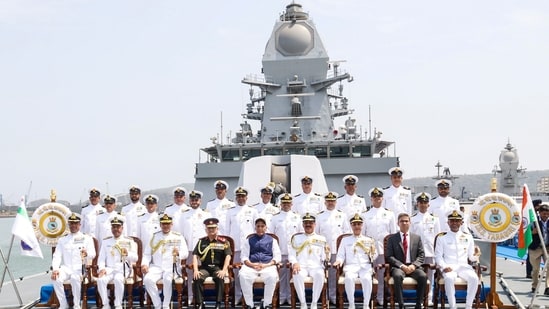
Indian Navy gets two big additions: Nuclear-ready submarine Aridhaman, warship Taragiri
INS Taragiri Bolsters Indian Navy With Over 75 Percent Indigenous Content
The Indian Navy recently marked a significant milestone with the commissioning of INS Taragiri, the third stealth frigate of Project 17A. This modern warship, built by Mazagon Dock Shipbuilders Ltd (MDL) in Mumbai, stands as a powerful testament to India’s burgeoning capabilities in indigenous defense manufacturing. Defence Minister Rajnath Singh, during the commissioning ceremony, underscored the strategic importance of such advancements for national security and economic growth, further solidifying the nation’s resolve towards self-reliance.
INS Taragiri’s most striking feature is its remarkable indigenous content, exceeding 75 percent. This isn’t just a number; it represents a meticulously orchestrated effort involving a vast network of Indian talent, technology, and industry. From the advanced weaponry systems and sophisticated sensors to the intricate communication networks and propulsion components, a significant majority of the ship’s architecture and operational systems have been designed and manufactured within the country. This high level of indigenization translates into reduced dependence on foreign suppliers, streamlined maintenance, and a deeper understanding of the vessel’s intricate workings by Indian personnel. It also ensures that critical technologies remain under national control, a paramount concern in an increasingly complex global security landscape.
The construction of INS Taragiri has been a massive collaborative undertaking, bringing together over 200 Indian enterprises. This diverse group includes large public sector undertakings, medium-sized businesses, and numerous micro, small, and medium enterprises (MSMEs) spread across various states. These companies have contributed a wide array of products and services, ranging from steel and specialized alloys to complex electronic systems, valves, pumps, and fabrication work. This broad participation highlights the depth and breadth of India’s industrial base, demonstrating its capacity to meet the stringent demands of modern naval warfare. For many of these smaller enterprises, contributing to a national defense project like Taragiri offers invaluable experience, technological upgrades, and a significant boost to their growth trajectory. It fosters innovation and skill development, creating a ripple effect across the broader manufacturing sector. The economic benefits are substantial, generating employment opportunities and stimulating local economies, all while building a robust domestic supply chain for future defense projects.
The commissioning of INS Taragiri aligns perfectly with the government’s ambitious ‘Make in India’ and ‘Atmanirbhar Bharat’ (Self-Reliant India) initiatives in the defense sector. These policies aim to transform India from a major defense importer into a global defense manufacturing hub. The success of projects like Taragiri provides tangible evidence that this vision is rapidly becoming a reality. It showcases India’s capability not just to assemble, but to design, develop, and integrate cutting-edge defense technologies, empowering the nation with greater strategic autonomy. This commitment to indigenous production is not merely about manufacturing; it’s about fostering a culture of innovation, research, and development within the country, ensuring that India remains at the forefront of defense technology.
Named after a mountain peak in the Himalayas, INS Taragiri is a formidable stealth frigate, designed to operate in a multi-threat environment. Its advanced stealth features, including a low radar cross-section, make it difficult for enemy radars to detect, providing a critical tactical advantage. The ship is armed with a sophisticated array of missiles, anti-submarine rockets, and modern electronic warfare systems, enabling it to perform a wide range of naval operations, from maritime surveillance and anti-piracy missions to protecting sea lanes and participating in international exercises. Its induction significantly enhances the operational readiness and combat prowess of the Indian Navy, particularly in safeguarding India’s vast maritime interests and projecting its influence across the Indo-Pacific region.
Defence Minister Rajnath Singh highlighted that such indigenous efforts are crucial for India’s journey towards becoming a superpower. He emphasized that self-reliance in defense is not just about producing military hardware, but about nurturing a robust ecosystem of research, development, and manufacturing that can meet the evolving security challenges of the 21st century. The success of INS Taragiri is a beacon for future projects, encouraging further investment in domestic defense production and fostering a sense of national pride in India’s industrial and technological prowess. This continuous push for indigenization ensures that every new addition to the fleet, like Taragiri, is a step towards a more secure and self-reliant India.
For the readers of Omni 360 News, understanding the profound impact of INS Taragiri goes beyond its technical specifications. It represents a powerful narrative of national ambition, technological mastery, and economic empowerment. It’s a clear message to the world that India is not only capable of defending its sovereignty but also of contributing significantly to global security through its self-developed capabilities. The journey from dependence to self-reliance in defense is long, but with each warship like Taragiri, India sails closer to its strategic goals.
Key Takeaways:
- INS Taragiri, the third stealth frigate of Project 17A, has significantly bolstered the Indian Navy’s capabilities.
- The warship boasts over 75 percent indigenous content, showcasing India’s growing self-reliance in defense manufacturing.
- More than 200 Indian enterprises contributed to its construction, fostering industrial growth and employment across the nation.
- Defence Minister Rajnath Singh’s commissioning of the vessel underscores India’s commitment to ‘Make in India’ and ‘Atmanirbhar Bharat’ in the defense sector.
- INS Taragiri represents a crucial step towards strengthening India’s strategic autonomy and maritime security in a complex geopolitical environment.