Just Like That
World Cup Win Temple Trip Ignites India’s Secular Debate Key Learnings
The recent fervor surrounding India’s triumph in the T20 World Cup brought immense joy across the nation. Yet, amidst the celebrations, a specific event — the cricket team’s visit to the revered Tirumala Tirupati temple — sparked a spirited discussion that transcended the boundaries of sports, delving deep into the enduring questions of secularism and faith within India’s public sphere. This incident, brought to the forefront by the pointed criticism from Trinamool Congress (TMC) Member of Parliament and former cricketer Kirti Azad, has once again underscored the intricate dance between personal belief, public representation, and constitutional principles in a diverse society.
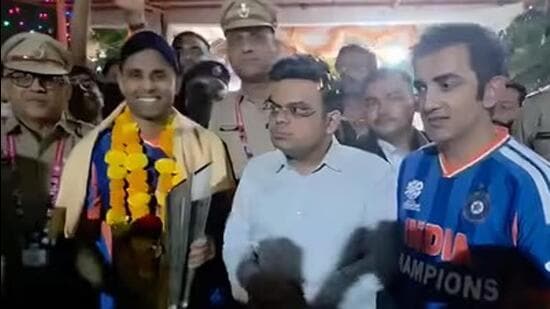
Following their spectacular win, the Indian cricket squad, a group of national heroes, made a pilgrimage to the famed Tirumala Tirupati Devasthanams. For many, this was a moment of thanksgiving, a private expression of faith by individuals seeking blessings after achieving a monumental goal. Images of the players, adorned in traditional attire, participating in rituals, quickly circulated, eliciting widespread appreciation from a populace that often views its sporting icons through a lens of shared cultural and religious values. Local news reports highlighted the devotion shown by the team, framing it as a natural extension of personal spirituality.
However, Kirti Azad, a voice familiar to both cricket enthusiasts and political observers, quickly challenged this narrative. Azad, himself a member of India’s 1983 World Cup-winning team, questioned the appropriateness of a national sports team collectively engaging in a religious act, arguing it potentially infringes upon the secular fabric of the nation. His contention was not about the individual players’ right to practice their faith, but rather about the collective identity of the team representing a secular state. “A national team,” he posited, “represents every citizen, regardless of their religious affiliation. Their public actions should ideally reflect this neutrality.” This perspective, articulated across various media platforms and social discussions, stirred a robust exchange of ideas.
The immediate aftermath saw a spectrum of reactions. Many citizens and public commentators defended the players, asserting that their personal religious freedom should not be curtailed simply because they are public figures. They argued that a temple visit is a benign act of gratitude, distinct from any state endorsement of religion. For these proponents, the act was a reflection of the deeply spiritual nature of Indian society, where faith often intertwines with all aspects of life, including moments of grand success. The sentiment was that players, like any other individual, are entitled to their spiritual expressions.
Conversely, others echoed Azad’s concerns, emphasizing the unique nature of India’s secularism. Unlike Western models that often advocate for a strict separation of church and state, India’s secularism, or ‘sarva dharma sambhava’ (equal respect for all religions), encourages the state to maintain an equidistant stance from all faiths. The debate then hinged on whether a national team, often seen as an extension of the state’s representation on an international stage, should maintain a similar distance. For a 12th-grade student trying to grasp this, imagine the school principal, representing everyone, attending a religious ceremony of one particular faith as an official act. While individuals are free to believe, the question arises if the collective, representing *all*, should publicly align with one specific religious practice.
This discussion is not new. India has grappled with the role of faith in its public institutions and the lives of its public figures for decades. The T20 World Cup win merely provided a high-profile stage for this perennial dialogue. It compelled people to ponder whether national heroes, revered by millions from diverse backgrounds, should be seen as purely individual citizens exercising private faith, or as symbols whose actions carry broader implications for national identity and secular principles. It raises the fundamental question: where do we draw the line between personal religious expression and the secular image of public institutions and national representatives?
Key Learnings from the Debate:
* Navigating Individual vs. Collective Identity: The incident highlights the tension between a public figure’s individual right to practice faith and the collective identity of a national team representing a secular state.
* India’s Unique Secularism: It provides a practical context to understand India’s ‘sarva dharma sambhava’ model, where respecting all religions doesn’t necessarily mean ignoring religious expression, but rather avoiding state preference or endorsement.
* Public Scrutiny of National Symbols: Actions by national teams, even seemingly personal ones, are subject to intense public scrutiny and interpretation, reflecting deeper societal values and constitutional principles.
* Ongoing Dialogue: The debate confirms that the discourse around faith, public life, and secularism is an ever-evolving conversation in India’s vibrant democracy.
In conclusion, the Indian cricket team’s post-World Cup temple visit, rather than being a simple act of devotion, became a catalyst for a profound societal introspection. It reminded the nation that while celebrating triumphs, it must also continue to thoughtfully engage with the complex interplay of faith, identity, and the fundamental principles that govern its public life. The ongoing conversation, as reported by outlets like Omni 360 News and local community voices, ensures that these crucial questions remain at the heart of India’s democratic discourse.