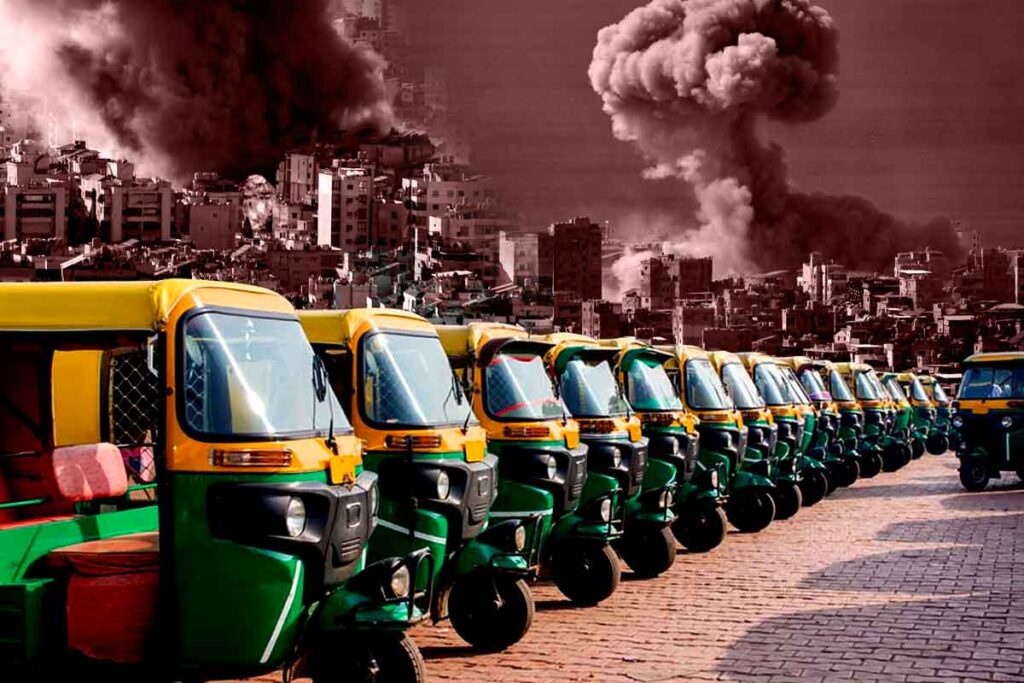
Iran war and Auto fare spike in Kolkata
In the bustling twilight of a Kolkata evening, as the aroma of kebabs and rolls wafted from local eateries, a simple auto ride ended with a question that echoed a much larger global reality. Just off the auto at Sree Colony Market, a friend, Ribhuda, his face etched with concern, pointed towards the departing three-wheeler. “How much did you pay?” he queried, a cigarette dangling from his lips. When told the usual fare, his frustration spilled out: “Auto fares are increasing. In Ultadanga, they took five rupees extra. Why is this happening? There’s a war in Iran, they say, and suddenly, there’s no gas. How can a war in Iran raise auto fares in Kolkata?”
Ribhuda’s question, posed amidst the mundane rhythm of market life, cuts to the core of a complex geopolitical strategy that stretches from the Persian Gulf to the streets of India. It’s a compelling query that Omni 360 News explores, dissecting how distant conflicts ripple through global economies, ultimately reaching into the pockets of everyday commuters.
A Distant Conflict, A Local Consequence
The Middle East has long been a theater of tension, a region synonymous with strategic importance and volatile dynamics. For decades, images of the Gulf War, with its burning oil fields, and the 1990s invasion of Kuwait by Iraq, followed by America’s Operation Desert Storm, have dominated headlines. This is a region where geopolitical drama is an inherent part of the landscape. However, recent developments, even if hypothetical in their specific details as sometimes reported, highlight a new, evolving strategy from key players.
Consider a scenario where tensions escalate dramatically, leading to significant disruptions in the region. Reports, albeit sometimes speculative in their immediate aftermath, could suggest severe military engagements, targeting critical infrastructure and even leadership figures. The immediate assumption might be that such a conflict would quickly conclude with one side dominant. Yet, as the situation unfolds, a different reality emerges – one where conventional military victory isn’t the sole objective, especially for a nation facing superior adversaries.
Iran, for instance, in facing potential overwhelming military might, has developed a doctrine that suggests it may not seek outright victory in a direct conventional confrontation. Instead, its strategy could be to make the cost of ‘victory’ for its opponents so astronomically high that it effectively becomes a strategic defeat. This approach hinges on leveraging its geographical and strategic assets to inflict maximum economic pain globally. And at the heart of this strategy lies one of the world’s most critical maritime passages: the Strait of Hormuz.
The Strait of Hormuz A Global Chokepoint
The Strait of Hormuz is not just a body of water; it is a global economic lifeline. This narrow channel, connecting the Persian Gulf to the Arabian Sea, acts as the world’s primary oil artery. Roughly one-fifth of the world’s total petroleum consumption, including crude oil, condensate, and liquid natural gas (LNG), transits through this strait daily. That’s an astonishing average of over 20 million barrels per day, carrying an estimated annual value exceeding hundreds of billions of dollars.
The importance of Hormuz cannot be overstated. Major oil-producing nations like Saudi Arabia, the United Arab Emirates, Kuwait, Iraq, and Iran itself, rely on this strait for the vast majority of their oil exports, especially to energy-hungry markets in Asia, including India and China. Any disruption here sends immediate shockwaves across global energy markets, making it a powerful strategic lever.
In a scenario of heightened conflict, if the Strait of Hormuz were to be significantly constrained or closed, the impact would be immediate and severe. Imagine reports of naval speedboats, potentially from forces like Iran’s Islamic Revolutionary Guard Corps (IRGC), menacing foreign warships and commercial oil tankers using drones or missiles. Picture the deployment of naval mines, effectively declaring parts of the strait impassable. Such actions, even if sporadic, could bring the world’s most critical oil transit route to a standstill.
The Economic Tidal Wave Hitting Shores Far and Wide
The immediate consequence of such a scenario is a rapid surge in global crude oil prices. Within hours, benchmark prices like Brent crude could leap past the $100 per barrel mark, reflecting a significant percentage increase. This isn’t just a number on a trading screen; it’s a direct hit to the global economy. Shipping costs for crude oil, particularly to major importers like India and China, could double, adding millions of dollars daily to transportation expenses. Furthermore, insurance companies, wary of the heightened risk, might withdraw coverage or drastically increase premiums, further escalating costs and complicating maritime trade.
As experts like former intelligence chiefs have noted in general discussions about global energy security, closing Hormuz would create an “incredible economic problem.” The ripple effect is profound. Nations dependent on oil imports, with little strategic reserve or alternative supply routes, would face immense pressure. For India, a nation heavily reliant on imported crude oil, such a disruption spells immediate trouble.
Kolkata’s Reality A Direct Link to Global Oil Markets
The anecdote of Ribhuda’s frustration in Kolkata perfectly illustrates this connection. When global crude oil prices spike due to geopolitical instability, the cost of refined fuels—petrol, diesel, and Compressed Natural Gas (CNG)—at the local pump invariably rises. For auto drivers in Kolkata, who depend on these fuels, increased prices mean higher operating costs. This, in turn, often translates into increased auto fares on routes across the city, from Dum Dum-Sinthi to Garia-Baruipur.
But the impact isn’t limited to transport. The cost of cooking gas, a household staple, also rises. Consumers might find it harder to book cylinders, with dealers reportedly cutting calls or facing supply issues. Reports from various cities in India sometimes highlight extended waiting periods for cylinder refills, sometimes up to 25 days, putting a strain on household budgets and daily life. Queues at CNG stations become longer, reflecting a shortage or increased demand against limited supply.
Such a situation compels local governments to react. The chief minister of West Bengal, for example, would likely hold urgent meetings with gas and fuel companies to assess the situation and explore solutions, highlighting the direct line between international geopolitical events and local governance challenges.
The Strategic Impasse And The Path Forward
The overarching strategy in such a scenario from the perspective of a nation like Iran isn’t about winning a conventional battle but about prolonging the conflict to exert maximum economic leverage. This economic pressure would then build on powerful nations. Major oil consumers and even traditional allies in the Middle East, dependent on the free flow of oil, would exert immense diplomatic pressure. Nations like India might seek to diversify their energy sources, perhaps increasing purchases from other suppliers like Russia, to mitigate the immediate impact.
Ultimately, a direct military engagement with a large and complex nation is a costly and protracted affair, a lesson learned by major powers from previous conflicts in the region. Iran’s hypothetical strategy, therefore, is simply to endure and ensure the economic consequences become unbearable for its adversaries and the global economy. In such a high-stakes environment, even proposals for de-escalation would carry significant conditions, such as recognition of sovereignty, war reparations, and international guarantees against future aggression, all aimed at solidifying its position.
The Strait of Hormuz, therefore, remains at the core of this intricate strategy. It symbolizes how a nation, even when militarily outmatched, can wield significant power on the global stage through its control over vital economic pathways. As long as such tensions persist and the threat of disruption looms, the world will continue to feel the reverberations.
Key Takeaways for Omni 360 News Readers
- Global Oil Artery: The Strait of Hormuz is vital for global oil supply, with about 20% of the world’s petroleum passing through it daily.
- Iran’s Strategic Calculus: For nations like Iran, the goal in a conflict might not be military victory, but to make the economic cost of war too high for adversaries by disrupting global oil trade.
- Direct Local Impact: Disruptions in Hormuz lead to sharp increases in crude oil prices, directly affecting local fuel costs for petrol, diesel, and CNG.
- Kolkata’s Experience: Rising fuel prices result in higher auto fares, increased cooking gas prices, and potential supply shortages, impacting daily life for ordinary citizens.
- Economic Leverage: Control over a strategic choke point like Hormuz gives significant economic and political leverage in international conflicts, affecting global supply chains and national economies.
So, the next time an auto fare rises in Kolkata, or the cooking gas cylinder takes longer to arrive, remember Ribhuda’s question. It’s a stark reminder that the world is more interconnected than ever, and a distant geopolitical chess game can indeed dictate the cost of a simple auto ride in a vibrant Indian city. As Ribhuda might conclude, “If Iran doesn’t want to lose the war, Kolkata’s auto fares go up.”