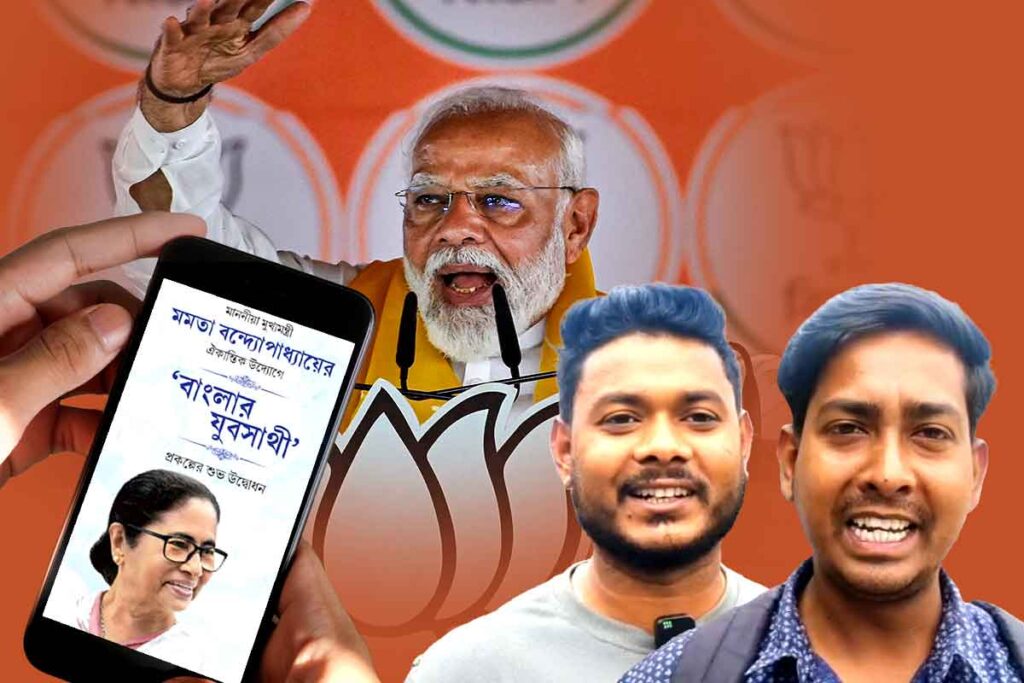
PM Modi Rally: Yuvasathi fulfills wishes of two Man from Rajganj on their brigade journey
In West Bengal, a state-backed welfare initiative designed to support unemployed youth has recently found itself at the heart of an interesting political narrative. The ‘Yuva Sathi’ scheme, implemented by the Mamata Banerjee-led government, aims to provide financial assistance to help young individuals with their studies and preparation for various examinations. However, a recent incident involving two beneficiaries has sparked widespread discussion across the state.
The Yuva Sathi scheme, intended for the educational and professional advancement of unemployed residents, offers a monthly grant of Rs. 1500, directly deposited into the bank accounts of eligible applicants. The initiative underscores the state government’s commitment to fostering skill development and enhancing employment prospects for its youth population.
Recently, two young men from Rajganj, identified as Gopal Das and Kalyan Sarkar, who are reported local workers of the Bharatiya Janata Party (BJP), received their monthly stipend under the Yuva Sathi scheme. What followed was an unexpected turn of events that captured public attention. The duo candidly revealed their plans to use this very assistance to attend a political rally of Prime Minister Narendra Modi at the Brigade Parade Ground in Kolkata.
Before embarking on their journey from North Bengal, Kalyan Sarkar shared, “I didn’t have money. I thought I wouldn’t be able to go. But last night, the Yuva Sathi money arrived in my account. I am going to the Brigade rally with that money.” Gopal Das echoed this sentiment, stating, “This morning, Didi’s money came to my account. I am going to see Modi with that money.” Their frank admissions quickly became a talking point, highlighting a unique intersection of state welfare and political engagement.
Reacting to these developments, Arindam Mukhopadhyay, the Rajganj Block President of the Trinamool Congress (TMC), emphasized the non-partisan nature of the state government’s welfare initiatives. “This clearly demonstrates that Mamata Banerjee’s government does not discriminate. The goal is the upliftment of everyone,” Mukhopadhyay stated. He further added that the Yuva Sathi funds are distributed with the specific purpose of assisting unemployed individuals with their education and exam preparation. While acknowledging the non-discriminatory distribution, he subtly urged the beneficiaries to utilize the funds for their intended purpose, reinforcing the scheme’s original objective.
This incident, closely observed by media outlets and the public, offers a rare glimpse into the functioning of welfare schemes in a politically charged environment. It reinforces the idea that state-sponsored aid often reaches beneficiaries irrespective of their political affiliations, underscoring a commitment to universal welfare. For Omni 360 News, this story exemplifies how government programs, designed for broad social benefit, can sometimes lead to unexpected narratives that challenge conventional political boundaries.
The candid statements of Gopal Das and Kalyan Sarkar, coupled with the Trinamool Congress’s response, suggest that while the funds are disbursed universally, there remains a public discussion around the intended versus actual use of welfare money. It opens a dialogue on how such schemes are perceived and utilized by citizens across the political spectrum, reinforcing the principle of equal access to state aid.
Key Takeaways
- The West Bengal government’s Yuva Sathi scheme provides Rs. 1500 monthly to unemployed youth for studies and exam preparation.
- Two BJP workers from Rajganj openly stated they used their Yuva Sathi funds to attend a PM Modi rally in Kolkata.
- This incident was highlighted by the Trinamool Congress as proof of the non-partisan nature of the state government’s welfare distribution.
- The TMC emphasized that the scheme aims for universal development, not just for party supporters.
- The event sparked discussions about the intended use of welfare funds versus their actual utilization by beneficiaries.