
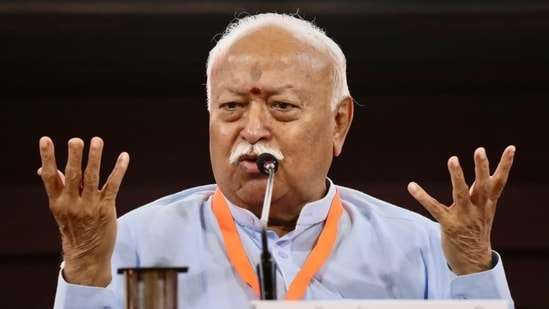
Mohan Bhagwat says India follows ‘law of humanity’, can help end wars| India News
India’s Global Compass A Call for Humanity and Harmony
In a world often defined by geopolitical shifts and economic competition, a resonant voice from India recently put forth a perspective that challenges the prevailing narrative. Mohan Bhagwat, the chief of the Rashtriya Swayamsevak Sangh (RSS), articulated a vision of India rooted in universal humanity, standing in stark contrast to what he described as a “survival-of-the-fittest mindset” observed elsewhere. His reiteration that the world urgently needs harmony, not conflict, invites a deeper examination of India’s philosophical underpinnings and its actions on the global stage.
Bhagwat’s remarks, reported across various Indian news outlets from regional dailies to national platforms like The Hindu and Dainik Bhaskar, were not an isolated statement but rather an echo of India’s long-held civilizational ethos. The core of his message posits that India’s engagement with the world is fundamentally driven by a principle of universal well-being, often encapsulated in the ancient Sanskrit maxim ‘Vasudhaiva Kutumbakam’—the world is one family. This isn’t merely a philosophical ideal but, as Bhagwat suggested, a guiding principle informing India’s foreign policy and humanitarian actions.
At its heart, this perspective contrasts sharply with a “survival-of-the-fittest” approach. This phrase, borrowed from evolutionary biology, describes a worldview where entities—in this context, nations—prioritize their own interests, security, and power above all else. Such a mindset can lead to aggressive competition, protectionism, and a readiness to engage in conflict to secure perceived advantages. History is replete with examples where this drive for dominance has resulted in widespread suffering and instability. From resource acquisition to strategic territorial claims, a narrow focus on self-preservation at any cost often neglects the broader implications for global peace and shared prosperity.
India, however, has often charted a different course. Its foreign policy, particularly since independence, has largely emphasized non-alignment, multilateralism, and peaceful resolution of disputes. This isn’t to say India hasn’t asserted its own interests, but it has frequently done so through diplomatic channels and with an appeal to shared values. Consider India’s consistent contribution to UN peacekeeping missions across various continents, demonstrating a commitment to global stability not tied to direct national gain, but rather to the principle of restoring order and protecting vulnerable populations. These contributions, often highlighted in local reports from states whose soldiers participate, underscore a practical application of a humanitarian outlook.
More recently, the nation’s response to global crises further illustrates this ethos. During the height of the COVID-19 pandemic, India launched “Vaccine Maitri” (Vaccine Friendship), supplying millions of doses of domestically produced vaccines to over 100 countries, including many developing nations, often as grants. This initiative, widely covered by regional Indian media that celebrated India’s role as a global pharmaceutical hub, exemplified a stance that prioritizes collective health over narrow commercial or geopolitical leverage. While wealthier nations grappled with vaccine nationalism, India’s approach demonstrated a commitment to shared humanity. Similarly, during natural disasters or humanitarian crises abroad, India has often been among the first responders, providing medical aid, relief supplies, and rescue operations without political preconditions. Reports from local news in affected regions often praise the swift and unconditional assistance received.
The call for harmony, not conflict, by Bhagwat, resonates deeply in a contemporary world marked by escalating tensions, regional disputes, and growing ideological divides. The interconnectedness of modern economies and societies means that conflict in one part of the world inevitably sends ripples across the globe, affecting supply chains, displacing populations, and fostering instability. In such a scenario, an approach centered on cooperation, mutual respect, and shared growth becomes not just an ethical ideal but a pragmatic necessity for survival and progress.
India’s vision, as articulated by Bhagwat, champions dialogue, understanding, and the pursuit of common good over zero-sum games. It suggests that true strength lies not in domination, but in fostering collective resilience and empathy. For Omni 360 News, understanding this perspective is crucial to comprehending India’s evolving role on the international stage—a role increasingly defined by its ancient wisdom applied to modern challenges.
Key Takeaways:
* Mohan Bhagwat highlights India’s identity as a nation driven by universal humanity, contrasting it with a “survival-of-the-fittest” global mentality.
* India’s philosophical foundation, rooted in concepts like ‘Vasudhaiva Kutumbakam’ (the world is one family), guides its international engagements.
* The “survival-of-the-fittest” mindset prioritizes national self-interest and power, potentially leading to conflict and competition.
* India’s actions, such as contributing to UN peacekeeping, providing humanitarian aid, and launching vaccine diplomacy, exemplify its humanity-first approach.
* The call for harmony over conflict emphasizes the critical need for global cooperation and diplomacy in an interconnected world facing various challenges.
In essence, India’s message is a reminder that while national interests are vital, a sustainable global future hinges on shared values, collaborative solutions, and an unwavering commitment to humanity. It’s a compelling argument for a path less trodden, one that offers a beacon of hope for a more harmonious world.