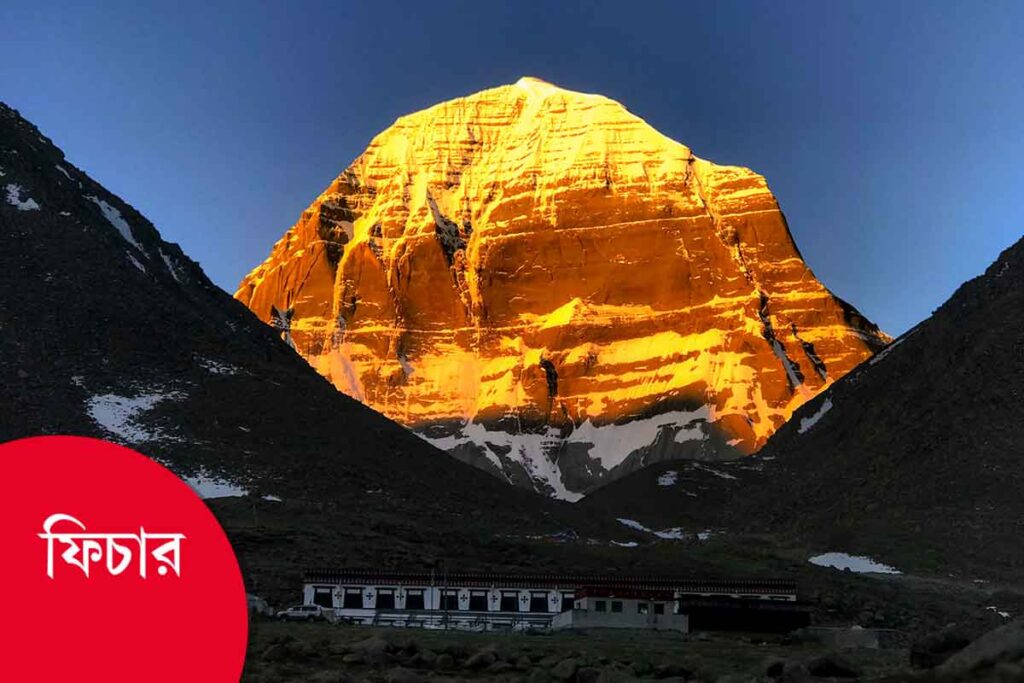
Here is why no one ever climbed Mount Kailash
Mount Kailash The Unconquered Summit of Ancient Mystery
In the far western reaches of the Tibetan plateau stands a mountain unlike any other. Mount Kailash, known in Nepal as Gang Rinpoche, meaning “precious jewel of snow,” is not merely a geological formation. It is a profound enigma, a whispered legend, and a sacred cornerstone for billions. While countless mountaineers have scaled the dizzying heights of Mount Everest, a peak significantly taller, Kailash remains an unconquered sanctuary. Its summit has never been touched by human feet in recorded history, giving rise to an enduring question: why?
Ancient scriptures, particularly the Shiva Purana, paint a vivid picture of Kailash as the eternal abode of Lord Shiva and Goddess Parvati, a place “adorned with various jewels.” This spiritual grandeur permeates the very air around it, transforming the mountain into a mystical beacon. For centuries, pilgrims have journeyed to its base, undertaking the arduous circumambulation (parikrama), convinced they are treading upon hallowed ground, but none dare to ascend. Omni 360 News delves into the layers of mystery surrounding this singular peak.
Whispers of Time and Ancient Structures
The allure of Kailash has drawn not only spiritual seekers but also curious explorers and researchers. Among them was the Russian doctor, Ernst Muldashev, who, along with his team, embarked on an expedition in 1999. Their return sparked widespread debate with their extraordinary claims. Muldashev asserted that Kailash is no ordinary mountain but a colossal, ancient pyramid, perhaps even part of a larger complex of structures, deliberately constructed, not naturally formed. He proposed it is hollow, sheltering vast internal caves where representatives of a primordial civilization continue to meditate, an “other world within Earth.”
More astonishing were the reports of time distortion. Muldashev and others who ventured near the peak spoke of a peculiar temporal anomaly. It was claimed that time itself beats to a different drum here, accelerating the aging process. Anecdotes, often shared among those who have pilgrimaged there, describe hair and nails growing at an astonishing rate in a matter of days or weeks, as if years had passed. These accounts, while lacking conventional scientific validation, echo the fantastical elements of cinematic narratives where time flows differently, leaving a profound impact on those who experience it.
A Confluence of Sacred Waters and Cultures
The geographical setting of Kailash only amplifies its mystique. At its foot lie two remarkable lakes, polar opposites in character yet intertwined in legend. Manasarovar, known as the “Lake of the Gods,” is a freshwater expanse, its pristine waters believed to possess purifying powers, a place where deities themselves are said to bathe. Nearby, lies Rakshastal, or the “Lake of Demons,” a saltwater lake, often described as barren and forbidding. Hindu mythology recounts that the demon king Ravana performed intense penance for Lord Shiva on the shores of Rakshastal, seeking immense power.
Beyond its lakes, Kailash serves as the fabled origin point for four of Asia’s most vital rivers: the Indus, the Sutlej, the Brahmaputra, and the Karnali (a major tributary of the Ganges). This unparalleled hydrological significance further cements its status as a cosmic axis, a pivotal point from which life-sustaining waters flow across vast civilizations. This confluence of natural wonder and profound spiritual belief is rarely seen anywhere else on the planet, making Kailash a truly unique phenomenon.
A Spiritual Magnet for Diverse Faiths
Kailash’s sacredness transcends the boundaries of a single religion. While it is the earthly abode of Lord Shiva in Hinduism, it holds equally profound significance for Buddhists, Jains, and followers of the indigenous Bön faith of Tibet. Buddhists believe it is where the tantric deity Heruka Chakrasamvara meditates. Jains consider it the place where their first Tirthankara, Rishabhanatha, attained liberation. For Bön adherents, it is the home of the sky goddess Sipaimen, a cosmic axis connecting heaven and earth. This multi-religious reverence transforms Kailash into a universal spiritual magnet, a place of convergence for diverse paths seeking enlightenment and connection.
At 6,638 meters (21,778 feet), Kailash is not exceptionally tall by Himalayan standards; Everest towers over it by more than 2,000 meters. Yet, its relatively modest height has not made it any less formidable. The sheer number of attempts on Everest, and the successful ascents of countless other higher peaks, only deepen the mystery surrounding Kailash’s untouched summit.
The Unseen Guardians and Legal Barriers
What prevents humanity from conquering this peak? The answer lies in a combination of reported supernatural occurrences, extreme physical challenges, and, crucially, legal restrictions.
Stories abound of climbers being inexplicably turned back. Accounts often speak of sudden, dramatic shifts in weather conditions; a clear, sunny day can instantaneously transform into a raging blizzard, rendering ascent impossible. Others report encountering vast, unexpected fissures opening up on the slopes, blocking their path. There are also chilling narratives, particularly from a group of Siberian mountaineers, who allegedly experienced rapid aging, akin to the time dilation depicted in science fiction, forcing them to retreat in terror, prematurely aged by hours that felt like years.
Some theories point to an unseen force. Speculation includes the presence of a powerful, undiscovered magnetic field that disorients climbers and interferes with equipment, though scientific evidence for this remains elusive. Others suggest the mountain’s unusually steep slopes, often exceeding 60 degrees, present an almost insurmountable technical challenge, even for the most experienced climbers.
However, perhaps the most definitive barrier today is a human one. The Chinese government, which administers the region, has officially prohibited all attempts to climb Mount Kailash. This decision stems from a deep respect for the mountain’s profound religious significance to millions worldwide and a commitment to preserving its pristine environment. While pilgrims are permitted to undertake the arduous circumambulation, any attempt to ascend the summit is now considered illegal. This official stance has effectively closed the door on modern mountaineering efforts, cementing Kailash’s status as an unconquered peak, not just by natural design but by human decree.
Mount Kailash stands as a testament to the enduring power of mystery and faith. It is a monument to the unknown, a place where the spiritual and the physical intertwine, daring humanity to look beyond conventional understanding. For Omni 360 News, the story of Kailash is a reminder that some wonders are meant to be revered from afar, their secrets held close by nature itself, inspiring awe and wonder for generations to come.
Key Takeaways:
* Mount Kailash in Tibet is a sacred and mysterious mountain, revered by Hindus, Buddhists, Jains, and Bön.
* Unlike Everest, its summit remains unconquered, sparking numerous theories and legends.
* Reports from expeditions, including Dr. Ernst Muldashev’s, claim Kailash might be an ancient, hollow pyramid structure where time operates differently.
* Pilgrims and explorers have described strange phenomena such as rapid aging, sudden weather changes, and unexplainable obstacles that prevent ascent.
* Geographically, it hosts the sacred freshwater Manasarovar and saltwater Rakshastal lakes, and is the source of four major Asian rivers.
* The Chinese government has officially prohibited climbing Mount Kailash for religious and environmental preservation, making any ascent illegal.
* Kailash continues to be an unparalleled enigma, a symbol of spirituality and the unconquered wild.