Noida workers protest low wages: ‘We work 12 hours a day, earn just ₹13,000’
# Noida Workers Protest 12-Hour Shifts, Low Pay
**By Staff Reporter, The Metro Chronicler**
**April 13, 2026**
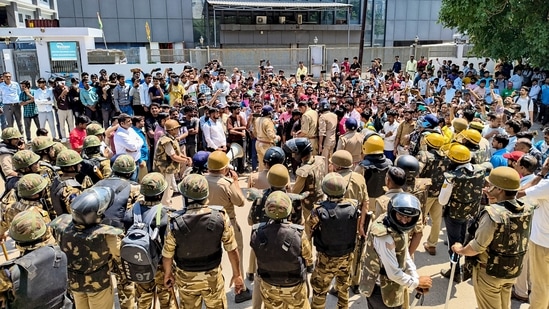
Thousands of factory workers in Noida’s sprawling industrial sectors launched indefinite protests on Monday, April 13, 2026, demanding fair compensation, regulated working hours, and an end to labor exploitation. Strikers are voicing intense frustration over stagnant wages juxtaposed with soaring inflation across the National Capital Region (NCR). With many laborers reporting grueling 12-hour daily shifts for a meager ₹13,000 per month, the unrest has temporarily halted production lines across several major manufacturing hubs. This standoff highlights systemic wage stagnation, prompting urgent calls for government intervention to enforce state minimum wage laws. [Source: Hindustan Times].
## The Spark: Overworked and Underpaid
The current wave of industrial action in Noida—one of India’s premier manufacturing and IT hubs—has been brewing for months. The catalyst for the ongoing protests is the stark disparity between the arduous labor demanded of factory workers and the financial compensation they receive. Workers across garment manufacturing, auto parts, and electronics assembly lines have abandoned their stations, gathering outside factory gates with placards demanding an immediate revision of basic pay structures.
The core grievance is mathematically stark. According to the agitating workers, standard operational expectations have quietly shifted from the legally mandated 8-hour workday to mandatory 12-hour shifts. Despite this 50% increase in daily working hours, compensation has remained rigidly anchored to baseline minimums.
“Our salary is very low. I earn ₹13,000 a month. And I work 12 hours a day,” one factory worker said during the ongoing protests, capturing the widespread sentiment of the labor force [Source: Hindustan Times].
Under the Factories Act and current occupational guidelines, any work beyond 8 hours a day or 48 hours a week is classified as overtime, which legally must be compensated at twice the ordinary rate of wages. However, on-the-ground reports suggest a rampant circumvention of these laws, with employers allegedly bundling grueling overtime into a flat, non-negotiable monthly rate of ₹13,000 (approximately $155 USD).
## Cost of Living Crisis in the NCR
To understand the desperation driving the Noida protests, one must contextualize a ₹13,000 salary within the harsh economic realities of the National Capital Region in 2026. Over the past three years, post-pandemic inflation, combined with rising energy and real estate costs, has severely eroded the purchasing power of the working class.
Noida draws hundreds of thousands of migrant workers from neighboring states like Bihar, Uttar Pradesh, and West Bengal. These workers typically reside in densely populated urban villages and unauthorized colonies such as Mamura, Chotpur, and Nithari, where living conditions are cramped, and rents are steadily climbing.
**Estimated Monthly Expenses for a Working-Class Family of Four in Noida (2026):**
| Expense Category | Average Monthly Cost (₹) |
| :— | :— |
| Rent (Single Room with shared amenities) | 4,500 – 6,000 |
| Basic Groceries & Provisions | 6,000 – 7,500 |
| Utilities (Electricity, Water, Cooking Gas) | 1,500 – 2,000 |
| Transportation (Auto/Bus fares) | 1,200 – 1,800 |
| Medical and Educational Expenses | 2,000 – 3,500 |
| **Total Estimated Survival Budget** | **₹15,200 – ₹20,800** |
*Data Context: Based on current public economic indices for the NCR.*
As the data illustrates, a take-home pay of ₹13,000 falls significantly short of a family’s basic survival needs. This deficit forces workers into cycles of high-interest micro-debt, further entrenching them in poverty despite working up to 72 hours a week. [Source: Public Economic Data / NCR Cost of Living Index].
## Voices from the Picket Line
The atmosphere at the protest sites across Noida’s Phase 2 and Phase 3 industrial sectors is a mix of exhaustion and resolute defiance. Workers from various industrial backgrounds have united under makeshift banners, chanting slogans demanding dignity and fair pay.
Many protesters highlight that the ₹13,000 figure is often a gross amount, subject to deductions. “By the time contractors take their cut, and penalties for taking a sick day are applied, we are left with barely ₹11,000,” explained Ramesh Kumar, a 34-year-old electronics assembly worker who has been with his current employer for four years. “We are building smart devices and luxury goods, but we cannot afford to buy fresh milk for our children.”
Female workers, who make up a substantial portion of the garment manufacturing sector in Noida, are particularly vulnerable. They report facing not only grueling hours but also a lack of adequate sanitary facilities and night-shift transport safety. “When you work a 12-hour shift, you leave home in the dark and return in the dark. There is no life left, only the machine,” stated Sunita Devi, a textile worker participating in the strike.
## Labor Laws and The Contractor Loophole
A significant structural issue fueling the protests is the rampant contractualization of the industrial workforce. Very few of the protesting workers are technically employed directly by the factories where they labor. Instead, they are hired through third-party staffing agencies and labor contractors.
This tripartite relationship creates a deliberate diffusion of responsibility. When workers demand higher pay, factory management often points to the contractors, claiming they pay the agencies a fair gross amount. Contractors, in turn, cite high operational costs and narrow margins to justify the low wages passed down to the actual laborers.
Furthermore, this setup frequently allows employers to bypass mandatory social security contributions. Many workers protesting in Noida claim they do not have access to Employee State Insurance (ESI) for healthcare or Provident Fund (PF) accounts for retirement savings, despite legal mandates requiring these benefits for workers earning up to ₹21,000 per month.
While Uttar Pradesh periodically revises its minimum wage structures, enforcement remains a critical bottleneck. Labor unions assert that the State Labor Department is severely understaffed, leading to infrequent factory inspections and widespread impunity for non-compliant employers.
## Economic Impact on Supply Chains
The strikes are beginning to send ripples through the broader regional economy. Noida is a vital cog in India’s “Make in India” manufacturing initiative, serving as a primary hub for mobile phone manufacturing, consumer durables, and export-oriented apparel.
Prolonged work stoppages threaten to disrupt delivery schedules for major domestic brands and international exporters alike. Several Micro, Small, and Medium Enterprises (MSMEs) that act as ancillary suppliers to larger factories have already reported a slowdown in orders due to the gridlock.
Industry associations, such as the Noida Entrepreneurs Association (NEA), have expressed concern over the unrest. Factory owners argue that they are currently squeezed between aggressive global price competition, rising raw material costs, and shrinking profit margins, leaving little room for sudden, sweeping wage hikes. However, critics maintain that relying on suppressed wages to remain competitive is an unsustainable business model that ultimately harms the broader economy by stunting consumer demand.
## Expert Analysis on Industrial Unrest
Labor economists warn that the situation in Noida is indicative of a broader national challenge regarding job quality and wealth distribution.
“What we are witnessing in Noida is the breaking point of the low-wage, high-output manufacturing model,” says Dr. Meera Chandran, a senior fellow and labor economist at the Institute for Industrial Development (IID). “When inflation outpaces nominal wage growth for half a decade, working-class resilience snaps. The claim of ₹13,000 for 12 hours of labor is not just a violation of the Minimum Wages Act; it is a severe breach of human capital sustainability. If India wants to move up the global value chain, it cannot do so on the backs of an undernourished, over-exhausted workforce.”
Dr. Chandran notes that the failure to pay statutory overtime is one of the most common, yet least prosecuted, corporate crimes in India’s informal and semi-formal industrial sectors. [Source: Independent Economic Analysis].
## Government Response and Mediation Efforts
In response to the escalating situation, the Gautam Buddha Nagar district administration and the Deputy Labor Commissioner’s office have initiated preliminary steps to defuse the tension.
Officials have announced the formation of a tri-partite mediation committee, comprising representatives from worker unions, factory management boards, and state labor officers. The primary mandate of this committee is to audit the payment registers of the targeted factories to verify the claims regarding unpaid overtime and sub-minimum wages.
Police presence has been heavily bolstered in key industrial sectors to prevent any escalation of violence, though the protests have remained largely peaceful to date. Local authorities have urged workers to return to their stations while negotiations proceed, but union leaders have so far refused to call off the strike until concrete, written commitments regarding wage hikes and strict 8-hour shift compliance are secured.
## Conclusion: A Turning Point for Labor Rights?
The Noida factory protests of April 2026 represent more than just a localized dispute over a ₹13,000 paycheck; they serve as a critical stress test for India’s industrial labor policies. As the cost of living continues its upward trajectory, the traditional model of leveraging ultra-cheap labor for manufacturing competitiveness is facing unprecedented pushback from the very workers who sustain it.
**Key Takeaways:**
* **Severe Wage Discrepancy:** Workers are being paid ₹13,000 for 12-hour shifts, well below legal and living standards when factoring in unpaid overtime.
* **Systemic Failures:** The reliance on third-party labor contractors has allowed factories to evade legal responsibilities regarding fair pay and social security.
* **Economic Impasse:** While factory owners cite tight margins, workers are pushed to the brink of poverty by relentless NCR inflation.
* **Immediate Outlook:** The duration and resolution of these strikes will likely set a precedent for wage negotiations across North India’s industrial belts.
Whether this unrest will catalyze systemic reform in labor law enforcement or end in a temporary, stop-gap compromise remains to be seen. However, the voices echoing through Noida’s industrial sectors make one thing clear: the current dynamic is fundamentally unsustainable, and the demand for a living wage can no longer be ignored.