“Not a Single Pomegranate Can Enter from Afghanistan, but Terrorists Can”: Maulana Fazlur Rehman Roasts Pakistan’s Border Policy
A Caustic Critique of a Failing Frontier
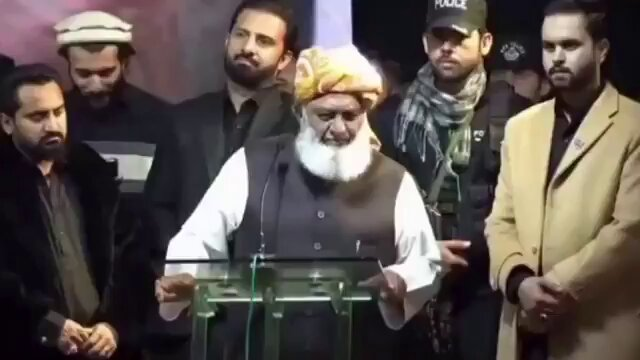
In a scathing indictment of Pakistan’s internal security and diplomatic framework, Maulana Fazlur Rehman, the chief of Jamiat Ulema-e-Islam (JUI-F), has ignited a firestorm with his recent remarks concerning the porous nature of the Durand Line. Addressing a massive public gathering in Rawalpindi on Sunday, February 8, 2026, the veteran politician utilized a biting metaphor to highlight what he describes as the “miserable failure” of the state’s Afghan policy.
Rehman’s central grievance revolves around a perceived contradiction in the Pakistani establishment’s logic: while legitimate trade symbolized by the humble pomegranate is strangled by bureaucracy and border closures, militant elements allegedly move across the frontier with impunity. His comments come at a time of peak tension following a devastating suicide bombing at an Islamabad mosque that claimed at least 69 lives, further straining the already frayed relations between Islamabad and the Taliban-led administration in Kabul.
The ‘Pomegranate’ Metaphor: Dissecting the Speech
Maulana Fazlur Rehman, a figure who has historically navigated the complex intersection of religious politics and statecraft, did not mince words. His rhetoric targeted the very heart of Pakistan’s security narrative.
“In all these decades, we never paused to ask why our Afghan policy failed so miserably. Today, not a single pomegranate or melon can enter Pakistan from Afghanistan due to restrictions, yet you claim terrorists keep crossing the border,” Rehman remarked with a dry, caustic smile. “If they are coming, stop them. If they are coming, eliminate them. The Afghan government has never objected to you taking action on your own side.”
The “pomegranate” reference serves as more than just a colorful anecdote; it is a direct jab at the economic strangulation of the border regions. For months, trade transit points like Torkham and Chaman have seen frequent closures, leaving thousands of trucks carrying perishable Afghan produce to rot. By juxtaposing the blockage of fruit with the alleged movement of armed militants, Rehman effectively accused the state of being “selectively competent” capable of stopping commerce but seemingly incapable of securing the sovereign border against kinetic threats.
Historical Failure: “78 Years of Missteps”
The JUI-F leader expanded his critique beyond current events, framing the present crisis as the culmination of 78 years of strategic blunders. He questioned the long-term efficacy of Pakistan’s engagement with its neighbor, noting that regardless of the regime in Kabul be it the monarchy of Zahir Shah, the Communists, the Mujahideen, or the various incarnations of the Taliban Pakistan has failed to foster a stable, cooperative relationship.
Rehman’s analysis suggests a deep-seated institutional flaw. He argued that Pakistan’s foreign policy is not the product of civilian deliberation but is dictated by the military establishment. “One general comes and says we will negotiate; another comes and says we will wage war,” he stated, highlighting a lack of continuity and democratic oversight that has led to regional isolation.
Regional Isolation and the Breakdown of Trust
A significant portion of Rehman’s “roast” was dedicated to Pakistan’s dwindling list of allies. He painted a grim picture of a nation surrounded by “unhappy neighbors.”
- India: Remains a perennial antagonist.
- Afghanistan: Relations are at an all-time low due to mutual accusations of harboring proxies.
- Iran: Tensions have simmered over border security and sectarian dynamics.
- China: Perhaps most alarmingly, Rehman claimed that even Beijing Pakistan’s “all-weather friend” has grown weary.
Regarding the China-Pakistan Economic Corridor (CPEC), Rehman alleged that the project has effectively stalled. He claimed that Chinese leadership no longer trusts the current administration to provide the necessary security or political stability for high-value investments. “Has even a single brick moved under this government?” he asked rhetorically, suggesting that the flagship infrastructure project is now a shadow of its former self.
The Catalyst: The Islamabad Mosque Bombing
The timing of Rehman’s outburst is critical. On Friday, February 6, 2026, a suicide bomber targeted the Imambargah Qasr-i-Khadijatul Kubra in Islamabad’s Tarlai area during Friday prayers. The scale of the carnage over 240 casualties in total sent shockwaves through the capital.
In the immediate aftermath, Pakistan’s Defence Minister, Khawaja Asif, took to social media to allege that the attacker had traveled from Afghanistan. This “blame-game” has become a standard diplomatic ritual between the two nations. However, the Taliban’s Ministry of National Defence swiftly rubbished the claims, calling them “irresponsible” and urging Pakistan to look inward at its own “security lapses.”
Rehman’s speech reflects a growing domestic exhaustion with this narrative. By mocking the “terrorist entry” claim, he is siding with a segment of the public that believes “external threats” are often used as a smokescreen for “internal incompetence.”
Fact-Check: Cross-Border Realities
To provide an objective lens, it is necessary to cross-reference Rehman’s claims with independent data:
- Trade Barriers: According to recent trade reports, bilateral trade between Pakistan and Afghanistan dropped by nearly 17% in the last fiscal quarter due to frequent border closures and new visa requirements for truck drivers.
- Security Incidents: The Center for Research and Security Studies (CRSS) indicates that while border fencing exists, the rugged terrain makes a 100% “seal” nearly impossible. However, the discrepancy between “zero trade” and “active militant transit” remains a point of intense debate among security analysts.
- The Afghan Stance: The Taliban administration has consistently denied providing “safe havens” to the TTP (Tehreek-e-Taliban Pakistan), though UN monitoring reports continue to suggest a significant militant presence on Afghan soil.
The Political Fallout
Maulana Fazlur Rehman is not the only voice of dissent. Aimal Wali Khan of the Awami National Party (ANP) has echoed similar sentiments, recently stating that “terrorism cannot be eliminated through military operations alone.” Khan also accused former military and political leaders including Gen. Qamar Javed Bajwa and Imran Khan of facilitating the “resettlement” of militants in Khyber Pakhtunkhwa.
The alignment of these disparate political forces suggests a burgeoning “anti-establishment” sentiment in the border provinces, where the local population bears the brunt of both militant violence and the economic fallout of closed trade routes.
Conclusion: A Nation at a Crossroads
Rehman’s “pomegranate” speech is a watershed moment in Pakistani political discourse. It marks a departure from the traditional “patriotism” expected of high-profile leaders during national tragedies. Instead, it offers a brutally honest reflection of a state struggling to reconcile its security imperatives with its economic survival.
As Islamabad continues to grapple with rising inflation, a stalled CPEC, and a resurgent TTP, the words of the JUI-F chief serve as a reminder: a border that is closed to pomegranates but open to extremists is not a border, it is a liability.