‘Not Kashmir’: Rajasthan's Bikaner turns white after intense hailstorm
Bikaner’s April Freeze A Stark Contrast From Last Year’s Scorcher Key Takeaways
The heart of Rajasthan, Bikaner, a city synonymous with scorching deserts and relentless heat, recently witnessed an astonishing weather event that has left locals and meteorologists alike pondering. On April 4th, as much of India braced for the onset of summer, Bikaner experienced a significant dip in temperature, registering a cool 30 degrees Celsius. This figure stands in stark contrast to the blistering 40 degrees Celsius recorded on the exact same date just one year prior, a difference that tells a compelling story of nature’s unpredictable shifts.
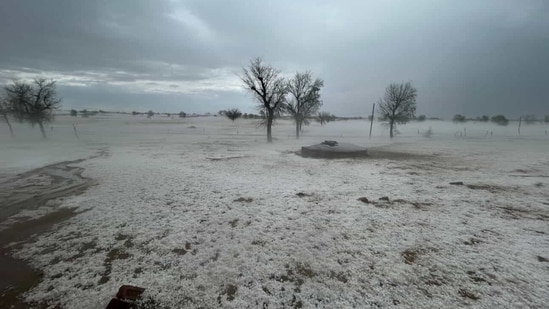
This unusual chill was not merely a gentle breeze; it was accompanied by an intense hailstorm that transformed the arid landscape into an unexpected white canvas. For a region known for its golden sands, seeing streets and fields blanketed in hailstones felt like a scene plucked from an entirely different climate zone. Local reports from outlets like Rajasthan Patrika and Dainik Bhaskar’s Bikaner editions widely covered the phenomenon, highlighting the sheer surprise and mixed reactions among residents.
An Unseasonal Turn in the Desert City
Bikaner’s weather typically begins its ascent towards extreme heat by April, with temperatures regularly soaring above 40 degrees Celsius, sometimes even touching 45 degrees. Residents are accustomed to seeking refuge indoors, limiting outdoor activities to cooler morning or evening hours. The sudden ten-degree drop from the previous year’s mark on the same day is therefore not just a statistical anomaly but a tangible experience for everyone in the region. Images circulating across local news channels and social media, often verified by reporters from News18 Rajasthan and ETV Bharat Rajasthan, showed layers of ice covering vehicles and rooftops, giving the impression of a winter wonderland rather than a pre-summer scene in a desert city.
The hailstorm itself was described by many as unprecedented in its intensity for this time of year. Eyewitnesses recounted hailstones ranging from pea-sized to small marbles, falling for an extended period, creating a veritable carpet of ice. While a momentary spectacle for some, it was a stark reminder of the capricious nature of weather.
The Impact on Life and Livelihoods
While the novelty of snow-like scenery might offer a momentary thrill, the unseasonal weather event carries significant implications, particularly for the agrarian community. Bikaner and its surrounding areas are crucial for various crops, including wheat, mustard, cumin, and gram. Farmers, already contending with the inherent challenges of desert agriculture, now face the potential devastation wrought by sudden hailstorms and accompanying heavy rains. Local farming associations expressed deep concern, with many lamenting the damage to standing crops that were nearing harvest. Such extreme weather events can wipe out months of hard work and investment, plunging families into financial distress.
Beyond agriculture, daily life was also disrupted. Commutes became hazardous, and outdoor markets, a staple of Bikaner’s economy, saw reduced activity. The surprise element meant many were unprepared for the sudden cold and wet conditions, leading to discomfort and minor inconveniences across the city. Omni 360 News believes in bringing these localized impacts to the forefront, highlighting how global weather patterns manifest in specific communities.
Understanding the Meteorological Anomaly
For a 12th-grade student trying to grasp this phenomenon, it helps to understand that weather isn’t always linear. While Bikaner is hot, its weather is still influenced by larger systems. This unseasonal weather event can be largely attributed to a phenomenon known as ‘Western Disturbances’. These are weather systems that originate in the Mediterranean region and bring sudden winter rain and snow to the northwestern parts of the Indian subcontinent. While typically active during the winter months, their influence can occasionally extend into early spring, bringing unseasonal precipitation and a dip in temperatures.
Coupled with localized atmospheric conditions, these disturbances can lead to significant weather changes. When warm, moist air meets cold air at higher altitudes, it can create conditions ripe for thunderstorms and, if the freezing level is low enough, hailstorms. This unusual confluence of factors led to Bikaner’s surprising cold snap and white landscape in what should traditionally be a warming April.
A Glimpse into Changing Climates
The Bikaner incident serves as more than just a local weather story; it’s a poignant reminder of broader climate shifts. Increasingly, regions across the globe are experiencing weather patterns that defy historical norms. From extreme heatwaves in temperate zones to unseasonal cold and torrential downpours in arid regions, the planet’s climate system appears to be in a state of flux. Such events underscore the urgent need to understand and adapt to these evolving climatic realities. Omni 360 News consistently tracks these localized changes, recognizing their collective significance.
Key Takeaways
* Bikaner, a historically hot desert region, experienced an unseasonal drop to 30 degrees Celsius on April 4th, a significant 10-degree dip from the previous year’s 40 degrees on the same date.
* The temperature fall was accompanied by an intense hailstorm, blanketing parts of the city in a thick layer of ice, a rare sight for early April.
* The event has caused considerable concern for farmers, threatening damage to crucial crops like wheat, mustard, and cumin nearing harvest.
* Meteorologically, such events are often linked to the lingering effects of Western Disturbances, which bring moisture and cooler air from the Mediterranean, extending their influence beyond typical winter months.
* This specific incident highlights the increasing unpredictability of regional weather patterns, prompting discussions about broader climate change impacts and the need for greater preparedness.