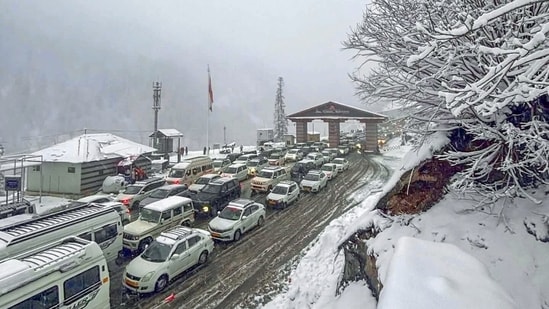
Over 1,000 vehicles stuck at Atal Tunnel stretch after heavy snowfall in Manali| India News
BRO’s Winter Warriors Restore Access at South Portal After Heavy Snowfall
Winter’s grip often brings breathtaking beauty but also formidable challenges to India’s high-altitude regions. As heavy snowfall recently blanketed parts of Himachal Pradesh, rendering crucial routes impassable, the Border Roads Organisation, or BRO, once again stepped into action. Their dedicated teams are currently engaged in extensive snow clearance operations at the South Portal, working tirelessly to restore movement and ensure essential connectivity along the vital axis.
For communities nestled amidst the towering Himalayas, and for the nation’s strategic interests, these routes are nothing short of lifelines. When winter unleashes its fury, dumping several feet of snow, roads vanish under white blankets, cutting off regions from supplies, medical aid, and the rest of the country. This is where the BRO’s relentless efforts become paramount, and the recent situation at the South Portal highlights their unwavering commitment.
The Challenge at the South Portal
The South Portal, often referencing the entrance to the Atal Tunnel from the Manali side, is a critical gateway. Its closure due to snow does not just inconvenience travellers; it disrupts the flow of goods, affects local livelihoods, and impacts military movements. Local reports from Manali indicate that several feet of fresh snow accumulated over recent days, making vehicular passage treacherous, if not impossible. The sheer volume of snow, combined with sub-zero temperatures and strong winds, presents a formidable obstacle for any clearance operation. Roads become slick with ice, and the risk of avalanches adds another layer of danger for the working personnel.
BRO’s Coordinated Response
As soon as weather conditions allowed for safe operations, BRO personnel, often referred to as ‘Snow Warriors,’ mobilized their heavy machinery. State-of-the-art snow cutters, excavators, dozers, and JCBs were deployed to systematically clear the accumulated snow. This isn’t just about pushing snow aside; it requires precision. Teams work in shifts, often around the clock, battling the biting cold and unpredictable mountain weather.
A local journalist covering the operations for the ‘Himalayan Echo’ noted the methodical approach: “They start from specific points, often from both ends if possible, slowly chipping away at the dense snow. It’s a grueling process, inch by inch, ensuring that the road surface underneath remains intact and safe for traffic.” This careful methodology prevents damage to the road infrastructure and ensures longevity, a detail Omni 360 News finds crucial in understanding the complexity of such tasks.
The BRO’s engineers and labourers are not merely operating machines; they are navigating treacherous terrain. Steep inclines, sharp bends, and narrow passages all add to the difficulty. Safety protocols are stringent, with continuous monitoring for avalanche risks and proper communication channels maintained to ensure the well-being of every individual involved in the operation.
Why This Connectivity Matters
The road through the South Portal and onwards is more than just a path; it’s an economic artery and a strategic necessity. For residents of Lahaul and Spiti valleys, it connects them to markets, healthcare facilities in Manali, and the wider world, especially during winter months when other passes are completely sealed. Tourism, a significant revenue generator for Himachal Pradesh, relies heavily on accessible roads, even in winter. Local businesses, dependent on the influx of visitors and the movement of goods, feel the immediate impact of closures.
From a national security perspective, maintaining year-round connectivity in border regions is non-negotiable. The BRO, primarily tasked with developing and maintaining road networks in India’s border areas, plays a crucial role in enabling troop movements and logistical support to forward posts. The speed and efficiency of their snow clearance operations directly translate to national preparedness.
BRO’s Enduring Legacy
For decades, the Border Roads Organisation has been at the forefront of tackling some of the toughest engineering and logistical challenges in the country. Their operations are not confined to snow clearance; they construct roads in deserts, build bridges over raging rivers, and carve pathways through dense forests. Their commitment to infrastructure development in harsh environments is unparalleled. Each winter, their ‘Project Deepak’ in Himachal Pradesh or ‘Project Himank’ in Ladakh becomes synonymous with resilience and determination, ensuring that isolation does not become a permanent state for mountain communities.
These operations are planned months in advance. Pre-winter assessments, machinery readiness, fuel stockpiles, and personnel training are all part of a comprehensive strategy. Yet, every winter brings its own unique set of challenges, demanding adaptability and quick thinking from the BRO teams on the ground.
Key Takeaways
* The Border Roads Organisation (BRO) is actively clearing heavy snow at the South Portal to restore vital road connectivity.
* Operations involve heavy machinery and dedicated personnel working in challenging, sub-zero conditions.
* This route is critical for local communities’ access to essential services and markets, bolstering the regional economy.
* Maintaining year-round access holds significant strategic importance for national security and border area logistics.
* The BRO’s consistent efforts underscore their pivotal role in connecting remote regions and overcoming environmental adversities.
As the roar of snow cutters echoes through the mountains, it signals progress. With each meter cleared, the hope for renewed movement strengthens. The BRO’s winter warriors continue their dedicated mission, proving that even the heaviest snowfall cannot deter their resolve to keep India’s mountain lifelines open. Omni 360 News will continue to track these crucial developments as the BRO works to reconnect these vital arteries.