Russian deputy PM meets PM Modi and EAM Jaishankar| India News
India Russia Deliberate Global Stability and West Asia Dynamics
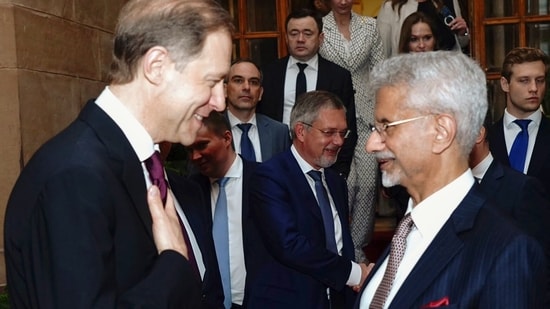
In a significant diplomatic engagement, India’s External Affairs Minister S. Jaishankar and Russian Deputy Prime Minister Denis Manturov recently held extensive discussions in New Delhi, charting a course for strengthened bilateral cooperation and addressing pressing global challenges. While the core agenda revolved around deepening the “special and privileged strategic partnership” between the two nations across various sectors, a crucial aspect of their dialogue centered on evolving regional and global developments, particularly the intricate conflict unfolding in West Asia.
The high-level meeting underscored the enduring nature of the India-Russia relationship, a bond built on decades of collaboration in trade, economic, investment, scientific, technical, and cultural spheres. Mr. Manturov, also co-chairing the 24th India-Russia Inter-Governmental Commission on Trade, Economic, Scientific, Technical and Cultural Cooperation (IRIGC-TEC), delivered a message from Russian President Vladimir Putin to Prime Minister Narendra Modi, further solidifying the strategic alignment. Prime Minister Modi, in turn, expressed appreciation for Russia’s support during India’s G20 presidency, highlighting the mutual respect and cooperative spirit. The discussions between Mr. Jaishankar and Mr. Manturov delved into reviewing the progress of ongoing bilateral projects, especially in critical areas like energy, defense, and broader trade relations, signaling a robust momentum in their joint endeavors.
The Critical Focus on West Asia
Beyond the bilateral blueprint, the deliberation on the West Asia conflict emerged as a pivotal element of their exchange. This region, a vital crossroads of global geopolitics and a crucial source of energy, remains a flashpoint with far-reaching consequences for international peace and stability. For both India and Russia, the developments in West Asia carry substantial weight, influencing energy security, trade routes, and the broader global security landscape.
Understanding the complexities of the West Asia situation is paramount. Imagine a bustling, interconnected neighborhood where different families, each with their own history and interests, live in close proximity. Sometimes, disagreements escalate, leading to larger issues that affect everyone. That’s a simplified way to view West Asia – a region with numerous countries, diverse populations, historical grievances, and significant external influences, all contributing to ongoing tensions and conflicts. These conflicts often involve a mix of state and non-state actors, making solutions incredibly challenging.
For India, stability in West Asia is directly linked to its energy needs, as a significant portion of its oil and gas imports originate from the region. Furthermore, millions of Indian expatriates reside and work there, making their safety and well-being a primary concern. Any major escalation can disrupt supply chains, impact global oil prices, and create humanitarian crises that demand international attention. Russia, on the other hand, maintains deep historical and strategic ties with several countries in the region. Its involvement is driven by geopolitical interests, including counter-terrorism efforts, maintaining its influence, and navigating the shifting power dynamics.
During their discussion, Mr. Jaishankar and Mr. Manturov likely explored various dimensions of the conflict. This would include its humanitarian toll, the potential for regional spillover, and the broader implications for international law and global order. While specific details of their nuanced conversation were not publicly disclosed, such high-level dialogues typically aim to find common ground on de-escalation, discuss pathways to peace, and perhaps coordinate diplomatic approaches in multilateral forums. Both nations, as significant global players, generally advocate for peaceful resolutions through dialogue and diplomacy, rather than military escalation, even if their specific tactical approaches might differ. They understand that prolonged instability in one critical region can send ripple effects across the entire global economy and security framework.
Broader Global Dynamics and Strategic Autonomy
The discussion extended beyond West Asia to encompass a wider array of global developments. This often includes topics like the evolving international economic order, challenges to multilateral institutions, and the importance of a multipolar world where power is distributed among several major players rather than concentrated in one or two. India, steadfast in its commitment to strategic autonomy, consistently seeks to maintain balanced relationships with all major global powers, navigating complex geopolitical currents to safeguard its national interests. This approach allows India to engage constructively on various platforms, contributing to global discourse without being constrained by bloc politics.
Russia, similarly, aims to project its influence on the global stage and seeks partners who respect its geopolitical interests. The ongoing dialogue with India, therefore, becomes a crucial channel for Moscow to discuss its perspectives on international affairs and to foster cooperation that can potentially counter a unipolar or overly centralized global order.
For Omni 360 News, these exchanges highlight the intricate dance of international diplomacy. They demonstrate that even amid geopolitical shifts and differing perspectives on certain issues, major nations continue to seek avenues for dialogue on shared concerns. Such direct conversations are indispensable for managing global crises, building understanding, and fostering an environment conducive to stability. It’s a testament to the fact that complex global challenges require collective deliberation and a willingness to engage, even when viewpoints may not perfectly align. These meetings are not just about signing agreements; they are about understanding each other’s fears, aspirations, and strategic calculus, which is the bedrock of any meaningful international relationship.
Key Takeaways
* The meeting between EAM Jaishankar and Russian Deputy PM Manturov reaffirmed the strong “special and privileged strategic partnership” between India and Russia.
* Discussions covered a broad spectrum, from bilateral trade and defense cooperation to significant regional and global developments.
* A key focus was the conflict in West Asia, reflecting its critical importance to both nations for energy security, regional stability, and geopolitical balance.
* Both countries likely emphasized diplomatic solutions and de-escalation in West Asia, despite potentially varied approaches.
* The dialogue underscores India’s strategic autonomy and Russia’s continued diplomatic outreach in navigating a complex global landscape.
* Such high-level interactions are vital for managing global challenges and fostering mutual understanding among major international players.