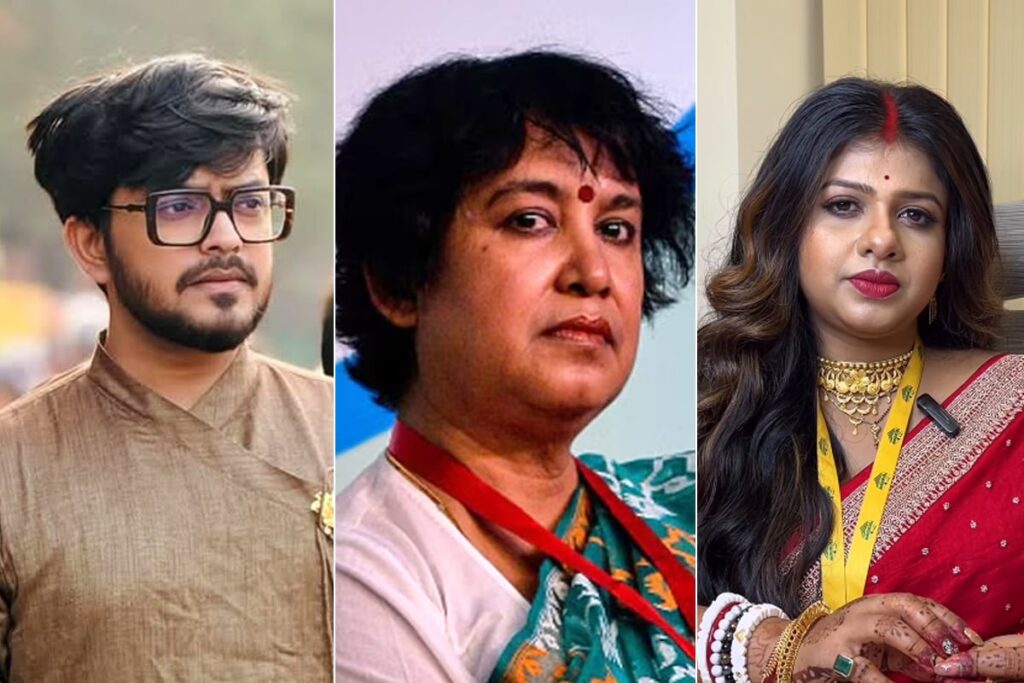
Taslima Nasrin Post on Sayak, Sushmita goes viral
Sayak Chakraborty Susmita Roy Online Dispute Taslima Nasrin Defends Personal Choices Omni 360 News
The digital realm often serves as a mirror to society’s evolving values, and sometimes, it becomes a contentious battleground for personal sagas. Recently, the online world has been buzzing with a heated exchange involving actor-influencer Sayak Chakraborty and his former sister-in-law, Susmita Roy. What began as a personal dispute swiftly escalated into a public spectacle, drawing widespread attention and sparking debates about privacy, personal conduct, and the responsibilities of public figures in the age of social media. Amidst the clamor, renowned writer Taslima Nasrin has offered a distinctive perspective, emphasizing individual liberty and consent, which has further fueled discussions across various online platforms.
For weeks, social media feeds have been inundated with posts outlining the virtual disagreements between Sayak Chakraborty and Susmita Roy. The conflict has seen both parties hurl serious allegations, turning private matters into public fodder. The core of the dispute appears to revolve around their past familial connections and deeply personal issues, including allegations concerning relationships, sexual preferences, and marital histories.
At one point, Susmita Roy’s estranged husband, Sabyasachi Chakraborty, reportedly accused her of having multiple marriages. In response, Susmita allegedly countered with claims of “perverted sexuality” against Sabyasachi. The controversy deepened with Susmita’s pointed remarks about Sayak Chakraborty’s alleged same-sex relationship, even hinting at a past medical incident related to a physical interaction with a partner. These exchanges have left many netizens bewildered, with some expressing discomfort over the intimate details being paraded publicly. The term ‘koltola culture,’ referring to street-side gossip, has been widely used by a segment of the online community to describe the nature of these virtual spats.
This ongoing drama has naturally led to a crucial question regarding the ethical boundaries and moral compass of influencers. As individuals who command significant online presence and shape public opinion, there’s an inherent expectation of a certain level of decorum. When personal grievances are aired in such a raw and unfiltered manner, it invariably raises questions about the impact on their audience, particularly younger followers who might look up to them. For Omni 360 News, tracking such narratives reveals a growing tension between the desire for authenticity in public figures and the need for discretion regarding extremely personal details.
Stepping into this maelstrom of opinion, Taslima Nasrin offered a viewpoint that staunchly defends individual choice and personal freedom. Her stance stands in stark contrast to the public’s tendency towards judgment and moral policing. Nasrin explicitly stated that she finds no fault in the actions being debated, whether it concerns same-sex relationships, consensual threesomes, or multiple marriages, as long as they are consensual and do not involve coercion or harm to others.
Reflecting on the specific allegations, Nasrin’s commentary underscored a liberal interpretation of personal relationships. Regarding Susmita’s claim about Sayak’s alleged same-sex relationship and related injury, Nasrin simply noted that such incidents can occur between partners and are not inherently “wrong.” She maintained that an injury in a consensual physical relationship is a private matter and does not constitute a moral failing. Similarly, concerning the accusation that Sabyasachi engaged in threesomes, Nasrin argued that if all partners consent, there is no issue. She extended this logic to Susmita’s alleged five marriages, suggesting that if an individual finds happiness or satisfaction in such choices and no one is forced, then it should be accepted.
Taslima Nasrin’s intervention has undeniably shifted the conversation. While many online users continued to express dismay at the perceived ‘lowering of standards’ in public discourse, Nasrin’s robust defense of personal autonomy provided a counter-narrative. Her comments highlight a fundamental tension in modern society: the clash between traditional moral frameworks and an increasingly vocal demand for individual liberty, particularly concerning non-normative relationships and lifestyle choices.
The saga of Sayak Chakraborty and Susmita Roy, amplified by Taslima Nasrin’s strong opinions, serves as more than just celebrity gossip. It’s a vivid illustration of how social media platforms have transformed into arenas where personal lives are dissected, moral codes are debated, and the very definition of ‘appropriate’ public behavior is constantly being reshaped. As influencers navigate their public and private lives, and as the audience consumes and reacts to these narratives, the discussion around individual freedom versus public accountability will undoubtedly continue to evolve. This ongoing dialogue is crucial for understanding the evolving landscape of digital interaction and societal values.
Key Takeaways:
* The Sayak Chakraborty and Susmita Roy online dispute has highlighted the growing trend of personal conflicts being aired publicly by influencers.
* The controversy has sparked widespread debate over ethical boundaries for public figures and the nature of online discourse, with many labeling it as ‘koltola culture.’
* Taslima Nasrin’s intervention introduced a strong defense of individual liberty, asserting that consensual same-sex relationships, threesomes, or multiple marriages are not inherently wrong.
* The incident underscores the ongoing societal tension between traditional moral expectations and the increasing advocacy for personal autonomy and diverse lifestyle choices in the digital age.