The Morning of 1950
The morning of 26 January 1950 holds a special place in the history of India. It was not just another winter morning. It was the day when India was officially reborn as a sovereign republic. From that moment, the country began its journey under a Constitution written by Indians, for Indians.
26 January is known as Republic Day. For most people, it means a national holiday. Schools, colleges, and offices remain closed. Tricolours are seen everywhere, patriotic songs play on television, and children proudly watch the parade. But the story of how this day began is far deeper and more meaningful.
On 26 January 1950, the Constitution of India came into force. With this, India stopped being governed by colonial-era laws and became a republic with its own system of governance. The Constitution replaced the Government of India Act of 1935 and gave the country a democratic structure based on justice, liberty, equality, and fraternity.
If we turn the pages of history, the memory of that morning in 1950 still shines brightly.
Delhi woke up to an atmosphere of celebration and hope. The city was decorated, and there was excitement in the air. Streets were filled with people, many of whom had lived through the struggle for independence just a few years earlier. They knew they were witnessing the birth of a new India.
People greeted one another with smiles and good wishes. Special prayers were held in temples across the city. The sense of pride was visible everywhere. India was no longer just free. It was now fully in charge of its own future.
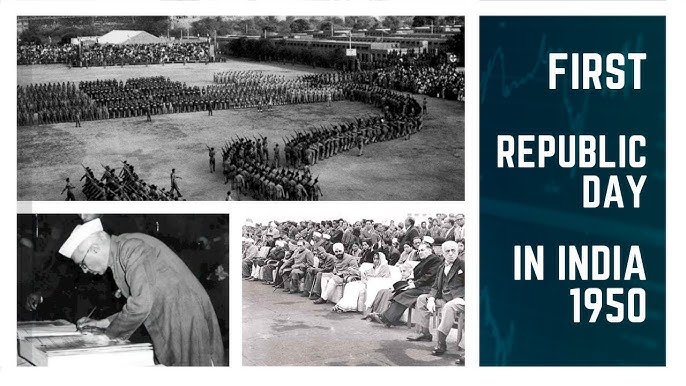
That day, Dr Rajendra Prasad took oath as the first President of India. He became the constitutional head of the nation. The oath was administered by C Rajagopalachari, a respected leader and statesman. Soon after, Prime Minister Jawaharlal Nehru and his Council of Ministers also took their oaths.
The main ceremony took place at Rajpath, which is known today as Kartavya Path. This location would later become the centre of Republic Day celebrations every year. The event marked the formal beginning of India’s republican journey.
One important tradition also began on that very first Republic Day. India invited a foreign leader as the Chief Guest. This was a symbolic step to show India’s friendship with the world. The first Chief Guest was Indonesia’s President Sukarno. His presence highlighted India’s support for newly independent nations and its growing role on the global stage.
In 1950, the Republic Day parade was held at the National Stadium. Unlike today’s grand and highly organised parades, the early celebrations were simpler but deeply emotional. In the evening, the President arrived in a horse-drawn carriage, a sight that many people remembered for years.
That year also marked another historic moment. For the first time, Indians witnessed an Air Force flypast. Fighter aircraft flying overhead filled people with pride and confidence in the country’s defence forces.
Over the years, Republic Day celebrations continued to evolve. From 1955 onwards, the parade became a regular annual event. Gradually, more elements were added. Tableaux representing different states and their cultures became part of the parade. The Indian Army, Navy, Air Force, and various paramilitary forces began marching with discipline and strength.
In 1959, another touching tradition was introduced. Brave children, known as “Veer Balaks”, were included in the parade. These children were honoured for their courage and selfless acts. In the early years, they rode elephants and waved to the crowd, becoming a symbol of young India’s bravery.
However, the biggest change brought by Republic Day was not the parade or celebrations. It was the Constitution itself.
The Constitution transformed India in a way no single event ever could. It gave voting rights to every adult citizen, regardless of caste, religion, gender, or wealth. Democracy was no longer limited to cities. It reached villages, towns, and remote corners of the country.
For the first time, ordinary Indians had the power to choose their leaders. The Constitution promised equality before law and protected fundamental rights. It laid the foundation for social justice and national unity.
India was a country of great diversity, languages, religions, and cultures. The Constitution gave this diversity a single democratic framework. It allowed people to remain different yet equal.
The journey since that morning in 1950 has not always been easy. India has faced challenges, debates, and changes. The Constitution itself has been amended many times to meet new needs. But its core values have remained strong.
Today, when we watch the Republic Day parade on television or attend flag hoisting ceremonies, we are not just celebrating a holiday. We are remembering the morning when India chose democracy, dignity, and self-rule.
That historic journey, which began on 26 January 1950, is what defines the strong and confident India we see today.