Turkey Warns of Rising Tensions as Israel Seen Seeking Chance to Strike Iran
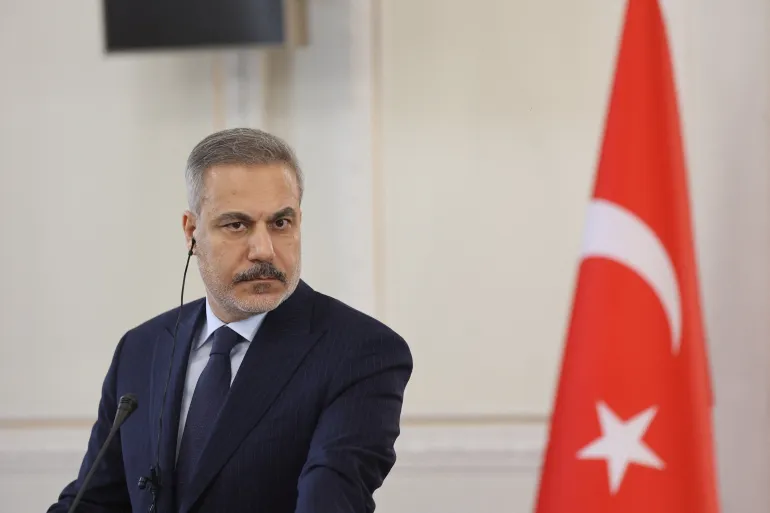
In a strong and carefully worded statement, Turkish Foreign Minister Hakan Fidan has raised concerns about the possibility of Israel launching an attack on Iran. According to Fidan, there are clear signs that Israel is searching for the right moment to strike, a move that could push the Middle East into deeper instability.
Fidan made these remarks during an interview with Turkish broadcaster NTV, which was aired on Friday. Speaking openly, he said that while he hopes a more peaceful route will be chosen, the situation on the ground suggests otherwise.
“I hope they find a different path,” Fidan said during the interview. “But the reality is that Israel, in particular, is looking for an opportunity to strike Iran.”
His statement has drawn attention across diplomatic circles, as it reflects growing fears among regional players about a possible escalation between Israel and Iran. Both countries have been engaged in long-standing hostility, often through indirect actions, intelligence operations, and proxy conflicts rather than direct military confrontation.
The Middle East is already dealing with multiple crises. Ongoing violence in Gaza, tensions along Israel’s borders, instability in Syria and Iraq, and concerns over Iran’s nuclear programme have all created a highly sensitive environment. In this context, any direct military action between Israel and Iran could have serious consequences not only for the two nations but for the entire region.
Fidan warned that an attack on Iran would not remain a limited or isolated event. He stressed that such a move could trigger wider unrest, drawing in other countries and armed groups, and making diplomatic solutions even harder to achieve.
Turkey, which has historically maintained complex relationships with both Israel and Iran, has often positioned itself as a voice calling for dialogue and restraint. While Ankara has had its disagreements with Israel, especially over the Palestinian issue, it has also expressed concern over Iran’s regional influence. Despite these differences, Turkey has consistently argued that military action is not the solution.
According to analysts, Fidan’s comments suggest that Ankara is closely monitoring developments behind the scenes. Diplomatic signals, military movements, and political statements are often studied carefully by regional governments to assess the likelihood of conflict. When a senior official like Turkey’s foreign minister speaks so directly, it indicates serious concern.
Israel has long viewed Iran as a major security threat, particularly due to Tehran’s nuclear ambitions and its support for armed groups such as Hezbollah in Lebanon. Iran, on the other hand, has accused Israel of carrying out covert operations, including cyber attacks and targeted strikes, inside Iranian territory. While neither side often admits responsibility, the tension between them is widely known.
In recent months, the risk of miscalculation has increased. With wars and conflicts already stretching diplomatic and military resources, a new front could easily spiral out of control. Fidan’s warning highlights fears that a single strike could set off a chain reaction across borders.
The Turkish foreign minister’s remarks also underline the importance of international diplomacy at this critical moment. He implied that global and regional powers must do more to reduce tensions and prevent actions that could lead to widespread instability.
Observers believe Turkey’s message is not directed only at Israel, but also at the international community. By speaking publicly, Ankara may be urging major powers to step in and encourage restraint before the situation worsens.
As of now, there has been no official response from Israel regarding Fidan’s comments. Iran has also not reacted publicly to the statement. However, the warning itself has added to the sense of urgency surrounding Middle Eastern geopolitics.
For ordinary people living in the region, the fear is simple but serious: another major conflict could bring loss of life, economic hardship, and long-term instability. Fidan’s words reflect that concern, reminding the world that peace remains fragile and that the cost of war would be high for everyone involved.