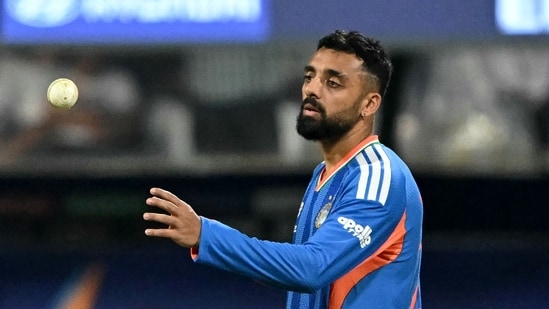
Varun Chakravarthy's form under the scanner after England ‘thrashing’, but receives support: ‘At least he took a wicket’
Varun Chakravarthy’s Bowling Struggles and Virender Sehwag’s Resolute Defense
The world of cricket often witnesses sharp fluctuations in player form, and with it, an equally swift wave of public opinion. Recently, India’s mystery spinner Varun Chakravarthy found himself under the spotlight for an expensive outing against England, conceding 64 runs. This performance, unfortunately, aligned with a broader period where the bowler has struggled to consistently replicate the dazzling form that first brought him national attention. Yet, amidst the rising tide of criticism, former Indian batting maestro Virender Sehwag emerged as a staunch defender, offering a seasoned perspective on player development and the realities of international cricket.
Chakravarthy, a talent who rose rapidly through the Indian Premier League (IPL) ranks with his array of variations and deceptive pace, was once hailed as a potent weapon in India’s spin arsenal. His inclusion in the national squad generated considerable buzz, promising an X-factor that could trouble even the best batting lineups. However, the transition from domestic success to the unforgiving glare of international competition has proven to be a significant challenge. The match against England saw him struggle to find rhythm, with opposition batsmen effectively navigating his variations and punishing loose deliveries. This high-scoring spell inevitably led to questions from pundits and fans alike about his efficacy at the highest level, particularly given the expectations tied to his unique bowling style.
Cricket analysts and commentators were quick to dissect Chakravarthy’s performance, pointing to a perceived lack of penetration, predictability in certain phases, and an inability to stem the flow of runs. The narrative began to coalesce around whether he truly possessed the “mystery” required to bamboozle international batsmen consistently. Social media discussions mirrored this sentiment, with many expressing disappointment and suggesting alternatives for future team selections.
It was against this backdrop of widespread concern that Virender Sehwag, known for his forthright opinions and deep understanding of the game, stepped forward to silence the critics. Sehwag’s defense of Chakravarthy was not a mere platitude but a well-reasoned argument rooted in experience. He emphasized that every player, especially those new to international cricket, requires time and consistent backing to find their feet and adapt. Sehwag highlighted the immense pressure that comes with representing one’s country, particularly for a spinner whose primary role is often to control the middle overs and pick up crucial wickets.
Sehwag underscored that a single bad performance, or even a barren run of a few matches, should not be the sole determinant of a player’s long-term potential. He reminded observers that conditions, opposition strategies, and the mental fortitude required for international cricket are vastly different from domestic tournaments. For a bowler like Chakravarthy, whose success hinges on deception and surprise, opponents at the international level invest significant time in analyzing techniques and developing counter-strategies. This continuous evolution demands that the bowler also evolve, something that takes time, coaching, and consistent opportunities.
The former opener’s comments resonated deeply, offering a much-needed voice of calm amid the clamor for immediate results. He subtly challenged the modern cricketing culture that often rushes to judgment, demanding instant impact from new talents. Sehwag’s perspective suggested that true player development is a journey, not a destination reached overnight. He implicitly argued against discarding a promising talent based on a few challenging outings, advocating instead for patience and sustained investment. This approach aligns with the long-term vision many national teams adopt, aiming to build a robust pool of players capable of performing under various conditions and pressures.
For Omni 360 News, this discourse highlights a critical aspect of contemporary sports journalism and fan engagement: the delicate balance between scrutiny and support. While objective analysis of performance is vital, a nuanced understanding of player circumstances, development cycles, and mental resilience is equally important. Chakravarthy’s situation is a classic example of a talent facing the crucible of international cricket, where every delivery is scrutinized, and every run conceded is amplified. Sehwag’s intervention serves as a reminder that empathy and a broader perspective are essential components of dissecting a player’s journey.
Key Takeaways:
* Varun Chakravarthy’s recent expensive spell against England fueled concerns over his international form.
* Critics questioned his efficacy and ability to replicate IPL success on the world stage.
* Virender Sehwag strongly defended Chakravarthy, emphasizing the need for patience and consistent opportunities for young players.
* Sehwag highlighted the immense pressure of international cricket and the time required for adaptation and development.
* The debate underscores the tension between immediate performance expectations and the long-term nurturing of talent in modern cricket.
* A balanced approach, valuing both scrutiny and support, is crucial for player growth and the health of the game.
The road ahead for Varun Chakravarthy will undoubtedly be challenging, but it is also an opportunity for growth. His variations remain intriguing, and with the right guidance and sustained confidence, he has the potential to rediscover his touch. As Sehwag’s comments suggest, true champions are not forged in flawless performances, but in their ability to learn from setbacks and emerge stronger. The cricketing world, through platforms like Omni 360 News, will be watching his journey with keen interest, hoping to witness the resurgence of a unique talent.