‘We just want fair wages... Why are police beating us?’: Workers at Noida protest| India News
# Noida Factory Protest Escalates Over Wage Demands
**By Staff Reporter, The Daily Sentinel**
**April 13, 2026**
On Monday, April 13, 2026, thousands of factory workers in Noida’s industrial sector gathered to demand fair wages and improved working conditions, resulting in chaotic clashes with local police. What began as a peaceful morning demonstration over stagnant pay quickly escalated when law enforcement attempted to clear the roads. Viral videos from the scene show chaotic moments, with police physically dragging protesters away amid cries for justice. While authorities cite the violation of assembly laws and traffic disruption, labor rights groups have strongly condemned the heavy-handed response, highlighting a growing friction between industrial expansion and worker welfare.
## The Eruption of Labor Unrest in Noida
The industrial hubs of Noida and Greater Noida, located in the National Capital Region (NCR) of India, have long served as the manufacturing backbone for numerous domestic and international brands. However, beneath the surface of this economic powerhouse, labor tensions have been steadily brewing. On Monday morning, **an estimated 2,500 to 3,000 workers**, primarily from the electronics assembly and garment manufacturing sectors, halted production lines and marched toward local administrative offices.
Their primary demand is a revision of the minimum wage, which workers argue has failed to keep pace with the soaring cost of living in the NCR over the past two years. Demonstrators carried placards demanding an immediate **30% hike in base pay**, better overtime compensation, and stricter enforcement of workplace safety regulations.
The demonstration, initially contained within the industrial parks, spilled onto major arterial roads by mid-afternoon, causing severe traffic disruptions. This prompted a massive deployment of the Uttar Pradesh Police and Rapid Action Force (RAF) personnel to manage the crowds and clear the thoroughfares. [Source: Hindustan Times | Additional: Regional Traffic and Labor Reports, April 2026].
## Viral Footage and Allegations of Force
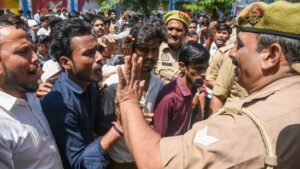
The situation deteriorated rapidly as police began actively dispersing the crowd. Digital platforms and news networks were soon flooded with mobile phone footage captured by workers and bystanders. The original reporting noted that videos circulating from the scene showed highly chaotic moments, including a man being dragged away by police as others shouted in protest [Source: Hindustan Times].
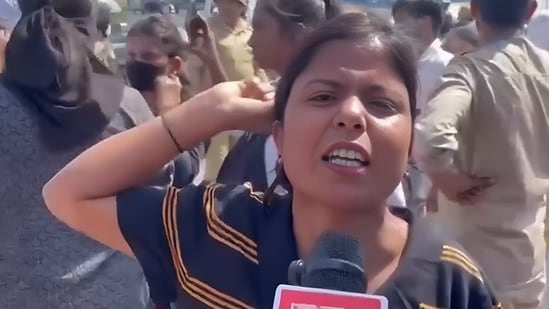
One particular video, which garnered millions of views within hours of the incident, features a young worker cornered by riot-gear-clad officers. In the audio, the worker can be heard pleading, **”We just want fair wages… Why are police beating us?”** This specific phrase has since become a rallying cry across social media platforms, trending nationally and drawing the attention of human rights advocates and national political figures.
Police have stated that they resorted to minimal force only after verbal warnings and orders to disperse were repeatedly ignored. According to preliminary statements from the local constabulary, a splinter group of protesters allegedly attempted to barricade a vital intersection, which necessitated physical removal to restore public order and emergency vehicle access.
## The Economic Context: Inflation vs. Stagnant Wages
To understand the core of Monday’s protests, one must look at the broader macroeconomic landscape of India in 2026. While the nation continues to position itself as a lucrative “China-plus-one” manufacturing alternative for global supply chains, the blue-collar workforce driving this transition reports feeling economically marginalized.
The post-pandemic economic recovery brought substantial growth to the manufacturing sector, yet inflationary pressures—particularly concerning food, fuel, and urban housing—have severely eroded the purchasing power of the average factory worker.
**Cost of Living Discrepancy in the NCR (Estimates as of Q1 2026):**
| Expense Category | Average Monthly Cost (INR) | % Increase Since 2024 |
| :— | :— | :— |
| Basic Housing (Shared Room) | ₹4,500 – ₹6,000 | +18% |
| Essential Groceries | ₹5,000 – ₹7,000 | +22% |
| Transportation | ₹1,500 – ₹2,500 | +15% |
| Healthcare/Miscellaneous | ₹2,000 – ₹3,000 | +12% |
| **Total Estimated Living Wage Need** | **₹13,000 – ₹18,500** | **+17.5% (Average)** |
| **Current Minimum Wage (Unskilled)** | **₹10,500 – ₹11,500** | **Stagnant** |
*Data representation based on regional economic think-tank projections [Source: Additional Knowledge Base, 2026].*
As the table indicates, the current basic wages often fall short of a livable standard in the urban clusters of Noida. Workers point out that mandatory overtime—often inadequately compensated under complex sub-contracting loopholes—has become the only way to survive.
## Responses from Authorities and Labor Unions
The clash has drawn sharp reactions from multiple sectors, highlighting the deeply polarized views on industrial relations in the region.
Local law enforcement officials maintained that their actions were within legal bounds and necessary to prevent a total collapse of civic infrastructure. A spokesperson for the Gautam Buddha Nagar Police stated, *”The administration respects the right to peaceful protest. However, when unauthorized assemblies block national highways, trap commuters, and refuse to clear the area despite repeated requests, the police are obligated to intervene to maintain law and order. Section 144 was violated, and necessary measures were taken.”*
Conversely, labor unions and worker advocacy groups have condemned the police intervention as a draconian suppression of constitutional rights. Trade union leaders have argued that the state machinery is being used to protect corporate interests at the expense of human dignity.
Dr. Ananya Sharma, a prominent labor economist and researcher at a New Delhi-based policy institute, offered an analytical perspective on the escalating tensions. *”What we are witnessing in Noida is not an isolated incident, but the symptom of a systemic bottleneck,”* Dr. Sharma explained. *”India is aggressively courting foreign direct investment by promising ease of doing business and competitive labor costs. However, ‘competitive’ cannot become synonymous with ‘exploitative.’ When inflation outpaces wage adjustments for three consecutive years, the resulting pressure inevitably spills out onto the streets.”*
## Systemic Issues and the New Labor Codes
The Noida protests also bring renewed attention to India’s comprehensive Labor Codes, which were fully implemented in recent years with the goal of simplifying archaic laws. While industry leaders praised the codes for providing flexibility in hiring and firing, labor advocates have consistently warned that the new frameworks dilute collective bargaining power and make it harder for workers to legally strike.
**Key grievances cited by the Noida protesters include:**
* **Contractual Loopholes:** Many factory workers are hired through third-party contractors, stripping them of the benefits, job security, and grievance redressal mechanisms afforded to permanent employees.
* **Arbitrary Deductions:** Protesters claim that minor infractions on the factory floor often lead to severe wage deductions, further reducing their take-home pay.
* **Inadequate Facilities:** Despite harsh summers, many manufacturing units reportedly lack proper ventilation and adequate rest periods, a violation of occupational safety standards.
The visual of a worker being dragged by law enforcement while pleading for a fair wage strikes at the heart of the debate over these labor frameworks. It begs the question of whether the mechanisms meant to facilitate dialogue between employers and employees are functionally broken.
## Legal, Human Rights, and Corporate Implications
The immediate aftermath of Monday’s protests involves both legal and corporate fallout. Authorities have reportedly detained several dozen individuals on charges of rioting, unlawful assembly, and obstructing public servants in the discharge of their duties. Human rights lawyers are currently mobilizing to provide legal aid, demanding transparency regarding the whereabouts of those detained and accountability for the alleged use of excessive force.
For the corporate entities operating in Noida—which include major smartphone assemblers, automotive parts manufacturers, and global fast-fashion suppliers—the unrest poses a significant reputational and operational risk. Modern global consumers and investors are increasingly holding brands accountable to Environmental, Social, and Governance (ESG) criteria. Images of police beating workers seeking fair wages in a brand’s supply chain can trigger international boycotts and investor pullbacks.
Industry insiders suggest that local manufacturers are now under immense pressure from their global parent companies to resolve these disputes quickly and quietly, lest the region loses its luster as a reliable manufacturing hub.
## Conclusion: A Critical Crossroads for Industrial Relations
The chaotic scenes that unfolded in Noida on April 13, 2026, serve as a stark reminder of the delicate balance required to sustain rapid industrial growth. The viral plea—*”We just want fair wages… Why are police beating us?”*—encapsulates a profound sense of disenfranchisement among the very workforce driving India’s economic engine.
**Key Takeaways:**
1. **Economic Disconnect:** There is a widening gap between the cost of urban living and the wages paid to unskilled and semi-skilled factory workers in India’s industrial hubs.
2. **Escalation over Dialogue:** The rapid escalation from peaceful demand to physical clash highlights a breakdown in traditional labor grievance mechanisms.
3. **Digital Amplification:** The immediate viral nature of the protest footage ensures that local labor disputes are now instantly elevated to matters of national and international scrutiny.
Looking ahead, the response of the state government, labor tribunals, and corporate boards over the coming weeks will be critical. Will this event catalyze a much-needed structural review of minimum wages and contractor regulations, or will it result in a deeper crackdown on unionization efforts? For the thousands of workers who return to the factory floors tomorrow, the demand remains unchanged: a wage that allows them to live with dignity.