
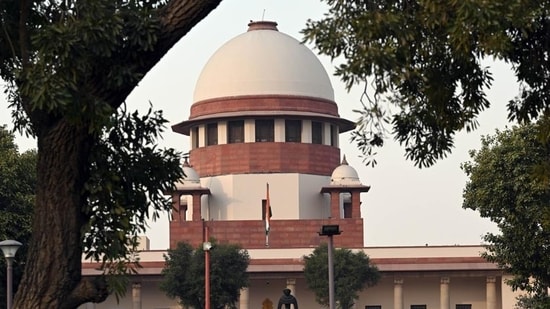
‘ ₹15,000 dete raho, khush raho’: SC refuses husband's divorce plea after living separately for 16 years| India News
# SC Denies Divorce After 16-Year Separation
**By Staff Correspondent, Legal Affairs Desk | April 10, 2026**
In a defining judgment on Friday, the Supreme Court of India dismissed a husband’s plea for divorce despite a 16-year separation from his wife, emphasizing that a prolonged period of living apart does not automatically justify the dissolution of a marriage. Rejecting the petition, the apex court directed the husband to continue paying a monthly maintenance of ₹15,000, lightly remarking, “₹15,000 dete raho, khush raho” (Keep paying ₹15,000 and stay happy). At the core of the bench’s decision was the enduring legal dilemma of whether a multi-decade separation constitutes an irretrievable breakdown, or if marital obligations and the chance of reconciliation still hold ground [Source: Hindustan Times].
## The Courtroom Exchange: Balancing Law and Empathy
The proceedings, which culminated in the denial of the divorce decree, highlighted the Supreme Court’s cautious approach to dismantling the institution of marriage unilaterally. The husband approached the top court arguing that a continuous separation of 16 years had entirely eroded the marital bond, leaving the marriage functionally dead. He pleaded that such a prolonged estrangement amounted to an “irretrievable breakdown,” a concept frequently debated in Indian family law.
However, the Supreme Court bench remained unconvinced that time alone is a sufficient metric for dissolution, particularly when one party—in this case, the wife—may still rely on the legal and social framework of the marriage. The court observed that granting a divorce simply because a spouse moved away and stayed away for over a decade could set a dangerous precedent, potentially leaving vulnerable partners abandoned without adequate recourse.
The bench’s candid remark, “shanti se baithe raho… ₹15,000 dete raho, khush raho” (sit peacefully… keep giving ₹15,000, and be happy), underscored a pragmatic judicial philosophy [Source: Hindustan Times]. It sent a clear message: financial responsibility and marital duties do not evaporate merely because a couple no longer shares a roof.
## Irretrievable Breakdown: A Discretionary Power, Not a Right
To understand the gravity of this ruling, one must contextualize it within the broader framework of the Hindu Marriage Act, 1955, and the specific powers granted to the Supreme Court under Article 142 of the Constitution of India.
Under current Indian statutory law, “irretrievable breakdown of marriage” is not explicitly listed as a ground for divorce. Traditionally, divorces are granted either on the basis of “fault” (such as cruelty, adultery, or desertion) or through mutual consent. When one party vehemently contests the divorce, the legal battle can drag on for years, as seen in this 16-year saga.
In a landmark 2023 Constitution Bench judgment (*Shilpa Sailesh v. Varun Sreenivasan*), the Supreme Court ruled that it has the inherent power under Article 142 to dissolve a marriage that has irretrievably broken down, bypassing the mandatory waiting periods of family courts. However, the 2023 ruling came with a heavy caveat: this power is discretionary, to be used to do “complete justice,” and cannot be claimed as a matter of absolute right by a litigating spouse [Source: Public Legal Records].
Friday’s ruling reinforces that boundary. The court carefully evaluates several factors before invoking Article 142, including the duration of the marriage, the time spent apart, the nature of pending litigations, and crucially, the socio-economic impact on the resisting spouse. In this instance, the court determined that the wife’s right to maintenance, dignity, and marital status outweighed the husband’s desire for legal closure.
## The Socio-Economic Anchor: The Role of Maintenance
The directive to continue paying ₹15,000 as monthly maintenance brings to the forefront the economic disparities that often characterize Indian marital disputes. For many women in India, marriage remains deeply tied to financial security and social standing.
Legal experts note that Indian courts frequently prioritize the economic rehabilitation of the dependent spouse over granting the earning spouse a quick exit. Under Section 125 of the erstwhile Code of Criminal Procedure (now integrated into the Bharatiya Nagarik Suraksha Sanhita, BNSS), the law mandates that individuals with sufficient means must not neglect their dependent spouses.
The ₹15,000 monthly maintenance is not merely a transactional figure; it represents the court’s commitment to preventing destitution. By tethering the refusal of the divorce to the continuation of maintenance, the Supreme Court highlighted that the husband cannot shed his financial obligations by citing the passage of time. The court’s stance reflects a protective jurisprudence designed to shield women who might otherwise be left economically disenfranchised in their later years.
## Expert Perspectives on Modern Family Jurisprudence
The judgment has sparked extensive debate among legal scholars and sociologists regarding the balance between individual liberty and the sanctity of institutional marriage.
“This ruling is a classic example of the Supreme Court acting as the guardian of the vulnerable,” says Dr. Ananya Chaturvedi, a senior family law advocate and researcher in New Delhi. “While modern legal systems in the West embrace ‘no-fault’ divorces, Indian jurisprudence remains deeply intertwined with social realities. The court recognizes that a unilateral divorce after 16 years, especially without mutual consent, can inflict severe emotional and financial trauma on a woman who has dedicated her life to the marital unit.”
Conversely, some proponents of legal reform argue that forcing couples to remain legally wedded when the relationship is functionally dead serves no practical purpose.
“When a couple has lived apart for 16 years, the marriage exists only on paper,” notes Rajesh Varma, a public policy analyst specializing in judicial reforms. “While ensuring financial maintenance is absolutely critical, denying the legal dissolution of the marriage forces both individuals to live in a state of indefinite limbo. It begs the question: should financial support be permanently tethered to the continuation of a dead marriage, or can we separate the two?”
Despite these differing viewpoints, the Supreme Court’s decision remains rooted in its assessment of the specific facts of the case, prioritizing stability and the wife’s security over the husband’s plea for legal separation.
## Implications for Pending Divorce Petitions
Friday’s verdict is expected to have a ripple effect on thousands of similar family court cases across the nation. Litigants who have abandoned their matrimonial homes, hoping that simply “waiting out the clock” will eventually guarantee a favorable divorce decree under the irretrievable breakdown doctrine, will need to reassess their legal strategies.
Key implications from this ruling include:
* **No Automatic Dissolution:** Time lived apart is a factor, but not a standalone guarantee for a divorce. Courts will continue to scrutinize the reasons for separation and the conduct of both parties.
* **Protection Against Unilateral Abandonment:** The judgment discourages spouses from deserting their partners with the expectation that the courts will eventually formalize the abandonment as an irretrievable breakdown.
* **Emphasis on Maintenance:** Courts will likely double down on ensuring that the financial needs of the dependent spouse are met before even considering discretionary relief for the earning spouse.
* **Consent Matters:** The ruling reiterates the importance of mutual consent in modern divorce proceedings. Where consent is absent, the burden of proof to dissolve the marriage remains exceptionally high.
For lower judiciary bodies and family courts, this Supreme Court observation serves as a guiding light. It reinforces the mandate that judges must exercise extreme caution and not mechanically grant divorces based solely on the duration of separation, ensuring that the scales of justice remain balanced.
## Conclusion and Future Outlook
The Supreme Court’s decision to dismiss the husband’s divorce plea after 16 years of separation is a profound statement on the enduring nature of marital obligations in India. By summarizing the decree with the pragmatic advice to “keep paying ₹15,000 and stay happy,” the judiciary has drawn a firm line: the desire for personal liberation cannot eclipse established duties of care and financial support [Source: Hindustan Times].
As Indian society evolves, the friction between individualistic legal concepts—like the irretrievable breakdown of marriage—and traditional marital obligations will undoubtedly continue to generate complex legal battles. However, for now, the apex court has made it unequivocally clear that the primary objective of family law in India is not merely to facilitate easy exits, but to ensure equitable and just outcomes for all parties involved. Until the legislature steps in to officially recognize “irretrievable breakdown” with clear statutory guidelines and economic safeguards, the Supreme Court will continue to weigh these matters on a stringent, case-by-case basis.





