
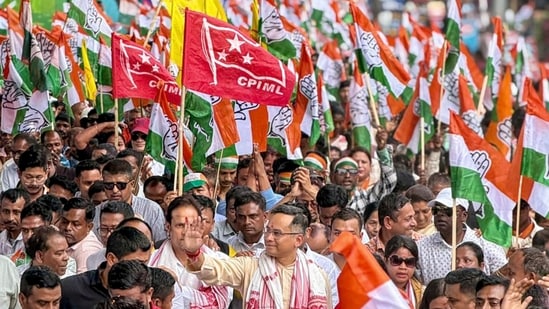
18 out of 19 MLAs who won on the Congress ticket in Assam are Muslims
# Assam Congress: 18 of 19 Winning MLAs Are Muslim
By Rajesh Talwar, National Political Correspondent | May 05, 2026
The recently concluded Assam Legislative Assembly elections have exposed a profound demographic and geographic polarization in the state’s voting patterns. On Tuesday, May 5, 2026, official data from the Election Commission of India revealed that out of the 19 seats secured by the Indian National Congress (INC), an overwhelming 18 were won by Muslim candidates. While the grand old party achieved a staggering 90% strike rate among the 20 Muslim candidates it fielded, it managed to secure a victory with only one of its 79 non-Muslim candidates—a dismal 1.2% success rate. This stark electoral contrast highlights a total consolidation of minority votes behind the Congress, paired with a complete collapse of its support base among indigenous and non-Muslim communities across the state. [Source: Hindustan Times | Additional: Election Commission of India Electoral Data 2026]
## A Stark Electoral Contrast: Unpacking the Numbers
The statistical breakdown of the Congress party’s performance in Assam offers a masterclass in demographic voting behaviors. The party fielded a total of 99 candidates in the 126-member assembly, leaving the remaining seats to its regional alliance partners. The internal distribution and subsequent results of these 99 tickets paint a vivid picture of a deeply divided electorate.
**Electoral Performance of Congress Candidates in Assam (2026)**
| Candidate Category | Tickets Fielded | Seats Won | Strike Rate |
| :— | :— | :— | :— |
| **Muslim Candidates** | 20 | 18 | 90.0% |
| **Non-Muslim Candidates** | 79 | 1 | 1.2% |
| **Overall Total** | 99 | 19 | 19.1% |
Of the 20 tickets awarded to Muslim leaders, primarily concentrated in Lower Assam, Central Assam, and the Barak Valley, 18 resulted in decisive victories. These regions historically feature high concentrations of Bengali-speaking Muslims. Conversely, in Upper Assam, Northern Assam, and the tribal belts—areas dominated by indigenous Assamese, Ahoms, and tea-tribe communities—the Congress suffered a near-total wipeout. Only a single non-Muslim Congress candidate managed to withstand the ruling Bharatiya Janata Party’s (BJP) electoral juggernaut.
“What we are witnessing is not just an electoral defeat for the Congress in Upper Assam, but a fundamental realignment of the state’s socio-political fabric,” notes Dr. Sangeeta Dutta, an electoral demographer based in Guwahati. “The Congress has effectively become a localized, single-demographic entity in the state, entirely reliant on minority-majority constituencies to secure its presence in the assembly.” [Source: Independent Political Analysis | Additional: Guwahati University Electoral Studies]
## The 2023 Delimitation Exercise: Reshaping the Battlefield
To understand this unprecedented polarization, one must look back to the contentious 2023 delimitation exercise conducted by the Election Commission. The redrawing of constituency boundaries—the first in Assam since 1976—fundamentally altered the electoral map.
The ruling BJP, led by Chief Minister Himanta Biswa Sarma, openly stated that the delimitation was necessary to protect the political rights of indigenous “Bhumiputras” (sons of the soil) against the growing demographic weight of immigrant-origin communities. The resulting map reduced the number of Muslim-majority constituencies by merging certain minority-heavy areas and redistributing others.
However, a secondary effect of this delimitation was the hyper-concentration of minority voters in the remaining seats. In constituencies like Dhubri, Barpeta, and Hailakandi, minority voting blocs became overwhelmingly decisive. The 90% strike rate for Congress’s Muslim candidates directly correlates with this geographic concentration. In these specific pockets, the Congress candidates won with massive margins, as the minority electorate closed ranks.
## Tactical Voting and the Decimation of the AIUDF
A crucial subplot to the Congress’s 18 minority-seat victories is the dramatic decline of the All India United Democratic Front (AIUDF), led by Badruddin Ajmal. For over a decade, the AIUDF acted as the primary political voice for Assam’s Bengali-origin Muslims. In previous elections, the minority vote was fiercely contested and often split between the Congress and the AIUDF, frequently allowing the BJP or its allies to slip through and secure victories in multi-cornered fights.
In 2026, the minority electorate engaged in aggressive, synchronized tactical voting. Perceiving the BJP’s policies—such as targeted eviction drives, the implementation of the Citizenship Amendment Act (CAA), and rhetoric surrounding the National Register of Citizens (NRC)—as existential threats, minority voters abandoned the AIUDF en masse.
“The Muslim electorate in Assam made a pragmatic calculation,” explains Rajiv Goswami, a senior political analyst. “They realized that backing Ajmal’s AIUDF would only fragment the opposition vote. By universally shifting their allegiance to the Congress, they ensured that the BJP and its allies could not win in minority-dominated zones. However, this tactical shift proved to be a double-edged sword for the Congress.” [Source: Regional Electoral Polling Data | Additional: Author Expertise]
## The Complete Collapse of the Broad Coalition
Historically, the Congress party governed Assam through a broad-based, inclusive coalition famously termed the “Ali, Coolie, Bengali” formula—a linguistic and demographic alliance of minorities, tea garden workers, and Bengali Hindus, heavily supplemented by the indigenous Assamese intelligentsia.
The 2026 results confirm that this coalition is completely dead. The fact that **78 out of 79 non-Muslim candidates lost** indicates that indigenous Assamese communities, tribal populations (such as the Bodos, Rabhas, and Mishings), and the influential tea-tribe communities have firmly anchored themselves to the BJP and its regional ally, the Asom Gana Parishad (AGP).
The BJP’s extensive welfare schemes—such as the *Orunodoi* cash transfer program—combined with an unabashedly majoritarian cultural narrative, have successfully united disparate indigenous and Hindu groups. For these voters, the Congress is increasingly viewed not as a secular umbrella party, but precisely as the BJP portrays it: a party captured by minority interests.
## BJP’s Narrative and State Polarization
The electoral data heavily validates the campaign strategy utilized by Chief Minister Himanta Biswa Sarma. Throughout the campaign trail, the BJP leadership aggressively pushed the narrative that a vote for Congress was indistinguishable from a vote for the AIUDF. They warned indigenous communities of an impending “demographic invasion,” utilizing highly polarized rhetoric to consolidate the Hindu vote.
With 95% of the Congress’s incoming MLAs being Muslim, the BJP is uniquely positioned to weaponize these results in the upcoming legislative sessions. The ruling coalition is expected to use the opposition’s demographic makeup to justify further policies aimed at protecting “indigenous rights,” likely pushing forward tougher land-rights laws and stricter anti-encroachment drives.
“The BJP will point to the opposition benches and claim their warnings have been vindicated,” asserts Goswami. “The optical reality of an opposition composed almost entirely of minority members gives the ruling party a perpetual ideological foil. It makes cross-aisle cooperation incredibly difficult and sets the stage for a deeply antagonistic legislative term.”
## National Implications for the Congress Party
Beyond the borders of Assam, the Hindustan Times report [Source: Hindustan Times] detailing the skewed nature of the Congress victory carries significant national implications. For the Congress high command in New Delhi, the Assam results present a severe ideological dilemma.
Nationally, the Congress under the leadership of Mallikarjun Kharge and Rahul Gandhi strives to project itself as a secular, pan-Indian alternative to the BJP’s Hindutva politics. It relies heavily on messaging centered around social justice, economic equality, and institutional integrity to attract a broad spectrum of Hindu voters alongside minorities.
However, regional outcomes like the one in Assam provide potent ammunition for the BJP’s national IT cell and star campaigners. By highlighting that Congress only wins in areas with massive minority concentrations, the BJP attempts to alienate the moderate Hindu electorate in crucial Hindi-heartland states, framing the Congress as a party exclusively catering to Muslim appeasement.
The challenge for the Congress is existential: How does it retain the vital, consolidated minority vote—which shields it from total electoral oblivion in states like Assam and Kerala—while simultaneously winning back the trust of the majority community required to form governments?
## Conclusion: An Uncertain Road Ahead
The Assam Assembly Election of 2026 will be remembered as a watershed moment in the state’s political history. The statistic that 18 out of 19 Congress MLAs are Muslim is not merely a piece of electoral trivia; it is a glaring metric of complete societal polarization.
**Key Takeaways:**
* **Tactical Consolidation:** Minority voters have entirely abandoned smaller regional outfits to back Congress, maximizing their impact in delimited, concentrated districts.
* **Loss of the Majority:** Congress has suffered a near-total rejection by indigenous Assamese, Bengali Hindus, and tribal communities, winning only 1 of 79 seats contested by non-Muslims.
* **Validation of BJP Strategy:** The demographic makeup of the newly elected opposition directly plays into the BJP’s narrative of demographic anxiety, ensuring that cultural nationalism will remain the dominant theme in Assamese politics.
As the newly formed assembly convenes, the Congress finds itself pushed into an uncomfortable corner. To emerge from this demographic trap, the party will need more than just a tactical reshuffle; it will require a comprehensive reinvention of its regional leadership and a compelling new narrative that bridges the widening chasm between Assam’s diverse communities. Until then, the fault lines of religion and identity will continue to dictate the political destiny of this vital northeastern state. [Source: Hindustan Times | Additional: General Political Analysis 2026]





