
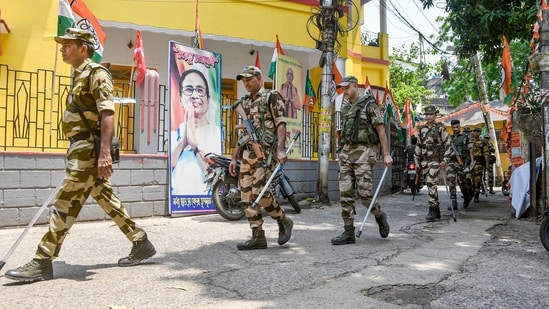
5 battlegrounds, 823 seats: All set for counting of votes for assembly elections tomorrow
# India Elections: Counting Set for 823 Seats
**By Special Correspondent, National Political Desk | May 3, 2026**
The Election Commission of India (ECI) has finalized comprehensive preparations for the massive vote-counting exercise across five critical battlegrounds: West Bengal, Kerala, Tamil Nadu, Assam, and the Union Territory of Puducherry, scheduled for tomorrow morning. Deciding the fate of 823 assembly seats, this high-stakes electoral showdown will test the dominance of regional heavyweights against the expansive ambitions of national political parties. As thousands of counting personnel take their positions amidst rigorous, multi-tiered security protocols, the nation waits with bated breath to see which political coalitions will secure the democratic mandate to govern these crucial states for the next five years. [Source: Hindustan Times | Additional: Election Commission of India Public Disclosures].
## Unprecedented Security and ECI Logistics
The scale of tomorrow’s counting process is monumental. Across the five regions, counting centers have been fortified with a standard three-tier security cordon. The inner perimeter is heavily guarded by the Central Armed Police Forces (CAPF), ensuring that the Electronic Voting Machine (EVM) strong rooms remain entirely inviolate until the seals are broken in the presence of authorized political agents.
According to guidelines released by the Election Commission, the counting of postal ballots will commence precisely at 8:00 AM, followed by the opening of EVMs at 8:30 AM. To ensure absolute transparency, the entire process will be broadcast on closed-circuit television (CCTV) within the centers, monitored closely by ECI-appointed micro-observers.
“The logistical framework deployed for the 2026 assembly elections sets a new benchmark for electoral integrity,” notes Dr. Sanjeev Kumar, a senior fellow at the Centre for Electoral Dynamics. “From randomized EVM deployment to the strict prohibition of mobile phones inside the counting halls, the ECI has instituted fail-safes that effectively eliminate tampering risks. The sheer volume of personnel—over 100,000 counting officials and security staff—demonstrates the robust nature of India’s democratic machinery.” [Source: Hindustan Times].
It is worth noting that while the five legislative assemblies hold a combined total of 824 seats, counting will take place for exactly **823 seats**. Polling in one specific constituency was previously countermanded due to the unfortunate demise of a recognized candidate, aligning with constitutional electoral protocols.
## West Bengal: The Epicenter of the 2026 Battle
Nowhere is the political temperature higher than in West Bengal. With **294 assembly seats**, the state remains the crown jewel of this electoral cycle. The ruling Trinamool Congress (TMC) is fighting a fierce battle to retain its absolute majority, leaning heavily on its expansive social welfare schemes, particularly those aimed at women and rural constituencies.
Conversely, the Bharatiya Janata Party (BJP) has mounted a deeply organized campaign, aiming to capitalize on localized anti-incumbency sentiments and controversies surrounding regional administrative transparency. The Left-Congress alliance, fighting to reclaim its lost political territory, adds a complex triangular dynamic to several key districts in the state’s northern and central regions.
Early voter turnout data suggests a profound mobilization of female voters in Bengal, an demographic that has historically swayed election outcomes in the state. Political analysts are closely watching the rural belts of South Bengal, which have traditionally been strongholds for the ruling party, while the BJP hopes to consolidate gains in North Bengal and the western tribal belts.
## Tamil Nadu: A Test of the Dravidian Model
In Tamil Nadu, the electoral contest for its **234 seats** remains firmly rooted in the state’s unique Dravidian political ecosystem. The ruling Dravida Munnetra Kazhagam (DMK) and its allies are seeking a renewed mandate by showcasing their “Dravidian Model” of governance, emphasizing industrial growth, state autonomy, and expansive social justice programs.
The primary opposition, the All India Anna Dravida Munnetra Kazhagam (AIADMK), has fought a spirited campaign to unseat the incumbents. Having consolidated its internal leadership structure over the past few years, the AIADMK is focusing heavily on local infrastructural issues and leveraging anti-incumbency waves in agrarian districts.
“Tamil Nadu’s electorate rarely offers a fractured mandate,” explains Meenakshi Ramanathan, a Chennai-based political strategist. “Tomorrow’s results will indicate whether the state’s voters are satisfied with the current administration’s macro-economic policies, or if the traditional cyclical nature of Tamil Nadu politics will propel the opposition back into Fort St. George.” [Source: Independent Political Analysis / Public Domain].
Furthermore, the performance of national parties like the BJP and Congress, who are fighting as junior partners in their respective Dravidian alliances, will be scrutinized to assess their expanding, albeit limited, independent footprints in the deep south.
## Kerala: Defying Anti-Incumbency or Honoring Tradition?
Kerala’s **140-seat** assembly presents a fascinating ideological clash. Historically, the state’s electorate has alternated between the Communist Party of India (Marxist)-led Left Democratic Front (LDF) and the Congress-led United Democratic Front (UDF). However, the LDF famously broke this four-decade-old tradition in the previous electoral cycle by retaining power.
Tomorrow’s counting will reveal if the LDF has managed to defy political gravity once again or if the UDF has successfully tapped into public grievances regarding the state’s economic health and youth unemployment. The UDF campaign relied heavily on promising infrastructural revitalization and fiscal prudence.
Meanwhile, the National Democratic Alliance (NDA) has invested heavily in specific pockets of Kerala, aiming to increase its vote share and secure strategic assembly segments, particularly in the southern and central districts. Their performance will be a crucial indicator of the shifting demographic alignments within the state.
## Assam and Puducherry: Vital Fronts for the NDA
In Assam, the battle for the **126 assembly seats** is a critical test for the ruling BJP-led alliance. The state’s government has campaigned aggressively on a platform of rapid infrastructure development, indigenous rights, and regional security. The opposition Congress-led coalition has countered by highlighting issues related to localized economic distress, tea garden workers’ rights, and debates over demographic shifts following recent delimitation exercises.
The political terrain in Assam has evolved, with ethnic and regional identities playing a massive role in voter preferences in Upper Assam and the Barak Valley. The results here will have a cascading effect on political stability across the broader Northeast region.
Down south in the Union Territory of Puducherry, counting for the **30 assembly seats** involves a unique set of localized dynamics. The political landscape here is highly fragmented, with shifting loyalties and hyper-local candidate influence dictating the terms of engagement between the NDA and the Secular Democratic Alliance (comprising Congress and the DMK). Despite its small size, Puducherry holds significant symbolic value for both national alliances.
## National Implications: The Road to 2029
While state elections are fought on local issues, the outcome of these 823 seats will undoubtedly cast a long shadow over national politics. The results will recalibrate the power dynamics within the Rajya Sabha (the Upper House of Parliament), directly impacting the legislative capabilities of the central government in the coming years.
### Assembly Seats at a Glance
| State/Union Territory | Total Seats | Key Competing Alliances |
| :— | :— | :— |
| **West Bengal** | 294 | TMC, NDA, Left-Congress |
| **Tamil Nadu** | 234 | DMK+, AIADMK+, NDA |
| **Kerala** | 140 | LDF, UDF, NDA |
| **Assam** | 126 | NDA, Congress+ |
| **Puducherry** | 30 | NDA, Secular Democratic Alliance |
| *Total Scheduled* | *824 (Counting for 823)* | |
Furthermore, these elections serve as a crucial barometer for the political mood of over 200 million citizens. For the national opposition, victories in these states are essential to maintain momentum and credibility as viable alternatives on the national stage. For the ruling dispensation at the center, expanding or holding onto state-level power is vital for executing its broader national policy agenda seamlessly.
## Conclusion and Future Outlook
As the sun rises tomorrow, the meticulous preparations by the Election Commission of India will culminate in the revelation of the people’s will. Initial trends are expected to start emerging by 9:30 AM, with clear pictures of the victorious alliances likely solidifying by late afternoon.
The 2026 assembly elections in West Bengal, Tamil Nadu, Kerala, Assam, and Puducherry have been characterized by intense campaigning, high voter turnout, and shifting demographic loyalties. Whether the results reinforce the existing political order or usher in a wave of transformative change, the peaceful execution of this mammoth democratic exercise remains a testament to the resilience of India’s electoral framework. As the nation prepares for counting day, the only absolute certainty is that the political map of India is on the verge of a significant recalibration.





