
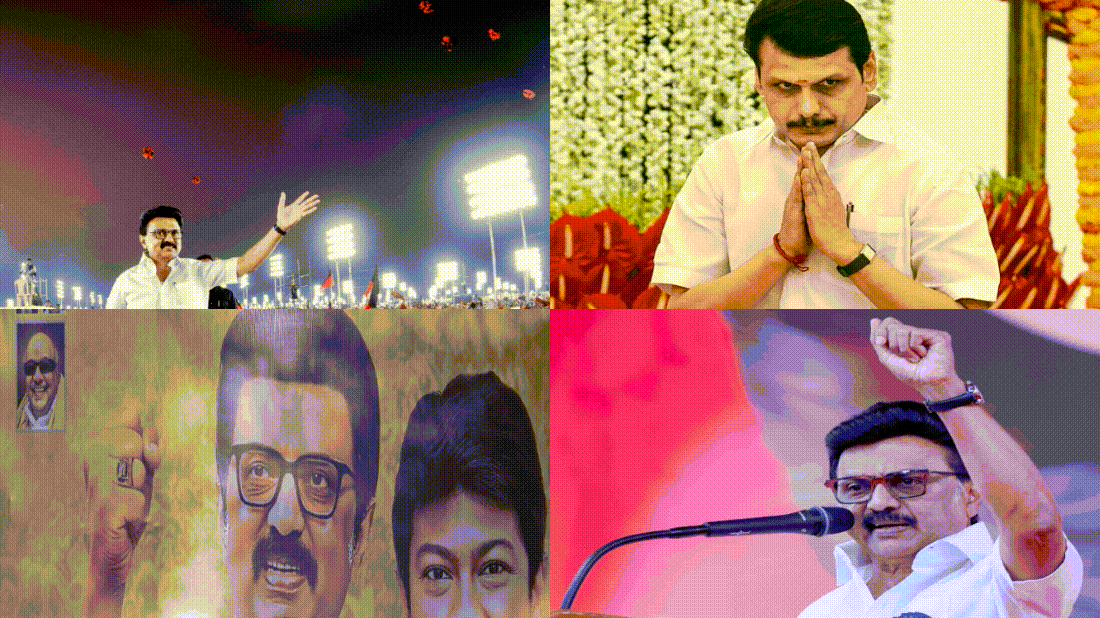
Udhayanidhi, OPS, Senthil Balaji feature in first DMK candidate list for Tamil Nadu election| India News
**DMK Leaders Chart Election Course in Key Tamil Nadu Seats**
As the political fervor builds across Tamil Nadu, the Dravida Munnetra Kazhagam, or DMK, has officially unveiled its initial roster of candidates for the upcoming assembly elections. Among the key announcements setting the stage for a compelling electoral battle, Chief Minister MK Stalin has once again been nominated to represent the Kolathur constituency, a seat he has held with a strong mandate. Simultaneously, his son and current Minister for Youth Welfare and Sports Development, Udhayanidhi Stalin, will embark on his electoral journey from the historically significant Chepauk-Triplicane constituency. These choices underscore a strategic blend of continuity and the progression of leadership within the party as reported by Omni 360 News, aiming to solidify its strongholds and project a clear vision to the electorate.
MK Stalin’s renomination from Kolathur is a move that speaks volumes about stability and a deeply established connection with his constituents. Kolathur, carved out as a constituency after the 2008 delimitation, first saw Stalin emerge victorious in 2011. Since then, he has successfully defended the seat in subsequent elections, transforming it into his personal bastion. Local reports and public sentiment often highlight his consistent engagement with the local populace, his personal oversight of development projects, and his accessibility to the people of the area. His presence in Kolathur represents not just a candidate defending his turf, but a leader reaffirming his foundational strength and the trust placed in him by a dedicated voter base. For the DMK, having its primary leader contest from a familiar and secure seat sends a message of confidence and unwavering leadership to the entire state, ensuring the party’s central campaign remains anchored by a proven electoral record. This strategic choice avoids any perception of uncertainty at the very top, allowing the party to focus its energies on other critical battles across Tamil Nadu.
On the other hand, Udhayanidhi Stalin’s candidacy from Chepauk-Triplicane carries its own unique weight and symbolism. This constituency holds a special place in the DMK’s history, having been represented by senior party stalwarts, including his grandfather, the late M Karunanidhi, who successfully contested from the erstwhile Chepauk seat. Udhayanidhi’s entry into electoral politics from such a prominent urban constituency is widely seen as a significant step in his political career and a clear signal regarding his future role within the party. His relatively swift ascent within the DMK hierarchy, from leading the youth wing to holding a cabinet position, has been closely watched. Local political observers suggest that positioning him in a constituency with a strong DMK legacy and a traditional voter base provides a robust platform for his electoral debut, mitigating potential risks and allowing him to focus on campaigning across the state. His nomination here is not merely about winning a seat, but about cementing his position as a prominent face of the next generation of DMK leadership, building on the party’s rich heritage while bringing a fresh appeal to younger voters. This move is designed to ensure a smooth transition and continuity of influence for the DMK for years to come.
The DMK’s candidate selection strategy, particularly concerning these two prominent figures, paints a picture of a party meticulously planning its electoral offensive. By anchoring its top leader in a familiar stronghold and strategically launching its next-generation face from a traditional party bastion, the DMK aims to project both stability and dynamism. This approach is crucial in a politically vibrant state like Tamil Nadu, where electoral outcomes are often influenced by the careful balancing of experience and new energy. The party’s focus will likely be on leveraging Stalin’s administrative track record and Udhayanidhi’s connect with the youth, alongside a broader platform addressing local issues, development, and social justice. The choices reflect a confidence in their respective abilities to not only win their individual contests but also to galvanize support for the party across the state. This measured approach seeks to reassure traditional voters while attracting new segments, setting the stage for an engaging and closely watched election cycle.
**Key Takeaways**
* Strategic Renomination: Chief Minister MK Stalin’s return to Kolathur reinforces his personal connection with the constituency and signifies the DMK’s emphasis on stable leadership.
* Succession Planning: Udhayanidhi Stalin’s candidacy in Chepauk-Triplicane is a clear step in his political journey, placing him in a historically significant and strong DMK seat.
* Blended Approach: The DMK’s overall strategy combines the proven electoral strength of its senior leader with the rising influence of its younger generation.
* Party Confidence: These nominations reflect the party’s confidence in maintaining its strongholds and projecting a cohesive leadership structure for the upcoming elections.
* Electoral Message: The choices aim to convey both continuity and fresh appeal, targeting a broad spectrum of voters across Tamil Nadu.
The upcoming elections will serve as a critical test for these strategies, determining the political trajectory of both leaders and the future landscape of Tamil Nadu.





