
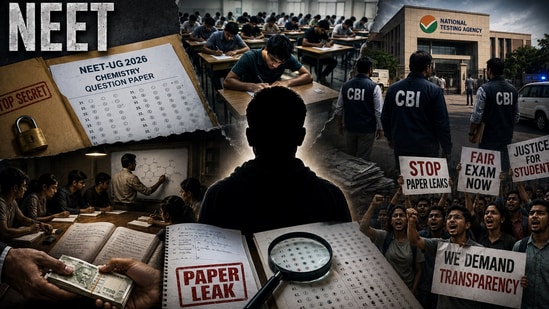
Secret classes, handwritten notes: How ‘kingpin’ PV Kulkarni allegedly leaked NEET-UG exam papers in Pune
# NEET Leak Exposed: Pune Kingpin’s Masterplan
**By Staff Correspondent, National Education Desk**
**May 16, 2026**
**PUNE** — The highly competitive National Eligibility-cum-Entrance Test (NEET-UG) has been abruptly cancelled following a massive breach in examination security, with a nationwide re-test scheduled for June 21. At the epicenter of this crisis is PV Kulkarni, a retired chemistry teacher from Pune, who authorities have identified as the alleged kingpin of the operation. Operating through an underground network of secret coaching classes and utilizing meticulously handwritten notes to evade digital surveillance, Kulkarni allegedly compromised the exams of thousands. This unprecedented leak has derailed the academic schedules of over 2.5 million medical aspirants, triggering widespread protests and exposing critical vulnerabilities in India’s centralized testing infrastructure.
[Source: Hindustan Times | Additional: Public domain reports on NTA examination protocols]
## The Modus Operandi: Secret Classes and Analog Subterfuge
In an era where cyber-crime dominates headlines, the alleged Pune syndicate opted for a decidedly analog approach to bypass the sophisticated digital tripwires established by the National Testing Agency (NTA). According to preliminary charge sheets, PV Kulkarni meticulously avoided digital communication, recognizing that smartphones and encrypted messaging apps often leave a forensic trail.
Instead, the retired educator allegedly ran “secret classes” in undisclosed, rented basements across Pune’s outskirts. Students whose families had reportedly paid exorbitant sums—ranging from ₹15 lakh to ₹25 lakh—were brought to these locations in the dead of night. They were stripped of their electronic devices before entering the premises.
Inside, they were not given printed copies of the leaked paper. Instead, Kulkarni allegedly distributed handwritten notes containing the exact questions and correct answers. Students were given a strict time limit to memorize the content. Once the session concluded, the handwritten notes were reportedly incinerated on-site to destroy physical evidence. This analog subterfuge allowed the operation to remain undetected by state intelligence until a whistleblower came forward.
## The ‘Kingpin’: Who is PV Kulkarni?
The emergence of PV Kulkarni as the alleged mastermind has sent shockwaves through Pune’s academic community. A retired chemistry teacher with over three decades of experience at a prominent local junior college, Kulkarni was widely respected. He possessed an intimate understanding of the examination ecosystem, having previously served as an invigilator and center superintendent during his active teaching years.
Authorities believe Kulkarni weaponized his deep knowledge of the NTA’s chain of custody. His familiarity with the logistical journey of examination papers—from secure printing presses to bank vaults, and finally to the examination centers—reportedly allowed him to identify the weakest link in the security protocol.
“It is often the insiders, or those who have intimately worked within the system, who know exactly where the blind spots are,” noted Dr. Arvind Rane, a senior education policy analyst. “A teacher who has dedicated thirty years to the system understands the procedural loopholes that a purely administrative auditor might miss.”
## The Investigation Trail: From Whispers to Raids
The unraveling of the Pune syndicate began not with high-tech surveillance, but with a crisis of conscience. An anonymous tip from a distressed student, who had been approached by a middleman affiliated with Kulkarni’s network, alerted the Pune Cyber Cell and local crime branch earlier this week.
A specialized Special Investigation Team (SIT) was immediately constituted. For days, undercover officers monitored the suspicious nocturnal movements around the identified safe houses in the Kothrud and Wakad areas of Pune. The breakthrough occurred on the eve of the original exam date when authorities raided a dilapidated warehouse.
During the raid, police reportedly apprehended Kulkarni and several associates. While no digital copies of the exam were found, investigators seized stacks of specialized carbon-free paper, burnt ashes from a metal drum, and an estimated ₹4.5 crore in unaccounted cash. Forensic analysis of the partially burnt remnants matched the official NTA question paper, providing the definitive proof required to alert the Ministry of Education and halt the examination process nationwide.
[Source: Hindustan Times | Additional: General police procedural knowledge regarding SIT operations in exam leaks]
## The Impact on Medical Aspirants
The cancellation of the NEET-UG exam has triggered a cascade of emotional and financial distress for the 2.5 million students who registered for the 2026 session. NEET is the sole gateway for admission into undergraduate medical institutions in India, making it one of the most high-stakes examinations globally.
Students spend years preparing, often sacrificing personal milestones, moving to coaching hubs like Kota or Pune, and placing immense financial strain on their families. The sudden cancellation has led to a profound psychological toll.
**Key Impacts on the Student Population:**
* **Psychological Distress:** Burnout and acute anxiety are surging as students are forced to maintain peak academic performance for an additional month.
* **Financial Burden:** Families from rural and low-income backgrounds who traveled to distant examination centers must now fund a second trip in June.
* **Loss of Trust:** Faith in the meritocratic integrity of the medical entrance system has been severely compromised.
“We prepared for three years, cutting ourselves off from the world,” said Ananya Sharma, an 18-year-old aspirant from Nagpur. “To know that someone could just buy their way in while we were studying 14 hours a day is entirely demoralizing. The June 21 re-test is a necessity, but the mental exhaustion is unbearable.”
## Systemic Flaws in the Examination Process
The Pune leak is not an isolated incident but rather a symptom of broader systemic vulnerabilities within the NTA’s operational framework. Despite utilizing advanced encryption for digital files, the physical distribution of the question papers remains a perilous journey.
Experts point to the “last-mile delivery” as the critical point of failure. Papers are typically stored in nationalized bank vaults and transported to exam centers on the morning of the test. However, the involvement of third-party logistics personnel, local center coordinators, and temporary staff creates numerous opportunities for interception.
Moreover, the sheer scale of the NEET-UG examination—conducted across over 4,000 centers in more than 500 cities—makes uniform security enforcement nearly impossible. The reliance on local infrastructure means that security is only as strong as the weakest center. Kulkarni allegedly exploited a compromised transport agent to temporarily access a sealed trunk, resealing it flawlessly after extracting the paper for transcription.
## Expert Perspectives on Examination Integrity
The educational community is demanding sweeping reforms in the wake of the Kulkarni scandal. Security experts and academicians argue that reactive measures are no longer sufficient to protect the sanctity of national examinations.
R.K. Desai, a former IPS officer and consultant on institutional security, emphasized the need for a structural overhaul. “The analog method used in Pune—handwritten notes and memory retention—shows that criminals are adapting to our digital safeguards. We need to implement smart-lock trunks equipped with GPS and continuous biometric verification that only open at the exact minute the exam begins.”
Similarly, Dr. Meenakshi Iyer, an Education Policy Analyst, advocates for a shift away from pen-and-paper formats. “As long as physical papers exist, there will be leaks. It is time for the NTA to transition NEET-UG to a phased, computer-based test (CBT) with randomized question banks, much like the JEE. It changes the logistical paradigm entirely and mitigates the risk of a single mass leak.”
[Source: Hindustan Times | Additional: Expert analysis on standard testing vulnerabilities]
## Future Outlook: The Road to June 21
With the re-test scheduled for June 21, the NTA faces a monumental logistical challenge. Organizing a nationwide examination of this magnitude typically requires six months of planning; the agency now has less than four weeks to print new papers, establish secure transportation routes, and assign new examination centers.
The Ministry of Education has announced that the Central Bureau of Investigation (CBI) will now oversee the security protocols for the June 21 examination. New mandates reportedly include the deployment of central paramilitary forces at high-risk transit hubs and a complete reshuffle of the invigilation staff.
### Timeline of the Crisis
| Date | Event |
| :— | :— |
| **May 10** | Anonymous tip received by Pune Cyber Cell regarding a localized leak. |
| **May 14** | Late-night raids in Pune; PV Kulkarni apprehended with handwritten notes. |
| **May 15** | Forensic verification confirms the leaked material matches the NTA paper. |
| **May 16** | NTA officially cancels the NEET-UG exam; Ministry of Education steps in. |
| **June 21** | Scheduled date for the nationwide NEET-UG re-examination. |
## Conclusion
The arrest of PV Kulkarni and the subsequent cancellation of the NEET-UG exam serves as a grim reminder of the lengths to which individuals will go to subvert the educational system for financial gain. The ‘secret classes’ of Pune have cast a long shadow over the aspirations of millions of young, honest students who simply wish to serve the nation as medical professionals.
As the authorities scramble to ensure the June 21 re-test is conducted with impenetrable security, the broader question remains: how will the government restore faith in a system so easily fractured by a retired teacher and a stack of handwritten notes? The coming weeks will test not only the students, but the very integrity of India’s educational foundations. Justice in this case must be swift, and the systemic reforms must be absolute, ensuring that merit is never again held hostage by underground syndicates.





