
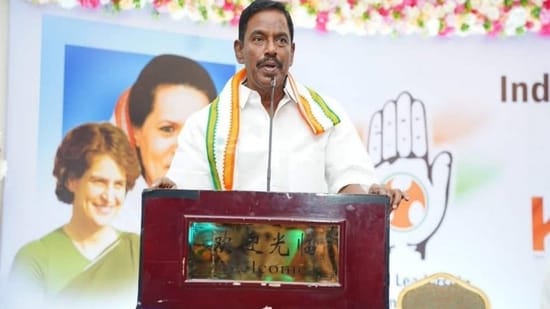
Puducherry Congress leader AV Subramanian resigns from all party positions ahead of assembly polls| India News
**Puducherry Congress Leader AV Subramanian Steps Down Ahead of Polls**
In a significant political development echoing through the Union Territory of Puducherry, veteran Congress leader A.V. Subramanian has tendered his resignation from all his party positions. Citing “private reasons and unavoidable circumstances,” Subramanian’s decision, conveyed in a letter to Puducherry Congress chief V. Vaithilingam, has sent ripples across the local political landscape, particularly as the region gears up for upcoming assembly elections. This move marks a notable shift within the Congress ranks and invites questions about the party’s cohesion and strategy in the crucial months ahead.
For decades, A.V. Subramanian has been a recognisable figure in Puducherry politics. His journey with the Congress party has been long and impactful, holding various key positions that have given him considerable influence within the party’s organizational structure. Known for his grounded approach and deep understanding of local dynamics, Subramanian’s presence has been a stabilising force for the party in many constituencies. His resignation, therefore, is not merely the departure of a single leader but potentially a tremor that could affect the party’s grassroots support and overall campaign machinery.
The formal communication of his resignation was a straightforward letter addressed to the party president. The phrase “private reasons and unavoidable circumstances” is often used in political circles when leaders step away from active roles. While it provides a general explanation, it also leaves room for speculation about underlying issues that might have contributed to the decision. Local political analysts, including insights gathered by Omni 360 News from conversations with community leaders, suggest that such resignations often hint at internal disagreements, disillusionment with party functioning, or a desire for a change in personal priorities. However, without further public statements from Subramanian himself, these remain conjectures within the political discourse.
Puducherry, as a Union Territory, has a unique political ecosystem. Unlike a full state, its governance structure involves a delicate balance between the elected government and the central administration. This often leads to heightened political sensitivities and frequent shifts in alliances and party loyalties. The Congress party, historically a dominant force, has faced challenges in recent times, battling against strong regional players and the growing influence of national parties. In this context, the departure of an experienced leader like Subramanian could impact the party’s ability to consolidate its base and present a united front, especially when facing the electoral challenge.
This resignation arrives at a crucial juncture, with assembly elections on the horizon. For a 12th standard student trying to understand this, imagine a school sports team preparing for a big championship. If one of their most experienced and respected players suddenly leaves the team just before the crucial matches, it creates uncertainty. The team might lose a valuable player, and others might wonder why they left. Similarly, in politics, when a key leader resigns, it can affect the party’s confidence, its ability to plan its election strategy, and even how voters perceive its strength.
Local news outlets and political commentators across Puducherry have been closely observing the implications. While major national media has reported the fact, deeper insights from regional publications like The New Indian Express and local web portals often reveal the grassroots sentiment. These sources frequently highlight how such internal shifts can either galvanise the remaining party members to work harder or, conversely, create a vacuum that opponents might exploit. The Congress party will now face the task of reassuring its cadre and voters that the departure will not derail its electoral ambitions.
The question now looms: what next for A.V. Subramanian and the Puducherry Congress? Will his “private reasons” lead to a complete withdrawal from political life, or might he resurface in a different capacity, perhaps even with another political outfit? Such moves are not uncommon in the dynamic world of Indian politics. For the Congress, it necessitates a swift internal review and possibly a restructuring of key roles to fill the void left by Subramanian’s exit. The party leadership will need to demonstrate strong leadership to maintain unity and focus as they head into the electoral contest.
This development underscores the ever-changing nature of political allegiances and the internal challenges that even long-established parties face. It serves as a stark reminder that electoral battles are not just fought against rival parties but also against internal dissent and shifts in individual commitment. The political narrative in Puducherry will undoubtedly weave this event into its fabric, with consequences that will unfold in the coming months.
Key Takeaways
* Veteran Congress Leader Resigns: A.V. Subramanian has stepped down from all his party positions in the Puducherry Congress.
* Citing Personal Reasons: The stated cause for his resignation is “private reasons and unavoidable circumstances.”
* Timing is Critical: The resignation occurs just ahead of crucial assembly elections in the Union Territory.
* Potential Impact on Congress: This departure could affect the party’s organizational strength, morale, and electoral strategy.
* Puducherry Political Dynamics: The Union Territory’s unique political landscape makes such internal shifts highly significant.





