
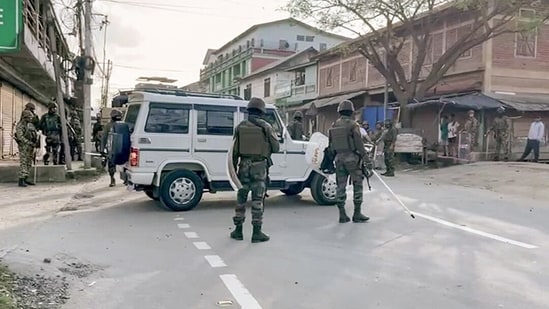
Manipur: Four killed in factional clash between Naga insurgent groups| India News
Deadly Factional Violence Grips Manipur’s Kamjong District
Kamjong, Manipur – A deeply unsettling incident unfolded in Manipur’s remote Kamjong district this past Saturday, casting a fresh shadow over the delicate peace in the region. Four individuals were killed in a fierce factional clash between rival Naga insurgent groups, a grim reminder of the long-standing complexities simmering beneath the surface of the state.
The violent confrontation took place near Hongbei village, nestled within the Kasom Khullen block of Kamjong district. Local reports and security sources confirm the exchange of fire erupted around 8:30 PM and continued for approximately fifty minutes, concluding by 9:20 PM. The immediate aftermath left a community in shock and highlighted the persistent challenges faced by authorities and residents alike.
Understanding the Conflict: A Look at the Factions
For those less familiar with the intricate dynamics of the region, understanding who was involved is crucial. The clash reportedly pitted cadres of the National Socialist Council of Nagaland-Isak-Muivah (NSCN-IM) against those from the National Socialist Council of Nagaland-Khaplang-Yung Aung (NSCN-K YA). Both are prominent Naga insurgent groups with distinct histories and objectives, and their rivalry often escalates into deadly encounters over territory, influence, and differing approaches to the Naga political movement.
The NSCN-IM has been engaged in a prolonged peace dialogue with the Indian government, advocating for a “Greater Nagalim” that encompasses Naga-inhabited areas across Manipur, Assam, Arunachal Pradesh, and Nagaland itself. This ambition frequently puts them at odds with other groups and local sentiments in the affected states. On the other hand, the NSCN-K YA, a splinter faction of the original NSCN-K, operates largely from across the international border and has historically adopted a more hardline stance, often clashing with groups like NSCN-IM over control and extortion activities in strategic areas.
Explaining this simply: imagine two large, powerful clubs in a school, each wanting to be the most influential and control certain areas of the playground. Sometimes, their disagreements become so intense that fights break out, even though both claim to be working for the ‘school’s best interests’. In the context of Manipur, these “clubs” are well-armed and their disputes have far more serious consequences, impacting entire villages and regions.
The Incident’s Details and Local Impact
According to initial reports from law enforcement and verified by local news outlets like Imphal Free Press and E-pao.net, the four fatalities were members of one of the warring factions. Their bodies were reportedly discovered later, a grim testament to the intensity of the brief but deadly gun battle. The remoteness of Hongbei village, a characteristic of much of Kamjong district, often means that such incidents take time to be fully investigated and understood by external agencies, with local communities bearing the immediate brunt of the violence.
The immediate reaction in the area typically involves heightened fear and a palpable sense of insecurity among villagers who find themselves caught between armed groups. While security forces, including the Assam Rifles, were alerted to the situation, accessing these remote locations quickly can be a logistical challenge, underscoring the difficulties in maintaining absolute control over every corner of the vast and geographically diverse region. The presence of armed groups in border areas remains a persistent concern for regional stability.
Such clashes not only lead to loss of life but also disrupt daily routines, impede development activities, and foster an environment of mistrust. Children’s education can suffer, economic activities are hindered, and the overall social fabric of communities living in these vulnerable areas is strained. The constant threat of violence, even if infrequent, leaves a lasting psychological impact.
Broader Implications for Regional Peace and Stability
The recent Kamjong incident serves as a stark reminder that despite ongoing peace processes with various groups, the internal dynamics and rivalries among insurgent factions continue to pose a significant threat to peace and security in India’s northeastern states. The Naga peace talks, a cornerstone of the central government’s efforts to bring lasting stability, often navigate these complex inter-factional relationships.
When groups involved in peace talks continue to clash with those outside or even within their own broader movement, it complicates the path forward. It underscores the challenges of consolidating peace when multiple actors, each with their own agendas and interpretations of a desired future, vie for supremacy. Omni 360 News understands the importance of detailed reporting on these nuanced situations, providing context beyond just the headlines.
The repeated occurrence of such incidents calls for sustained efforts on multiple fronts: robust intelligence gathering, effective deployment of security forces, and critically, a continued focus on bringing all stakeholders to the negotiating table. Building lasting peace requires not only political agreements but also community engagement and addressing the root causes of grievances that fuel insurgency.
Key Takeaways
* A fatal factional clash occurred near Hongbei village, Kamjong district, Manipur, involving rival Naga insurgent groups.
* The incident on Saturday between 8:30 PM and 9:20 PM resulted in four deaths.
* The conflict involved NSCN-IM and NSCN-K YA, groups with differing approaches to the Naga political issue.
* Such violence underscores the persistent challenges to peace and stability in Manipur and the broader northeastern region.
* Local communities bear the brunt of insecurity and disruption caused by these clashes.
The incident in Kamjong is more than just a statistic; it represents a continuing struggle for stability and peace in a region that has long yearned for it. As the details emerge and investigations proceed, the focus remains on ensuring the safety of innocent civilians and working towards a future where such tragic clashes become a relic of the past.





