
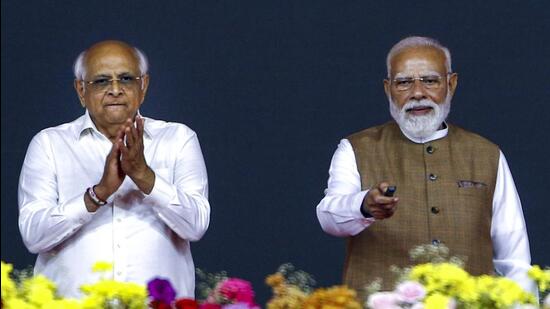
PM Modi accuses Congress of “spreading panic and fear” during global crises| India News
PM Modi’s Gujarat Address Navigating Crises Fuel Prices and a ₹20,000 Crore Development Spree Key Takeaways Omni 360 News
Prime Minister Narendra Modi recently addressed a spirited rally in Mehsana, Gujarat, delivering a sharp critique of the Congress party’s approach during global crises. His address also focused on defending the government’s management of fuel prices and spotlighting substantial development projects worth ₹20,000 crore. The event, a crucial stop in the ongoing election campaign, provided a platform for the Prime Minister to articulate his vision and counter opposition narratives. Omni 360 News brings you a detailed look at the key points from his address.
Accusations of Panic and Fear Mongering
During his address, Prime Minister Modi launched a direct attack on the Congress party, accusing them of consistently spreading panic and fear during times of global uncertainty. He specifically referenced the challenging periods of the COVID-19 pandemic and the Ukraine conflict. According to the Prime Minister, the opposition often blows minor issues out of proportion, creating unnecessary anxiety among the populace. He used the analogy of turning a “mole-hill into a mountain,” suggesting that such actions undermine public confidence and hinder effective crisis management.
This narrative aimed to portray the ruling government as a steady hand during turbulent times, contrasting it with an opposition seen as opportunistic and destabilizing. For a 12th-standard student, imagine a situation where a tough exam is coming up. Instead of preparing, some classmates might just spread rumors about how hard it will be, making everyone else worried, even though the teachers are providing study materials and support. PM Modi is essentially saying the Congress acts like those classmates, creating panic instead of offering constructive solutions during tough times like a global health crisis or an international conflict.
Defending Fuel Price Management
A significant portion of PM Modi’s speech was dedicated to defending his government’s handling of fuel prices, a sensitive issue that directly impacts every household. He highlighted the significant financial burden undertaken by the central government, stating it absorbed “crores of rupees” by reducing taxes on petrol and diesel. This move, he explained, was aimed at shielding ordinary citizens from the drastic increases in global crude oil prices, which surged due to international events like the Ukraine war.
The Prime Minister contrasted the central government’s actions with those of certain state governments, implicitly referring to Congress-ruled states, which he suggested did not sufficiently reduce Value Added Tax (VAT) on fuel. He argued that if these states had lowered their taxes, the financial relief to consumers would have been even greater. This explanation serves to clarify a complex economic issue for the public. Think of it this way: when you buy a cold drink, part of the price is for the drink itself, and part is a tax. If the cost of making the cold drink goes up, the seller might raise the price. But if the government decides to cut its ‘tax’ portion, the final price for you might not go up as much, or it might even come down. PM Modi is saying the central government reduced its ‘tax’ part to help people, but some states didn’t do the same with their ‘tax’ part.
A ₹20,000 Crore Development Spree for Gujarat
Beyond political rhetoric, the Prime Minister’s visit also marked a significant moment for Gujarat’s developmental landscape. He inaugurated and laid foundation stones for a wide array of projects totaling an impressive ₹20,000 crore. These initiatives span critical sectors vital for public welfare and economic growth, demonstrating a commitment to enhancing the quality of life in the state.
The projects encompass:
* Healthcare: New super-specialty hospitals and medical colleges, aimed at bolstering medical infrastructure and providing advanced healthcare services to more people. This means better doctors and facilities for everyone.
* Education: New university buildings, signifying an expansion of higher education opportunities and improved learning environments for students. More classrooms and better resources for college students.
* Transport: Railway electrification projects, which will enhance efficiency, reduce pollution, and improve connectivity across the region. Imagine faster and cleaner train travel.
* Urban Development: Smart city initiatives and urban housing projects, designed to create more livable, modern, and sustainable urban spaces. This means better roads, sanitation, and homes in cities.
* Water Supply: Water supply schemes, crucial for ensuring adequate and clean drinking water for communities, especially in arid or semi-arid regions. Getting clean water to every home is a big deal.
* Heritage Conservation: Renovation and development of pilgrimage sites, preserving cultural heritage while boosting religious tourism and local economies. Making historical and religious places better for visitors.
These projects reflect a comprehensive development agenda, addressing immediate needs while planning for future growth. The ₹20,000 crore investment is a substantial injection into Gujarat’s economy, promising job creation and improved services for its citizens.
Key Takeaways from the Address
The Prime Minister’s rally in Mehsana offered a multifaceted message, resonating with various segments of the electorate.
1. The central government aimed to position itself as a responsible and stable leader capable of managing both domestic challenges and global headwinds.
2. There was a clear effort to underscore the government’s economic policies, particularly regarding fuel prices, highlighting efforts to protect consumers.
3. The announcement and inauguration of numerous development projects showcased a tangible commitment to progress across essential sectors in Gujarat.
4. The political narrative sought to differentiate the ruling party from the opposition, portraying the latter as a source of negativity during crises.
As the election fervor continues, such addresses play a pivotal role in shaping public discourse and influencing voter sentiment. The specifics of these claims and project implementations will undoubtedly remain a focal point for public scrutiny and journalistic inquiry, offering a complete perspective to our readers at Omni 360 News.





