
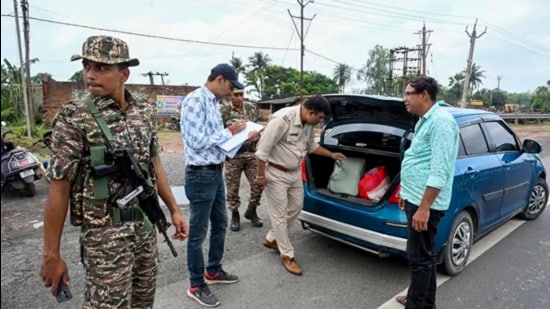
Bengal AIMIM leader held for violence during protests against voter deletions| India News
Malda Unrest Arrest Triggers Political Firestorm Omni 360 News Analysis
The arrest of Asadullah Biswas, a prominent leader of the All India Majlis-e-Ittehadul Muslimeen (AIMIM) in West Bengal, has ignited a fresh round of political accusations, particularly from Chief Minister Mamata Banerjee. The arrest, linked to violence during protests in Malda against alleged voter deletions, has been framed by the state’s top executive as evidence of a deeper conspiracy involving both AIMIM and the Bharatiya Janata Party (BJP) to destabilize the region. This incident, unfolding against the backdrop of an already charged political atmosphere, demands a closer look into its origins and potential ramifications.
The Malda Incident Unveiled
The focal point of this political drama is Malda district, a region in West Bengal that has witnessed sporadic unrest. On March 31, protests erupted concerning the deletion of voters from electoral rolls. For anyone in the 12th standard, imagine a situation where people are worried their names might be removed from the list that allows them to vote. This can be a very sensitive issue, especially in a democracy, as voting is a fundamental right. When people feel their right to vote is threatened, protests can sometimes turn volatile. In Malda, these protests regrettably escalated into violence, leading to a police investigation to identify and apprehend those responsible for the disruption.
The police investigation subsequently led to the arrest of Asadullah Biswas, who holds the position of state general secretary for AIMIM. This wasn’t just any arrest; it involved a recognized political figure, immediately drawing the attention of the state’s highest office.
Chief Minister’s Stern Allegations
Chief Minister Mamata Banerjee did not mince words. Speaking at a public gathering in Chopra, North Dinajpur, she directly addressed the Malda violence and the subsequent arrest. Her statement was clear and potent: the arrest of the AIMIM leader, in her view, laid bare a clandestine scheme. She explicitly alleged that AIMIM and the BJP were working in concert to create disturbances and communal disharmony within West Bengal.
From her perspective, the violence in Malda was not merely an isolated incident of unrest but a strategically orchestrated move aimed at disrupting peace and creating divisions among communities. This accusation is significant because it directly links two political parties, often seen as rivals in other contexts, in a shared objective of destabilizing the state. It paints a picture of a calculated effort to stir up trouble, potentially for electoral gains or to undermine the ruling Trinamool Congress (TMC) government. Such allegations, coming from a Chief Minister, carry substantial weight and often set the tone for the political narrative across the state.
The Counter-Narratives AIMIM and BJP Respond
As expected, both AIMIM and BJP swiftly responded to the Chief Minister’s strong accusations. AIMIM leaders vehemently denied any involvement in orchestrating violence. They argued that their leader, Asadullah Biswas, was being unfairly targeted and implicated in a political witch-hunt. For them, the arrest and the Chief Minister’s allegations are an attempt to suppress their political activities and influence in the state, especially as they try to expand their base. They often characterize such actions as the ruling party’s fear of growing opposition.
On the other side, the BJP also dismissed the allegations of collusion. Instead, they demanded a thorough and impartial investigation into the Malda violence, criticizing the TMC government for what they perceived as attempts to politicize a serious law and order situation. The BJP’s stance is typically to hold the state government accountable for maintaining peace and order, and they often accuse the TMC of failing in this regard or using police action for political vendettas. They call for transparency and justice, rejecting the notion of any secret alliance with AIMIM.
The Broader West Bengal Political Landscape
To truly understand this incident, one must grasp the broader political climate in West Bengal. The state is known for its intense political rivalries, particularly between the ruling TMC and the opposition BJP, with other parties like AIMIM trying to carve out their space. Elections, whether local or state-wide, are always around the corner, and every incident, every statement, is often viewed through the lens of political strategy and electoral advantage. Issues like voter deletion become highly sensitive, as they touch upon the very foundation of democratic participation and can fuel narratives around citizenship and belonging, especially in areas with diverse populations.
The Chief Minister’s allegations of collusion between AIMIM and BJP are not entirely new in the state’s political discourse. The TMC has previously suggested that AIMIM acts as a “B-team” for the BJP, implying that AIMIM’s presence in West Bengal primarily serves to divide votes that would otherwise go to the TMC, thereby indirectly benefiting the BJP. This narrative is frequently deployed to discredit both parties and consolidate the TMC’s support base. The Malda incident now provides a fresh flashpoint for this ongoing political rivalry.
Omni 360 News Perspective and Key Takeaways
From an Omni 360 News perspective, this event highlights the complexities of political dynamics in India, particularly in states like West Bengal. It underscores how law enforcement actions, especially arrests of political figures, can quickly become intertwined with broader political narratives and accusations.
Key Takeaways:
* An AIMIM leader’s arrest in connection with Malda violence has sparked a major political dispute.
* Chief Minister Mamata Banerjee explicitly alleges a conspiracy between AIMIM and BJP to create disturbances.
* Both AIMIM and BJP vehemently deny these claims, accusing the TMC of political targeting and politicizing a law and order issue.
* The incident reflects the high-stakes political environment in West Bengal, where every event is often viewed through an electoral lens.
* It emphasizes the importance of independent investigations to ascertain facts amidst conflicting political claims and ensure justice.
For the average citizen, especially a 12th-grade student trying to make sense of the news, this situation demonstrates how allegations can shape public perception. It emphasizes the need to look beyond headline statements and seek out detailed, verified information from various sources. The demand for a fair investigation and transparent processes becomes paramount to ensure that justice is served and political stability is maintained, irrespective of party affiliations. Ultimately, the Malda incident serves as a stark reminder of the delicate balance between protest, law enforcement, and political maneuvering in a vibrant democracy.





