
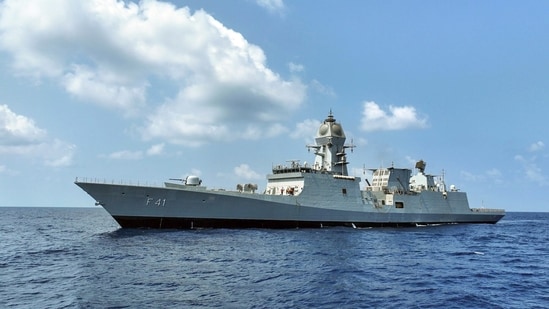
Defence minister Rajnath Singh commissions advanced stealth Frigate INS Taragiri| India News
Strengthening Eastern Waters India’s New Stealth Frigate Taragiri Joins Fleet
The Indian Navy’s capabilities received a significant boost with the recent induction of INS Taragiri, an advanced stealth frigate that now patrols India’s vital eastern seaboard. This development marks a pivotal moment, underscoring the nation’s commitment to fortifying its maritime security in a region of escalating geopolitical importance. For the team at Omni 360 News, understanding these strategic moves is paramount, as they directly impact regional stability and national interests.
The commissioning ceremony, a moment of national pride, saw Defence Minister Rajnath Singh officially welcome the warship into service. Built by Mazagon Dock Shipbuilders Limited (MDL) in Mumbai, Taragiri is the third vessel in the Project 17A series of stealth frigates. These ships are designed to be formidable assets, embodying India’s growing prowess in indigenous defense manufacturing and its strategic vision for naval power.
Understanding INS Taragiri’s Role and Design
To grasp the full significance of Taragiri, one must appreciate its sophisticated design and intended role. A stealth frigate, at its core, is engineered to minimize its radar, infrared, and acoustic signatures, making it difficult for adversaries to detect and track. This characteristic is crucial for surprise operations and maintaining a tactical advantage in contested waters.
Taragiri is not just another ship; it represents a leap in naval technology for India. It boasts an array of advanced weaponry, including surface-to-air missiles, anti-ship missiles, and torpedoes, providing a multi-layered defense and offensive capability. Its state-of-the-art sensors and combat management system allow for real-time threat assessment and rapid response. Importantly, the ship incorporates significant indigenous content, with approximately 75% of its equipment and systems sourced from Indian firms. This commitment to local manufacturing, under the ‘Make in India’ initiative, reduces reliance on foreign suppliers and fosters self-reliance in critical defense technologies, creating jobs and stimulating the national economy.
These frigates are designed to operate across the full spectrum of naval warfare, from anti-submarine operations to air defense and surface warfare. For a 12th standard student, think of it like a highly advanced, multi-purpose defender that can hide exceptionally well, strike accurately, and protect valuable areas, all while being built mostly by Indian engineers and workers.
The Strategic Imperative of the Eastern Seaboard
The timing of Taragiri’s induction is no coincidence. India’s eastern seaboard, encompassing the vast Bay of Bengal and stretching down to the Andaman and Nicobar Islands, holds immense strategic and economic significance. This region serves as a gateway to Southeast Asia and beyond, with crucial international shipping lanes passing through it. These sea lines of communication (SLOCs) are vital for global trade, including energy supplies, making their security a top priority.
However, this importance also brings challenges. The Bay of Bengal is an area where several regional and extra-regional powers have growing interests, leading to increased maritime traffic and, at times, heightened geopolitical sensitivities. Issues such as piracy, illegal fishing, and environmental threats also demand a robust naval presence.
The Andaman and Nicobar Islands, strategically positioned at the confluence of the Bay of Bengal and the Andaman Sea, are India’s eyes and ears in this critical maritime domain. Enhancing naval assets on the eastern front allows India to project power, conduct surveillance, and respond swiftly to any developing situation in this expansive area. It provides a credible deterrent against any potential maritime incursions and reinforces India’s role as a net security provider in the Indian Ocean Region. This strengthens India’s ability to protect its island territories and ensures free and open navigation for all.
A Step Towards Greater Maritime Power
The commissioning of INS Taragiri is more than just adding a new ship to the fleet; it represents a concrete step in India’s ongoing efforts to modernize its navy and bolster its maritime defense architecture. It’s part of a larger vision to build a truly blue-water navy, capable of operating across vast ocean expanses and protecting national interests far from its shores.
This frigate, along with its sister ships from Project 17A, will significantly enhance the Indian Navy’s operational readiness and combat effectiveness, particularly in the strategically crucial eastern theater. It allows India to better safeguard its economic interests, protect its maritime borders, and contribute to regional stability and security in the Indo-Pacific. This demonstrates a clear message of self-reliance and strategic assertiveness.
Key Takeaways
- Enhanced Naval Strength: INS Taragiri, a cutting-edge stealth frigate, significantly boosts the Indian Navy’s capabilities.
- Eastern Seaboard Focus: Its deployment strengthens India’s defense posture in the strategically vital eastern waters and the Bay of Bengal.
- Indigenous Prowess: Built in India, Taragiri highlights the nation’s growing self-reliance in advanced defense manufacturing.
- Regional Security: The ship’s advanced capabilities contribute to deterring threats and ensuring maritime stability in the Indian Ocean Region.
- Project 17A Progress: Taragiri is the third in a series of advanced stealth frigates, underscoring ongoing naval modernization.
As India continues its trajectory towards becoming a major global power, the strength and reach of its navy, particularly in critical maritime zones like the eastern seaboard, will remain a cornerstone of its national security strategy. The induction of INS Taragiri is a clear testament to this unwavering resolve, as reported by Omni 360 News.





