
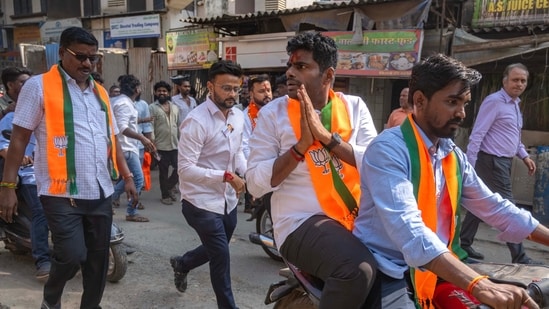
Annamalai not on BJP list for Tamil Nadu: Once the party's main South face, ‘Singham’ on the sidelines| India News
BJP’s Tamil Nadu Bypoll Candidate List Unveiled Annamalai’s Strategic Absence Explained
The political landscape in Tamil Nadu always brims with intrigue, and the recent announcement by the Bharatiya Janata Party (BJP) regarding its candidates for the upcoming assembly bypolls has certainly added another layer. The party has officially released the names of its 27 candidates slated to contest the Tamil Nadu assembly by-elections, set for April 23. This revelation, meticulously covered by Omni 360 News, brings into sharp focus the party’s localised strategies and broader national ambitions.
A significant point of discussion among political observers and local residents alike revolves around the absence of K. Annamalai, the former state unit chief, from this particular list. Initially, some interpretations might suggest a diminishment of his role, but a deeper dive into the electoral context reveals a strategic positioning rather than a sidestepping.
Annamalai’s Focus on Lok Sabha Elections
To understand why Annamalai is not among the 27 candidates for the assembly bypolls, it is crucial to remember his primary electoral commitment. K. Annamalai is actively contesting the much-anticipated Lok Sabha elections, representing the BJP from the high-profile Coimbatore parliamentary constituency. This pivotal Lok Sabha seat went to polls on April 19. Given that he is a prominent candidate in a national general election, it is a standard practice that he would not simultaneously be listed for assembly by-elections. His absence from the bypoll list, therefore, is not an oversight or a signal of him being “on the sidelines,” but rather a clear indication of the BJP’s strategic deployment of its key leaders in critical electoral battles.
Annamalai, often dubbed “Singham” for his fierce public persona and background as an IPS officer, has been a significant face for the BJP in Tamil Nadu. His energetic campaigns and assertive communication style have garnered considerable attention, particularly among the youth and a section of the urban electorate. His candidacy from Coimbatore for the Lok Sabha polls underscores the party’s ambition to make inroads in a state traditionally dominated by Dravidian parties. Placing him in a direct parliamentary contest highlights his importance to the party’s national growth agenda.
The Assembly Bypoll Candidates and Local Strategy
The release of 27 candidates for the assembly by-elections, meanwhile, reflects the BJP’s concerted effort to strengthen its presence at the grassroots level in Tamil Nadu. These bypolls, though smaller in scale than general elections, are vital for parties to test their organisational strength, local appeal, and ground-level machinery. Each candidate selected is likely seen as having strong local connections and the potential to sway voters in their respective constituencies.
For a 12th standard student trying to grasp this, imagine a school sports day. The star athlete might be focusing on the major long-distance race (Lok Sabha), so they wouldn’t also sign up for every single short sprint (assembly bypolls). It’s about prioritising where their effort can make the biggest impact. The party leadership, much like a coach, decides where each player can best serve the team’s overall goal. The bypoll candidates are crucial players focused on specific, local victories that contribute to the party’s wider presence and influence in the state. These contests allow the BJP to identify emerging local leaders and build a stronger foundation for future elections.
Local media outlets and political analysts in Tamil Nadu have been closely scrutinising the chosen candidates, looking for insights into the BJP’s strategy in different regions. Some candidates might be known for their community work, others for their political experience, and some for their ability to connect with specific voter demographics. These choices are rarely arbitrary; they are the result of careful deliberation aimed at maximising electoral chances in diverse local settings.
BJP’s Broader Ambitions in Tamil Nadu
The BJP’s approach in Tamil Nadu has been characterised by a long-term vision to expand its footprint in a region where it has historically faced challenges. By actively contesting both Lok Sabha seats with prominent leaders like Annamalai and simultaneously fielding candidates for assembly bypolls, the party demonstrates its dual strategy: aiming for national representation while simultaneously nurturing local growth.
The absence of Annamalai from the bypoll list, therefore, should be viewed not as a demotion, but as a strategic decision that allows him to concentrate all his efforts on securing a significant Lok Sabha victory from Coimbatore. This victory, if achieved, would be a landmark moment for the BJP in Tamil Nadu and would naturally elevate Annamalai’s standing further within the party and the state’s political arena. Meanwhile, the bypoll candidates are tasked with the equally important job of expanding the party’s reach and influence at a local, granular level, which is essential for any party aiming for sustained growth.
Key Takeaways
* The BJP has announced 27 candidates for the Tamil Nadu assembly by-elections on April 23.
* Former state chief K. Annamalai is not on this list because he is currently a Lok Sabha candidate from Coimbatore, which polled on April 19.
* His absence from the bypoll list signifies a strategic deployment for a higher-stakes national election, not a sidelining.
* The bypoll candidate list reflects BJP’s efforts to build grassroots strength and identify local leaders in Tamil Nadu.
* These moves are part of the BJP’s broader, long-term strategy to expand its influence in a key South Indian state.
The coming weeks will reveal the outcomes of both the Lok Sabha contests and these assembly bypolls, providing a clearer picture of the BJP’s progress and the evolving political dynamics in Tamil Nadu. Omni 360 News will continue to bring detailed, factual reports on these crucial developments.





