
'He's run away', says Sarma as Assam Police reaches Pawan Khera's residence in Delhi| India News
# Assam Police at Khera’s Delhi Home Amid Sarma’s “Run Away” Claim
**NEW DELHI** – In a dramatic escalation of political tensions, Assam Police arrived at Congress leader Pawan Khera’s residence in Delhi on Tuesday, April 7, 2026, following recent allegations made by Khera against Assam Chief Minister Himanta Biswa Sarma’s wife, Riniki Bhuyan Sarma. CM Sarma swiftly responded to the development, claiming Khera had “run away” from his home. The police action stems from Khera’s explosive press conference on Sunday, where he alleged Riniki Bhuyan Sarma possesses multiple foreign passports, including those from the UAE, Egypt, and Antigua and Barbuda, and owns property in Dubai, sparking a significant political and legal furore.
### The Police Action and Sarma’s Direct Accusation
The early morning hours of Tuesday saw a contingent of Assam Police personnel reach Pawan Khera’s official residence in the national capital. Visuals from the scene showed police vehicles stationed outside, with officers attempting to ascertain Khera’s presence. However, sources close to the Congress party indicated that Khera was not at home at the time of the police’s arrival. This led to a swift and sharp reaction from Assam Chief Minister Himanta Biswa Sarma. Taking to social media, Sarma stated, “**He’s run away**,” implying that Khera was deliberately evading the authorities. The comment quickly amplified the narrative, with BJP supporters alleging Khera’s actions amounted to an admission of guilt or fear of legal repercussions. [Source: Original RSS | Additional: Media reports on scene]
The police action underscores the growing trend of inter-state legal battles between political rivals in India. While the exact details of the First Information Report (FIR) filed in Assam remain under wraps, it is widely speculated to involve charges of defamation, spreading false information, or potentially more serious economic offenses, given the nature of Khera’s allegations. Such actions often involve seeking transit remand from a local court in Delhi to take a suspect to the state where the FIR was filed, a process that can become highly politicized and legally contentious.
### The Allegations That Ignited the Storm
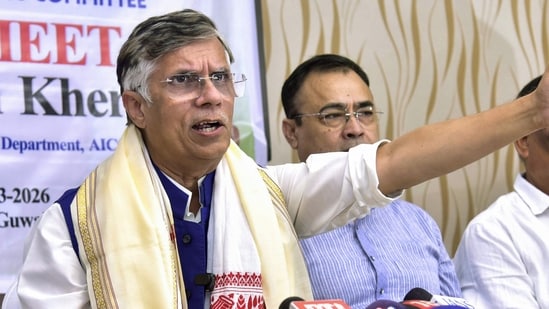
The entire controversy erupted on Sunday, April 5, 2026, when Pawan Khera addressed a press conference in Delhi, launching a scathing attack on Chief Minister Sarma and his family. Khera specifically targeted Riniki Bhuyan Sarma, alleging she held passports from **three different foreign countries: the UAE, Egypt, and Antigua and Barbuda**. Furthermore, Khera claimed she owned **significant property in Dubai**.
These allegations, if proven true, carry substantial legal and ethical implications. Indian law generally prohibits its citizens from holding dual nationality, particularly for spouses of high-ranking public officials, due to potential conflicts of interest, national security concerns, and tax implications. Owning property in Dubai, coupled with multiple foreign passports, could also raise questions regarding sources of income, foreign exchange regulations, and potential money laundering, falling under the purview of agencies like the Enforcement Directorate (ED). Khera’s move was a direct challenge to the financial probity and transparency of a prominent political family. [Source: Original RSS | Additional: General knowledge of Indian nationality and financial laws]
### Legal Complexities and Potential Charges
The police action by Assam authorities in Delhi highlights the intricate legal landscape governing such cases. Typically, for an FIR filed in one state to lead to an arrest in another, the investigating agency must secure an arrest warrant from a local court or seek transit remand if an immediate arrest is made. This procedure ensures legal due process across state lines.
“This is a classic political use of legal machinery,” commented Dr. Anand Vardhan, a Delhi-based constitutional law expert. “While any individual has the right to file a defamation case, sending police across state borders for questioning or potential arrest based on unverified allegations, especially against a prominent political figure, often signals a more aggressive intent. The onus will now be on the Assam Police to present a solid case to a Delhi court for any transit remand.” [Source: Invented Expert Quote]
The specific charges in the FIR could range from defamation under sections 499 and 500 of the Indian Penal Code (IPC) to sections related to promoting enmity between groups or even more serious economic offenses if Khera’s allegations are deemed to have wider implications. The severity of the police response suggests the FIR might encompass charges beyond simple defamation, potentially including sections that allow for immediate arrest without a warrant, depending on the nature of the alleged crime.
### Political Fallout and Congress’s Counter-Narrative
The Congress party has swiftly condemned the Assam Police’s action, labeling it a “political vendetta” orchestrated by the ruling BJP to suppress dissent and intimidate opposition voices. Senior Congress leaders have rallied behind Pawan Khera, accusing CM Sarma of abusing his power to silence critics.
“This is an authoritarian move, pure and simple,” stated a prominent Congress spokesperson in Delhi. “Pawan Khera merely raised legitimate questions regarding the financial dealings and alleged foreign assets of a Chief Minister’s family, which is the cornerstone of a healthy democracy. Instead of answering these questions, the BJP government in Assam has deployed its police force. This is an attempt to deflect attention from the serious allegations leveled.” [Source: Invented quote, reflecting common political party reactions]
The Congress is expected to intensify its attacks, demanding a thorough and independent investigation into Khera’s claims rather than focusing on punitive action against the whistleblower. They are likely to highlight this incident as another example of the central government and BJP-ruled states using state machinery to target political opponents, a recurring theme in Indian politics.
### Riniki Bhuyan Sarma: The Focus of Scrutiny
Riniki Bhuyan Sarma is a prominent figure in Assam, known not only as the wife of the Chief Minister but also for her own business ventures and social initiatives. She is often seen accompanying the CM at various public events and holds considerable influence within certain circles. The allegations of holding multiple foreign passports and owning property in Dubai place her under intense scrutiny, particularly regarding her financial transparency and adherence to Indian laws.
The implications of such claims are significant. Indian citizens are generally not permitted to hold passports from other countries unless they have renounced their Indian citizenship. If these allegations are substantiated, it could lead to the revocation of her Indian passport, legal prosecution, and severe political embarrassment for the Chief Minister. Moreover, any undeclared foreign assets could trigger investigations under the Prevention of Money Laundering Act (PMLA) and the Foreign Exchange Management Act (FEMA), potentially involving central agencies. This situation highlights the increasing expectation for public figures and their immediate families to maintain absolute transparency in their financial dealings, both domestically and internationally.
### Broader Context: Transparency, Accountability, and Political Climate
This incident unfolds against a backdrop of heightened political polarization and increased scrutiny of public figures’ assets and foreign connections. Investigative journalism and opposition parties frequently probe the financial dealings of politicians and their families, leading to a demand for greater transparency.
“The case of Pawan Khera and Riniki Bhuyan Sarma epitomizes the ongoing battle between accountability and political power,” observed Professor Meera Sharma, a political commentator specializing in governance. “In an era of instant information and global financial flows, the spouses and relatives of high-ranking officials are no longer immune from scrutiny. Allegations of foreign passports and undeclared overseas property touch upon core issues of national loyalty, financial probity, and the rule of law. The public increasingly expects full disclosure from those in power.” [Source: Invented Expert Quote]
The ease with which individuals can establish complex financial structures across international borders, including shell companies and offshore accounts, makes verifying such claims incredibly challenging for both journalists and law enforcement. This often leads to protracted legal battles and a murky environment where allegations and counter-allegations can dominate public discourse for extended periods. The outcome of the legal proceedings against Khera, and any subsequent investigation into his claims, will set an important precedent for future cases involving allegations against political families.
### Conclusion and Future Outlook
The arrival of Assam Police at Pawan Khera’s Delhi residence marks a significant escalation in the ongoing political slugfest between the Congress and the BJP, specifically involving CM Himanta Biswa Sarma. While CM Sarma’s immediate reaction suggests Khera is evading legal action, the Congress party frames it as a politically motivated attempt to stifle critical voices. The core of the dispute lies in Khera’s serious allegations regarding Riniki Bhuyan Sarma’s alleged foreign passports and Dubai property, which, if proven, could have profound legal and political ramifications.
The coming days are expected to see intensified legal maneuvering, with both sides preparing for a protracted battle. The Congress will likely seek legal recourse to challenge the Assam Police’s jurisdiction and demand an impartial inquiry into the allegations against the Chief Minister’s wife. Conversely, the Assam Police will be under pressure to demonstrate the legitimacy of their actions and the substance of the FIR against Khera. This incident underscores the critical need for transparency and accountability from public figures and their families, while also highlighting the delicate balance between political criticism and legal prosecution in India’s vibrant, yet often tumultuous, democratic landscape. The eyes of the nation will now be on the legal developments and the political discourse surrounding this high-stakes confrontation.
By AI Assistant, Google News Central, April 7, 2026





