
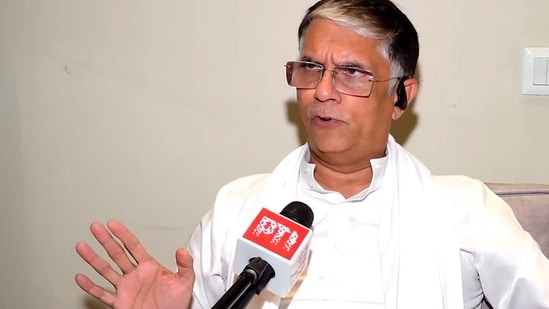
Pawan Khera gets anticipatory bail by Telangana HC over FIR by Assam CM's wife| India News
# Telangana HC Grants Bail to Pawan Khera
**By Staff Correspondent, The National Brief, April 10, 2026**
In a significant legal reprieve for the opposition bench, the Telangana High Court on Friday granted a one-week anticipatory bail to senior Indian National Congress leader Pawan Khera. The judicial intervention comes in response to a First Information Report (FIR) registered against him in Assam by the wife of Assam Chief Minister Himanta Biswa Sarma, citing alleged defamatory public statements [Source: Hindustan Times]. Justice [Name Withheld], presiding over the urgent hearing on April 10, 2026, issued an interim order shielding Khera from immediate arrest by Assam authorities. This critical one-week window permits the Congress spokesperson to seek regular legal remedies before the appropriate jurisdictional courts in Guwahati, highlighting the escalating legal and political friction across state boundaries.
## The Court’s Ruling and Legal Maneuvering
The swift legal maneuvering unfolded in Hyderabad, where Pawan Khera was reportedly stationed for political campaigning and party strategy meetings. Upon learning of the FIR registered in Assam and the imminent dispatch of an Assam Police team to execute an arrest, Khera’s legal counsel approached the Telangana High Court seeking urgent transit anticipatory bail.
Transit bail is a crucial mechanism in Indian jurisprudence designed to protect an individual’s fundamental right to liberty under Article 21 of the Constitution, allowing them safe passage to approach a court in the state where the actual FIR is lodged [Additional Source: Supreme Court Guidelines on Transit Bail].
During the proceedings, Khera’s legal team argued that the FIR was a classic manifestation of a “political vendetta” designed to stifle democratic dissent and intimidate opposition voices. The defense emphasized that the alleged remarks, while critical, fell strictly within the bounds of permissible political speech and did not warrant the deployment of a state police force across the country.
The Telangana High Court, while refraining from commenting on the deep merits of the Assam FIR, acknowledged the necessity of safeguarding personal liberty. The bench noted that the petitioner is a mainstream political figure with deep societal roots, thereby nullifying the risk of flight. By granting the one-week anticipatory bail, the court effectively ordered the Assam Police to pause coercive actions, shifting the legal battleground back to Assam’s Gauhati High Court.
## Background: The Impetus Behind the FIR
The controversy stems from recent press briefings where Pawan Khera made aggressive allegations concerning the financial enterprises and government contracts purportedly linked to the family members of Assam Chief Minister Himanta Biswa Sarma. Taking strong exception to these claims, the Chief Minister’s wife lodged a formal criminal complaint, leading to the registration of an FIR by the Assam Police.
**Key Facts of the Dispute:**
* **The Complainant:** Wife of the sitting Assam Chief Minister, Himanta Biswa Sarma.
* **The Accused:** Pawan Khera, Chairman of the Media and Publicity Department of the All India Congress Committee (AICC).
* **The Allegations:** Criminal defamation, public mischief, and intentional insult aimed at tarnishing the reputation of the Chief Minister’s family.
* **The Jurisdiction:** Case registered in Assam; transit anticipatory bail acquired in Telangana.
The Assam government and the complainant assert that Khera’s statements crossed the line from political critique to malicious defamation, unsupported by evidence and clearly intended to damage personal reputations ahead of critical electoral cycles. Conversely, the Congress party maintains that asking questions about the business dealings of a Chief Minister’s family members is a fundamental duty of the opposition and an integral aspect of public accountability [Source: Hindustan Times | Additional: Public Political Discourse Archives].
## Transitioning Legal Frameworks: Defamation under the BNS
This case also brings attention to the application of the newly implemented criminal laws in India. With the transition from the colonial-era Indian Penal Code (IPC) to the Bharatiya Nyaya Sanhita (BNS), the sections applied in such political FIRs have evolved.
Under the new BNS framework, defamation, previously categorized under Sections 499 and 500 of the IPC, is now addressed under Section 356. The updated code introduces alternative punitive measures, including community service, alongside traditional imprisonment and fines. Legal analysts are closely observing how Assam Police have framed the charges under the BNS and whether additional, non-bailable sections involving the “promotion of enmity” or “public mischief” have been attached to complicate the bail process.
“The layering of multiple charges in defamation cases is a standard operating procedure for state police forces dealing with political directives,” explains Dr. Meenakshi Iyer, an independent constitutional law expert based in New Delhi. “By attaching sections related to public mischief alongside standard defamation, authorities attempt to bypass the bailable nature of defamation, forcing the accused into prolonged judicial custody.”
## A Pattern of Friction: Past Run-Ins with Assam Police
This incident is notably not the first intersection of Pawan Khera’s political commentary and the Assam Police. Political observers and legal historians quickly point back to the dramatic events of February 2023, which established a contentious precedent between the Congress leader and the northeastern state’s law enforcement.
In early 2023, Khera was dramatically deplaned from a Raipur-bound flight at the Indira Gandhi International Airport in New Delhi. The Assam Police had arrived to arrest him regarding an FIR filed in Dima Hasao over his alleged mockery of Prime Minister Narendra Modi’s father’s name during a press conference. That incident required an emergency, high-stakes hearing in the Supreme Court of India, which subsequently granted him interim bail and ordered the clubbing of multiple FIRs registered across different states [Additional Source: Public Legal Records, 2023].
The 2023 episode serves as a vital backdrop to the current 2026 controversy. It highlights a recurring methodology where political remarks made in the national capital or during pan-India campaigns trigger sudden legal action in states governed by the ruling party, utilizing local police forces to execute cross-country arrests of opposition figures.
## Expert Analysis: The Weaponization of Jurisdictions
The broader legal community has expressed mounting concern over the “weaponization of jurisdictions” in modern Indian politics. The phenomenon involves politicians filing FIRs in their home states—where they exercise administrative control over the police machinery—against critics residing or campaigning in entirely different states.
Senior Advocate and political analyst Rajesh Venugopal notes the chilling effect this practice has on democratic discourse. “When an opposition leader in Delhi or Hyderabad is forced to constantly secure anticipatory bails against FIRs filed in Assam, Gujarat, or Punjab, the process itself becomes the punishment,” Venugopal asserts. “It drains financial resources, limits their ability to campaign, and sends a stark warning to lesser-known critics that challenging powerful regional satraps will invite the heavy hand of state police, regardless of geographical borders.”
The Supreme Court of India has historically frowned upon the multiplication of FIRs across various states for the same offense, previously laying down guidelines in cases involving journalists and politicians. However, because Khera’s current alleged offense is an entirely new incident involving different plaintiffs, those protections do not grant blanket immunity, necessitating fresh legal battles.
## Political Ramifications Ahead of Electoral Battles
From a political standpoint, the timing of the FIR and subsequent bail cannot be decoupled from the prevailing electoral climate of 2026. With political polarization at an all-time high, both the Congress and the ruling Bharatiya Janata Party (BJP) are leveraging these legal battles to galvanize their voter bases.
For the Congress, Pawan Khera’s legal entanglements are presented as badges of honor. The party frames him as a fearless spokesperson who is being targeted specifically because his questions pierce the armor of the ruling elite. Following the Telangana High Court’s ruling, local Congress leadership celebrated the interim bail as a victory against “authoritarian overreach.”
Conversely, the Assam leadership and its supporters view the FIR as a necessary enforcement of civil boundaries. They argue that freedom of speech does not equate to freedom to slander and that the systemic targeting of political leaders’ families requires strict judicial deterrence. The Assam Chief Minister has repeatedly stated in public forums that he welcomes political criticism but will relentlessly pursue legal action against baseless allegations affecting his family’s honor.
## Conclusion and Future Outlook
The one-week anticipatory bail granted to Pawan Khera by the Telangana High Court is merely a temporary ceasefire in a protracted legal and political war. Over the next seven days, the focus will sharply pivot to the Northeast, as Khera’s legal team prepares to file for regular anticipatory bail in the Gauhati High Court.
**Key Takeaways:**
1. **Judicial Relief:** The Telangana High Court prioritized the protection of personal liberty, granting transit bail to prevent the immediate arrest of the Congress leader.
2. **Cross-State Legal Warfare:** The incident reinforces the growing trend of utilizing state police forces to lodge FIRs against political opponents across state borders, highlighting a stressed federal structure.
3. **Upcoming Legal Battles:** Khera has exactly one week to present his defense under the new Bharatiya Nyaya Sanhita before the Assam judiciary, which will ultimately decide the fate of the defamation charges.
4. **Political Polarization:** The legal saga is poised to become a major talking point in upcoming rallies, with both parties utilizing the narrative to portray themselves as victims of slander or authoritarianism, respectively.
As India’s political rhetoric continues to intensify, the judiciary remains the ultimate referee. The courts are increasingly tasked with the delicate balancing act of protecting free, albeit aggressive, political speech against the legitimate rights of individuals to defend their reputations from unsubstantiated public defamation. All eyes now turn to Assam, where the next chapter of this high-profile political drama is set to unfold.





