
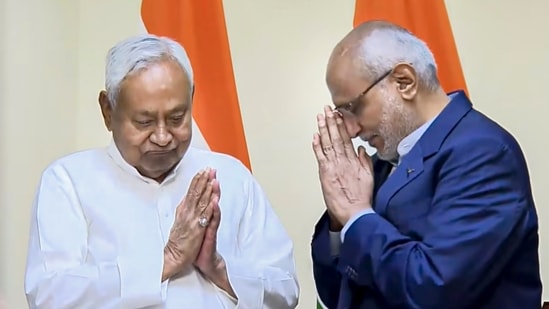
Nitish Kumar takes oath as Rajya Sabha MP; decision on next Bihar CM pending| India News
# Nitish Takes RS Oath; Bihar CM Race Wide Open
By Siddharth Narayan, The Political Observer, April 10, 2026
Nitish Kumar, Bihar’s **longest-serving Chief Minister**, officially took the oath as a Rajya Sabha Member of Parliament on Friday, April 10, 2026, in New Delhi. Administered by the Chairman of the Rajya Sabha, the ceremony marks a monumental shift in Indian politics, closing Kumar’s multi-decade dominance over the state legislative assembly. While the 75-year-old leader transitions to the national legislative arena, the crucial decision regarding his successor in Patna remains conspicuously pending. The ruling National Democratic Alliance (NDA) is currently locked in high-stakes deliberations to finalize the next Chief Minister, leaving the administrative helm of India’s third-most populous state temporarily in a transitional phase. [Source: Hindustan Times | Additional: Parliament of India Records].
## A Historic Transition to the Upper House
The oath-taking ceremony in the Parliament House complex was attended by top brass from both the Janata Dal (United) and the Bharatiya Janata Party (BJP), underscoring the gravity of Kumar’s elevation. For a leader whose political identity has been synonymous with Bihar’s governance since the turn of the millennium, moving to the Upper House of Parliament signifies a calculated recalibration of his political twilight.
Kumar’s entry into the Rajya Sabha is not entirely unfamiliar territory—he has served as a Union Minister in the past—but his departure from the state legislature creates an undeniable vacuum. Dressed in his signature crisp white kurta-pajama, Kumar read the oath in Hindi, affirming his allegiance to the Constitution. However, the murmurs in the corridors of power were less about the oath itself and more about the empty chair he left behind in the Bihar Secretariat.
Political analysts view this transition as a managed exit strategy orchestrated by the NDA leadership to facilitate a generational shift in Bihar’s political landscape while utilizing Kumar’s vast experience at the national level.
## The Legacy of Bihar’s Longest-Serving CM
To understand the magnitude of this transition, one must look at Nitish Kumar’s deep-rooted history in state politics. **He began his political journey as a Member of the Legislative Assembly (MLA) in 1985** from the Harnaut constituency. Over the decades, he meticulously engineered a coalition of the Extremely Backward Classes (EBCs) and Mahadalits, fundamentally altering the caste-based vote calculus of Bihar.
Though he briefly held the CM’s post for seven days in 2000, **he first firmly became Bihar Chief Minister in 2005**, overthrowing the 15-year reign of the Lalu Prasad Yadav-led Rashtriya Janata Dal (RJD). [Source: Hindustan Times]. Earning the moniker “Sushasan Babu” (the man of good governance), Kumar’s early tenures were characterized by a massive crackdown on organized crime, the construction of state-wide road networks, and initiatives aimed at female empowerment, notably the distribution of bicycles to school-going girls.
### Key Milestones in Nitish Kumar’s Career:
* **1985:** Elected to the Bihar Legislative Assembly for the first time.
* **1989-2004:** Served multiple terms as Lok Sabha MP, holding key portfolios like Railways and Agriculture under PM Atal Bihari Vajpayee.
* **2005:** Sworn in as Chief Minister, beginning his defining era of state governance.
* **2015:** Formed the Mahagathbandhan (Grand Alliance) to secure a massive electoral victory.
* **2026:** Transitions to the Rajya Sabha, stepping down as the state’s longest-serving Chief Minister.
While his later years in power drew criticism for frequent alliance-switching—oscillating between the NDA and the Mahagathbandhan—his overarching impact on Bihar’s infrastructure and administrative machinery remains an indelible part of modern Indian political history.
## The Void in Patna: Who Will Be the Next CM?
With Nitish Kumar officially bound to his duties in New Delhi, the focus dramatically shifts to the power vacuum in Patna. The decision on the next Chief Minister has been kept under tight wraps by the NDA high command.
Historically, the Janata Dal (United) has maintained the Chief Ministerial berth even when the BJP held a larger share of legislative seats. However, with Kumar’s departure from state politics, the BJP is reportedly pushing for a recalibration of the power-sharing formula. Sources indicate that intense backchannel negotiations are currently underway between JD(U) working president and BJP central strategists.
“Nitish Kumar’s elevation to the Rajya Sabha is a masterstroke of political choreography, but it opens a Pandora’s box for the state BJP and JD(U) units,” explains Dr. Rakesh Ranjan, a Patna-based political sociologist. “The BJP now has its best opportunity to claim the Chief Minister’s post, but they must tread carefully so as not to alienate the JD(U)’s crucial EBC vote bank.”
Several names are currently making the rounds in political circles. From the JD(U) camp, loyalists and senior ministers who have shadowed Kumar for decades are vying for the top spot. Meanwhile, the BJP is reportedly evaluating candidates who can aggressively counter the opposition RJD’s narrative while maintaining harmony within the NDA coalition. The delay in the announcement suggests that a broader consensus is still being hammered out, potentially involving a formula featuring a Chief Minister from one party and two Deputy Chief Ministers from the other.
## National Implications of Kumar’s Move
Nitish Kumar’s shift to the Rajya Sabha is not merely a retirement plan; it carries significant weight for national politics. As a seasoned administrator and an expert coalition builder, Kumar’s presence in the Upper House bolsters the NDA’s floor management strategies.
Furthermore, as the national political narrative continues to evolve, having a veteran socialist leader of Kumar’s stature advocating for the NDA at the Center provides the ruling coalition with enhanced credibility, particularly on issues related to caste census demands, reservation policies, and social justice initiatives.
His move also formally signals the end of his theoretical ambitions for the Prime Ministerial post—a speculation that had often surfaced during his stints with the opposition bloc. By accepting the Rajya Sabha mandate under the NDA umbrella, Kumar has firmly cemented his political alignment for the foreseeable future.
## NDA Alliance Dynamics in Bihar
The pending decision on the Chief Minister is the ultimate stress test for the BJP-JD(U) alliance in 2026. The political arithmetic of Bihar is notoriously complex. While the BJP brings organizational strength and the “double-engine” government appeal, the JD(U) controls the micro-caste demographics that swing elections.
If the BJP insists on installing its own Chief Minister, it risks making the JD(U) feel marginalized, which could lead to grassroots-level friction. Conversely, if the JD(U) retains the top post, the BJP’s local cadre, who have long waited for their own leader to govern the state, may experience deep dissatisfaction.
Political strategists suggest that the delay is intentional. The NDA leadership is likely utilizing this time to placate dissenting voices, assure equitable distribution of cabinet portfolios, and draft a common minimum program that will guide the new Chief Minister. The overarching goal is to present a united front, ensuring that the opposition Mahagathbandhan, led by Tejashwi Yadav, cannot capitalize on internal alliance rifts.
## Challenges for the Incoming Chief Minister
Whoever assumes the mantle of Bihar’s Chief Minister will face a Herculean task. Stepping into the shoes of a leader who governed for nearly two decades requires not just political acumen, but a robust vision for a state that still grapples with systemic challenges.
**1. Industrialization and Employment:** Despite vast improvements in basic infrastructure under Kumar, Bihar struggles with an industrial deficit. Massive out-migration for employment remains a pressing issue. The new CM will be under immediate pressure to attract private investment and generate local employment opportunities.
**2. Law and Order:** The opposition routinely targets the government over sporadic surges in crime rates. Maintaining the “Sushasan” (good governance) image established in Kumar’s early years will be a non-negotiable priority for the new leadership.
**3. Bureaucratic Inertia:** Over 20 years, a specific bureaucratic culture has crystallized around Nitish Kumar’s working style. A new Chief Minister will need to rapidly gain the confidence of the state’s administrative machinery to ensure policy implementation does not stall during the transition.
“The next Chief Minister does not have the luxury of a honeymoon period,” notes senior political correspondent Neha Sharma. “They are inheriting a state with high aspirations and a highly politically conscious electorate. Any misstep will be instantly magnified by a vigilant opposition.”
## Conclusion: An Era Concludes, A New Chapter Begins
Nitish Kumar’s oath as a Rajya Sabha MP on April 10, 2026, officially closes the chapter on his direct governance of Bihar, marking the end of one of the longest and most impactful chief ministerial tenures in Indian history. From an ambitious MLA in 1985 to the paramount leader of the state in 2005, his journey has been interwoven with the socio-economic evolution of modern Bihar.
As he takes his seat in the Upper House, the focus remains acutely fixed on Patna. The pending decision regarding the next Chief Minister will not merely determine the administrative head of the state, but will also establish the blueprint for the NDA’s future political trajectory in the Hindi heartland. Whether the leadership passes to a seasoned JD(U) loyalist or an ascendant BJP figure, the incoming Chief Minister will inherit a complex legacy—one defined by monumental progress, persistent challenges, and the long shadow of Nitish Kumar.
***
*Disclaimer: This report incorporates data and historical context derived from primary reporting by the Hindustan Times regarding Nitish Kumar’s Rajya Sabha oath and tenure history. Additional political context reflects ongoing developments as of April 2026.*





