
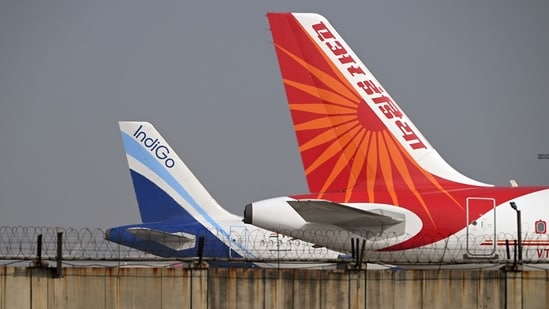
Ticket price hike, outlook cuts: What IndiGo, Air India are doing as fuel cost surges| India News
# Airlines Hike Fares Amid Fuel Surge
By Senior Aviation Editor, Aviation Today, April 10, 2026
In response to a relentless surge in global oil prices throughout the first quarter of 2026, major carriers including IndiGo, Air India, and United Airlines are aggressively hiking ticket prices and implementing steep fuel surcharges. As Aviation Turbine Fuel (ATF) breaches multi-year highs due to compounding geopolitical supply constraints, airlines are scrambling to protect their razor-thin margins. The sudden escalation in operating costs has forced industry leaders not only to pass the financial burden onto passengers ahead of the busy summer travel season but also to slash their financial outlooks for the upcoming quarters. [Source: Hindustan Times]
## The Macroeconomic Driver: ATF Price Escalation
The aviation industry’s recovery trajectory in 2026 is facing a severe headwind: the soaring cost of jet fuel. Aviation Turbine Fuel (ATF) traditionally accounts for **30% to 40% of an airline’s total operating expenses**, making profitability highly sensitive to crude oil volatility. Since January 2026, global crude benchmarks have rallied aggressively, driven by extended production cuts by major oil-producing nations and localized refinery disruptions in the Northern Hemisphere.
In India, where state levies and central excise duties further inflate the base cost of jet fuel, the impact is particularly acute. The state-run oil marketing companies (OMCs) have consistently raised ATF prices over the past three months, pushing the fuel cost to its highest level since the energy shocks of mid-2022.
“When fuel prices rise this sharply over a concentrated 90-day window, airlines have zero buffer to absorb the shock internally. The cost-pass-through to the consumer becomes an immediate operational necessity rather than a strategic choice,” notes Dr. Arindam Sen, Chief Transport Economist at the Centre for Aviation Economics. [Additional: Industry Market Analysis 2026]
## IndiGo’s Defensive Maneuvers: Surcharges Return
As India’s largest airline with a dominant domestic market share exceeding 60%, **IndiGo** has been swift to react. The low-cost carrier has formally reintroduced a distance-based fuel surcharge on all domestic and international flights. This mechanism allows the airline to dynamically adjust ticket prices based on the length of the sector, ensuring that long-haul flights bearing heavier fuel loads are priced accordingly.
For domestic routes under 1,000 kilometers, passengers are seeing incremental increases of roughly ₹400 to ₹600 per sector. However, for longer domestic routes and international flights to the Middle East and Southeast Asia, the surcharge escalates dramatically, adding upwards of ₹1,500 to the base fare.
The reintroduction of this surcharge underscores the pressure on IndiGo’s Cost per Available Seat Kilometer (CASK). Despite operating a highly fuel-efficient fleet of Airbus A320neo and A321neo aircraft, the sheer magnitude of the fuel price hike has outpaced the technological efficiency gains of their modern engines. [Source: Hindustan Times]
## Air India’s Balancing Act in a Competitive Market
For **Air India**, the surging fuel costs arrive at a critical juncture in its multi-year transformation under the Tata Group. The airline has been aggressively expanding its footprint, absorbing heavy capital expenditures for fleet modernization, cabin refurbishments, and international route expansion.
Unlike low-cost carriers, Air India operates a complex hub-and-spoke model with a heavy reliance on ultra-long-haul routes to North America and Europe. These extended sectors require massive fuel uplifts, making them highly vulnerable to ATF spikes. In response, Air India has initiated dynamic fare adjustments, particularly in premium cabins where demand remains relatively inelastic.
“Air India is attempting to thread a very fine needle,” explains Sarah Jenkins, Lead Aviation Analyst at Global Transport Intelligence. “They cannot afford to alienate the economy-class leisure traveler in a price-sensitive market like India, so they are heavily weighting their fare increases toward international business and first-class cabins, alongside cargo surcharges.” [Additional: Global Transport Intelligence 2026]
## A Global Shockwave: United Airlines and Beyond
The current crisis is far from localized to the Indian subcontinent. Major North American carriers, specifically highlighted by the actions of **United Airlines**, are reflecting a synchronized global response to the energy market’s volatility.
United Airlines recently alerted investors to an unexpected surge in its Q1 and Q2 fuel bills, citing high “crack spreads”—the pricing difference between crude oil and the refined aviation fuel. In the United States, limited refining capacity dedicated to jet fuel has artificially inflated prices beyond standard crude oil increases.
Consequently, United Airlines has aggressively revised its revenue management algorithms to push up base fares across its transatlantic and transpacific networks. By managing capacity—selectively trimming frequencies on less profitable routes—United aims to artificially constrain supply, thereby supporting higher ticket yields to offset the fuel premium. [Source: Hindustan Times]
### Estimated Global Fare Increases (Q2 2026 Projection)
| Route Type | Average Distance | Estimated Fare Hike | Primary Driver |
| :— | :— | :— | :— |
| Short-Haul Domestic | < 1,000 km | 4% - 7% | Fixed Base Surcharges |
| Medium-Haul Int'l | 1,000 - 4,000 km | 8% - 12% | Dynamic Pricing & Distance Levies |
| Ultra-Long-Haul | > 8,000 km | 10% – 15% | Premium Cabin Repricing |
## Earnings Outlooks Take a Severe Hit
Perhaps the most significant long-term consequence of the April 2026 fuel crisis is the wave of revised financial outlooks sweeping through airline boardrooms. Despite robust passenger demand, the mathematical reality of fuel economics cannot be ignored.
IndiGo and Air India, alongside global peers like United, have quietly begun tempering investor expectations. Analysts predict that **profit margins for the first half of fiscal 2026 will contract by 150 to 250 basis points** industry-wide. The combination of high operational costs and a potentially softening demand curve—should ticket prices breach consumer pain thresholds—presents a dual threat to airline profitability.
Airlines that had previously guided for record-breaking summer revenues are now guiding for flat or marginally reduced net incomes. The stock market reaction has been swift, with global airline indices underperforming broader market averages over the past three weeks as investors digest the reality of elevated operational costs.
## Impact on the Summer Travel Season
For the average consumer, these corporate maneuvers translate directly into “sticker shock” during the booking process. The upcoming 2026 summer vacation period, traditionally a high-revenue season for airlines, is expected to be the most expensive travel period of the decade.
Travel agents and aggregator platforms are already noting a shift in consumer behavior. While the “revenge travel” phenomenon defined the post-pandemic years, 2026 is seeing a return to high price sensitivity. Families planning summer getaways are increasingly utilizing fare-alert trackers, shifting their travel dates to off-peak mid-week days, or downgrading their destinations from international to domestic locales.
In India, the surge in domestic airfares is inadvertently providing a massive boost to the railway sector. The rapid expansion of the premium Vande Bharat express train network offers a highly competitive, cost-effective alternative for routes under 800 kilometers. As airlines push their fares higher to cover fuel costs, they risk permanent market share erosion to modernized, high-speed rail networks.
## Long-Term Mitigation: SAF and Fleet Modernization
The current crisis has reinvigorated industry discussions surrounding long-term fuel hedging and energy transitions. Airlines are acutely aware that relying entirely on fare hikes is an unsustainable strategy in a competitive market.
To insulate themselves from future petroleum volatility, carriers are accelerating their transition to next-generation aircraft. Both Air India and IndiGo have massive order books for Airbus A350s, Boeing 787s, and A320neo family jets, which offer up to **20% to 25% greater fuel efficiency** compared to the older generation aircraft they are replacing.
Furthermore, the conversation around Sustainable Aviation Fuel (SAF) has shifted from an environmental imperative to an economic one. While SAF currently trades at a premium to conventional jet fuel, airlines are aggressively lobbying governments for subsidies and tax incentives to scale SAF production. By diversifying their energy mix, airlines hope to eventually decouple their operational costs from the chaotic swings of the global crude market.
## Conclusion
The synchronized move by IndiGo, Air India, and United Airlines to hike ticket prices and implement fuel surcharges underscores the fragile economic foundation of global aviation. While airlines have no choice but to pass the burden of soaring ATF prices onto the consumer to protect their balance sheets, this strategy carries inherent risks.
As the industry navigates the pivotal summer 2026 travel season, the key metric to watch will be demand elasticity. If passengers absorb the higher fares and continue to fly, airlines may successfully weather the storm with only minor dents to their revised financial outlooks. However, if the sticker shock causes a significant drop in booking volumes, the industry could face a compounding crisis of high costs and empty seats. Moving forward, the accelerated deployment of fuel-efficient fleets and the scaling of Sustainable Aviation Fuel will be the only viable long-term defense against an increasingly volatile energy market.





