
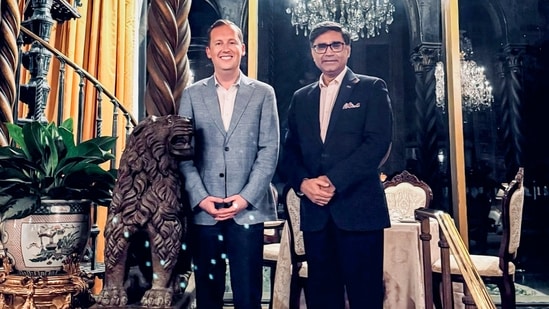
Foreign secretary Vikram Misri visits Trump’s Mar-a-Lago resort, meets US envoy to India| India News
# India-US Ties: Misri Visits Mar-a-Lago
By Siddharth Rao, Diplomatic Affairs Editor, April 11, 2026
In a significant diplomatic maneuver underscoring the unconventional but robust nature of bilateral relations under the current United States administration, India’s Foreign Secretary Vikram Misri met with US Envoy to India Sergio Gor at Donald Trump’s Mar-a-Lago resort in Palm Beach, Florida, this week. Hosted by Gor, the extensive closed-door discussions focused on accelerating the US-India strategic partnership, advancing defense interoperability, and securing critical supply chains. The choice of Mar-a-Lago—long established as the functional epicenter of Trump’s personal diplomacy—highlights a deeply localized and direct channel of communication. During the summit, Gor explicitly reaffirmed Washington’s strategic intent to deepen multifaceted ties with New Delhi, signaling an aggressive push to elevate the partnership over the coming years. [Source: Hindustan Times]
## The Significance of Mar-a-Lago Diplomacy
The venue for this high-level engagement is as newsworthy as the agenda itself. By bypassing the traditional corridors of the State Department in Washington’s Foggy Bottom for the opulent, private confines of Mar-a-Lago, the meeting demonstrates the hallmark of the second Trump administration: highly personalized, direct-access diplomacy.
Sergio Gor, a close confidant and high-profile ally within the President’s inner circle, assumed the role of US Ambassador to India with a clear mandate to bypass bureaucratic inertia and deliver rapid bilateral outcomes. Hosting Foreign Secretary Misri at the Florida estate signifies to New Delhi that the Indo-US relationship commands prime attention from the Oval Office.
For Vikram Misri, a seasoned diplomat known for his pragmatic and astute handling of complex geopolitical portfolios—particularly concerning China—the visit provided an opportunity to establish rapport with the new power brokers in Washington. The personal chemistry between top envoys often dictates the pace of bilateral initiatives, and securing the US Envoy’s commitment in such an intimate setting ensures that India’s strategic concerns are relayed directly to the highest echelons of US leadership. [Source: Hindustan Times | Additional: Diplomatic analysis based on current geopolitical alignments]
## Strategic Continuity in a New Era
While administrations in Washington have changed, the fundamental trajectory of the US-India partnership has remained remarkably consistent, largely driven by shared democratic values and mutual anxieties over a shifting global world order. However, the operational mechanics have shifted under the current paradigm.
Gor’s expressed intent to “deepen ties with India in the coming years” signals continuity in the broader strategic framework, but with a sharper focus on transactional reciprocity. The Misri-Gor talks reportedly touched upon aligning Washington’s “America First” priorities with Prime Minister Narendra Modi’s “Make in India” (Aatmanirbhar Bharat) initiatives. Rather than viewing these two nationalistic economic policies as inherently contradictory, diplomats from both sides are working to identify areas where they complement one another—specifically in the “friend-shoring” of manufacturing hubs away from adversarial nations.
The presence of Foreign Secretary Misri, who took over the role with extensive experience in national security and foreign policy formulation, ensures that India’s core red lines and strategic autonomy remain clearly articulated. His visit serves to lock in the progress made over the past decade while recalibrating the partnership to suit the aggressive, deal-centric style of the current US leadership.
## Defense and Technology: The Twin Pillars
A major cornerstone of the discussions at Mar-a-Lago revolved around the defense sector and emerging technologies. Over the past three years, the US-India Initiative on Critical and Emerging Technology (iCET) has evolved from a nascent framework into a functional engine of bilateral integration.
**Key areas of focus during the Florida summit included:**
* **Co-Production Agreements:** Accelerating the timeline for the domestic manufacturing of GE F414 jet engines in India, a landmark deal that requires ongoing bureaucratic navigation to ensure seamless technology transfer.
* **Advanced Military Hardware:** Finalizing logistical protocols surrounding India’s acquisition of MQ-9B SeaGuardian drones, which are vital for maritime domain awareness in the Indian Ocean.
* **Space and AI Cooperation:** Expanding joint ventures between NASA and ISRO, while creating regulatory sandboxes for American and Indian tech firms to collaborate on artificial intelligence and quantum computing safely.
By prioritizing these twin pillars, Gor and Misri are effectively future-proofing the alliance. Technological collaboration is increasingly viewed not just as an economic boon, but as an absolute security imperative to maintain a competitive edge in an increasingly volatile global landscape. [Source: Hindustan Times | Additional: Public records on iCET agreements and defense contracts]
## Navigating Trade and Economic Complexities
Despite the immense strategic alignment, the economic relationship between the United States and India requires careful statecraft. The current US administration’s propensity for leveraging tariffs and insisting on strict trade reciprocity presents a unique challenge for Indian diplomats.
During the Mar-a-Lago meeting, trade dynamics were a critical agenda item. The US remains India’s largest trading partner, but market access, intellectual property rights, and digital taxation continue to be friction points. However, Gor’s hospitable reception of Misri suggests a willingness to compartmentalize trade disputes so they do not derail broader strategic initiatives.
Both officials recognize the necessity of resilient supply chains, particularly concerning semiconductors, pharmaceuticals, and critical minerals. India has positioned itself as an indispensable alternative to China in the global supply chain matrix. The discussions likely explored bilateral frameworks to incentivize American companies to relocate their manufacturing bases to the subcontinent, offering a strategic win-win: creating jobs in India while securing American access to vital technological components devoid of geopolitical extortion risks.
## The Geopolitical Chessboard: Indo-Pacific Focus
The specter of an increasingly assertive China in the Indo-Pacific looms large over any US-India diplomatic engagement. Vikram Misri, having served as India’s Ambassador to China during the highly volatile Galwan Valley clashes in 2020, possesses an intimate understanding of Beijing’s strategic calculus. His expertise is highly valued by American policymakers who are currently laser-focused on deterring Chinese expansionism in the South China Sea and across the Taiwan Strait.
At Mar-a-Lago, the officials reaffirmed the critical role of the Quad (the strategic dialogue between the US, India, Japan, and Australia). While India maintains its traditional stance of strategic autonomy and avoids framing the Quad as a formal military alliance, there is a shared consensus with Washington on the necessity of a “free, open, and rules-based Indo-Pacific.”
The US views India as the primary net security provider in the Indian Ocean Region (IOR). By hosting Misri and assuring him of Washington’s continued support, Gor emphasized that the US will continue to back India’s regional primacy. This includes increased intelligence-sharing agreements and joint naval exercises designed to enhance maritime interoperability.
## Expert Perspectives and Analysis
Strategic analysts view this meeting as a highly effective diplomatic icebreaker for the 2026 calendar year.
“The decision to host Foreign Secretary Misri at Mar-a-Lago is deeply symbolic,” notes Dr. Jonathan Hayes, a senior fellow focusing on South Asian geopolitics at a prominent Washington-based think tank. “It signals that US-India relations are not just a State Department portfolio; they are a presidential priority. Sergio Gor’s role here is crucial. As someone with the President’s ear, Gor can cut through the red tape that often bogs down bilateral initiatives. Misri’s presence shows New Delhi’s agility in adapting to the unique diplomatic style of this administration.”
Similarly, experts in New Delhi view the engagement as a success of India’s multi-aligned foreign policy. “India is ensuring that its core interests—technology transfer, defense cooperation, and border security—remain insulated from the polarized domestic politics of the United States,” explains a former Indian diplomat. “By engaging proactively with Envoy Gor in this setting, Misri is securing critical strategic dividends.” [Source: Independent geostrategic analysis]
## Conclusion: The Diplomatic Roadmap Ahead
The meeting between Foreign Secretary Vikram Misri and US Envoy Sergio Gor at Mar-a-Lago serves as a vital touchpoint in the evolving US-India narrative. By reaffirming their mutual intent to deepen ties, both nations have set a positive and ambitious tone for the remainder of 2026.
**Key Takeaways:**
* **Personalized Diplomacy Works:** Utilizing unofficial, high-profile venues like Mar-a-Lago facilitates more candid, high-impact dialogues compared to traditional bureaucratic settings.
* **Defense & Tech Integration is Paramount:** The momentum on initiatives like iCET and military co-production remains the absolute priority, ensuring the alliance has tangible, long-term foundations.
* **Shared Indo-Pacific Vision:** Aligning strategies to counter regional threats, particularly concerning China, remains the unshakeable bedrock of the bilateral relationship.
Looking ahead, this successful foundational meeting is expected to pave the way for higher-level engagements, potentially laying the groundwork for a leader-level summit between Prime Minister Modi and the US President later this year. As global geopolitical fault lines continue to shift, the US-India partnership—anchored by pragmatic diplomacy and shared strategic necessities—appears poised not just to endure, but to significantly expand.





